A vibration from the hull's outer wall traveled up through the floor of the wheelhouse. The frequency was different. The engine's vibration was steady and low, but what reached the soles of her feet now was irregular and high. The feel of something not-metal crawling over metal. Gyeongjin gripped the armrest of the pilot's seat and focused on the sensation in her feet. She rose from the seat and pressed her hand to the floor. A faint pulse passed into her palm. The hull was moving.
It was the 47th day since the freighter Seokho had passed Neptune's orbit. The sun had already shrunk to a single bright star. At this distance there was no lettering you could read by sunlight. The destination was Chesed, an asteroid mining base in the Kuiper Belt. Crew of 8, cargo load of 1,200 tons. Seokho's hull was made of magnetofluid alloy. Forty-seven days since Seokho had begun its third voyage. Gyeongjin had grown used to the way this alloy's surface shifted color faintly with temperature. Nanoscale magnetic particles, embedded in the alloy matrix, responded to magnetic fields and changed their arrangement. When a crack formed in the hull, the surrounding magnetic particles migrated to the fracture and filled the gap. A self-healing hull. It was a new material released three years ago by a materials lab on Earth, and Seokho was the fourth freighter to use the alloy.
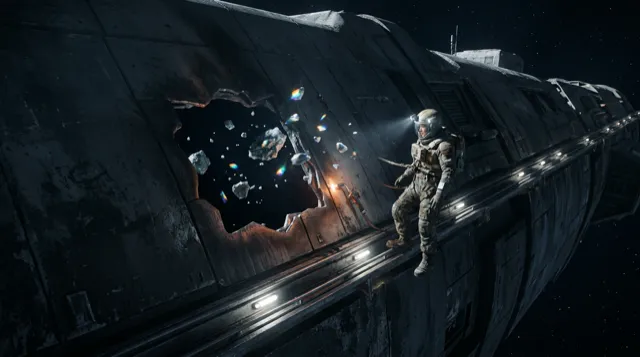
Sixteen hours ago, an asteroid fragment 40 centimeters in diameter had punched through the lower port side of Seokho. At the instant of impact, the sound of the hull tearing rang out for 2 seconds. The pressure in Cargo Bay 2 dropped to zero in 4 seconds. The bulkhead sealed automatically. The alarm blared for 30 seconds. Even after Gyeongjin silenced it, an afterimage of the sound lingered in her ears. When Taesu, the assistant engineer, brought up the video of Bay 2's outer wall, the puncture had widened to 60 centimeters across. At the point where the fragment had passed through, the cross-section of the alloy lay exposed. Along that cross-section the magnetic particles' arrangement glowed in a dense lattice pattern. The exit side was larger than the side the fragment had entered.
The magnetofluid alloy began to work 12 minutes after the impact. On the hull surface around the puncture, the alloy's skin moved like ripples of water. The magnetic particles gathered toward the fracture's edges, filling in the gap. Two hours later the puncture had shrunk by half. Four hours later it had closed completely. Just as designed. Gyeongjin confirmed that Bay 2 was fully restored and ordered repressurization. It took 40 minutes for the pressure to return to normal. She told Taesu to monitor the state of the hull repair.
The trouble began 6 hours after the repair was complete. Taesu came running into the wheelhouse. His hand was quick as he swiped through the screens.
"The puncture's sealed, but the alloy won't stop."
Real-time shape data of the hull glowed on the monitor. On the lower port side, where the puncture had been, the hull surface was pushing outward. Protrusions were growing on the once-flat outer wall. Six of them, 30 centimeters long and 15 centimeters wide. They were growing at 2 centimeters an hour.
Gyeongjin stood before the monitor. She enlarged the cross-sectional image of a protrusion. The internal structure came into view. It was not uniform alloy. The magnetic particles were arranged in a dense spiral. It was a pattern found nowhere in Seokho's design specifications. Gyeongjin looked at Taesu.
"Did the magnetic-field control module command this pattern?"
Taesu shook his head.
"The module switched to standby after the repair finished. Nothing is issuing magnetic-field commands right now. The alloy is moving on its own. There's no record of anything in the magnetic-field module's log."
Gyeongjin went down to the engine room. The magnetic-field control module was the device that dictated direction to the hull's magnetic particles. Repair commands, shape retention, strength adjustment. Every deformation was supposed to happen by this module's command. Gyeongjin opened the module's log. The last command was 6 hours and 12 minutes ago—a switch to standby mode after confirming the puncture repair was complete. Since then the module had issued no commands at all. The hull's deformation was happening without any command.
When Gyeongjin climbed the ladder, leaving the smell of oil in the engine room behind her, Minji, the communications officer, was waiting in the corridor.
"Captain, the outer-wall temperature is rising."
Minji held out a tablet. The outer-wall temperature in the zone where the protrusions were growing was 4 degrees higher than its surroundings. As the magnetic particles rearranged themselves, they were releasing heat. It meant the particles were moving vigorously. Gyeongjin asked.
"The growth rate of the protrusions?"
Minji answered.
"It's accelerated to 3 centimeters an hour. Faster than an hour ago."
Gyeongjin returned to the wheelhouse and ordered a precision scan of the entire hull. The results took 20 minutes to come back. It wasn't only the lower port side. Faint surface deformation had begun on the upper starboard side as well. Twelve raised bumps, 3 millimeters high. Still too small to call protrusions, but they showed the same spiral internal structure as the port side. The whole hull was changing. Gyeongjin pressed her palm to the wall of the wheelhouse. The magnetofluid alloy extended even into the wheelhouse. From the wall, too, a faint vibration was rising.
It was 22 hours after the impact when she called a crew meeting. Eight people gathered in the wheelhouse. Gyeongjin put the hull-scan results up on the screen. The port-side protrusions had grown from six to eleven, and the longest reached 48 centimeters. A thin membrane had begun to form between the protrusions. It was a structure connecting them, like the membrane between ribs.
The chief engineer, Hyewon, spoke first.
"What if we shut the magnetic-field module down completely? With no external field acting on them, the particles might stop moving."
Taesu shook his head.
"The module's already on standby. Cutting it off won't change anything. The particles are generating their own magnetic field."
Hyewon looked at him.
"Their own field? The alloy has no such capability."
Taesu pointed at the screen.
"Not by design. But the data's showing it, isn't it."
Gyeongjin cut in.
"Can we take the hull apart?"
Hyewon answered.
"We can cut out the deformed sections. Slice them off with a plasma torch and swap in spare panels. But if the alloy's in the middle of self-repair, whatever we cut could just grow back."
Gyeongjin asked.
"Is there any way to deactivate the whole alloy?"
Hyewon thought for a moment.
"Heat it to the Curie point and the magnetism vanishes. But bring the entire hull up to that temperature and the structural strength collapses. Partial heating is possible, but if the deformation breaks out in several places at once, we won't be able to chase all of it."
Jun, the navigator, spoke up.
"The hull isn't putting us in danger. Pressure in Bay 2 is normal, structural strength is within tolerance. The protrusions are growing, yes, but the hull isn't weakening."
Gyeongjin looked at him.
"For now. But we don't know how far this out-of-control deformation goes."
Jun nodded, but pressed on.
"We're 61 days out from Chesed. Cut into the hull now and the repairs set the voyage back. Miss the supply window and the base takes the hit."
The meeting ended without a conclusion. The footsteps of the crew leaving the wheelhouse rang off the metal floor. It wasn't that Gyeongjin had failed to decide—there wasn't enough data. Not knowing why the deformation was happening, cutting and leaving it alone were both gambles. Gyeongjin looked over the hull-scan data one last time, then closed the file.
That night Gyeongjin went down to Cargo Bay 2. Opening the bulkhead and stepping inside, the air was different. The temperature ran 2 degrees warmer than the corridor—heat bleeding off the hull. Gyeongjin switched on a flashlight and moved through the narrow passage to the port lower section. The protrusions surfaced in the beam. They had changed since the first time. The membrane between them had thickened, and the whole structure looked like a shoulder blade. Gyeongjin touched one of the protrusions with a gloved hand. It was hard. The surface was smoother than ordinary hull. Holding a finger against it, a faint vibration came through from inside. The magnetic particles were still moving. Gyeongjin drew the hand back.
Forty-eight hours after the collision, the hull's deformation entered a new stage. The structure of protrusions and membrane was growing symmetrically on port and starboard. The hull's original cylindrical outline was changing. Taesu ran a three-dimensional model. He fed the deformed hull's shape into a simulation. When the result came up, his expression changed.
Taesu opened the wheelhouse door and came in.
"Captain, you need to see this."
Two models floated side by side on the screen. On the left, the Seokho's current deformed hull. On the right, an academic model Taesu had dug up for comparison. He pointed at the screen.
"On the right is the theoretical hull shape for optimal orbital insertion into the gravity field of the Chesed asteroid. It's a model from a paper the Aerospace Research Institute published three years ago."
Gyeongjin looked from one model to the other. The shapes were alike. The placement of the protrusions, the angle of the membrane, the symmetry. Not identical, but tending the same way.
"What's the match rate?"
Taesu answered.
"72 percent. And it can climb, since the deformation's still in progress."
Gyeongjin sat down in the chair and stared at the monitor. There was no way the alloy could know the gravity field of the destination. Magnetofluid alloy was a material. It couldn't read navigation data, couldn't run orbital calculations. And yet, when the kinetic energy of the asteroid collision had been absorbed into the alloy, the arrangement of the particles had shifted. That arrangement had expanded in a chain, and the whole alloy was converging on a single pattern. Whether that pattern happened by chance to fit Chesed's gravity field—or whether the alloy, in some way, 'knew' the destination.
Gyeongjin called for Hyewon. When she came up from the engine room there was grease on her hands.
"Are we ready to cut out the deformed sections?"
Hyewon nodded.
"Torch is set. Give the word and I can have every protrusion on the port side cut off within 2 hours."
Gyeongjin said.
"Did you see Taesu's analysis?"
Hyewon nodded. A brief silence fell. The sound of air from the ventilation filled the space between them.
"So what are you going to do?"
Gyeongjin didn't answer. Hyewon spoke.
"Captain, this is a material. It has no intent. It could just be coincidence."
Gyeongjin looked at her.
"Is 72 percent coincidence?"
Hyewon answered.
"Well, the other 28 percent isn't."
Gyeongjin didn't sleep that night. The vibration of the hull carried faintly to the ceiling of her cabin. The alloy was still moving. She got up from her bunk, crossed the dark corridor, and went to the helm. Jun, on night watch, was watching the navigation monitor. Gyeongjin asked. "Any change in drag from the deformed hull on our current course?" Jun checked the data. "Negligible. A 0.3 percent drop. If anything, the deformed structure is reducing drag." Gyeongjin asked. "Will the hull shape affect us when we enter the deceleration orbit?" Jun ran a simulation. "If the deformation continues at the current rate, deceleration efficiency will be 7 percent higher by the time we approach Chesed. We could save fuel." Gyeongjin looked at Jun's monitor. The numbers were speaking. The deformed hull was more efficient than the original design.
Seventy-two hours since the collision. Gyeongjin made her decision. She notified the whole crew. "We leave the hull deformation alone. But the moment structural strength drops below 80 percent of the allowable range, we cut it off immediately. We shorten the monitoring cycle from one hour to 15 minutes. Cargo hold 2 is off-limits." Hyewon asked. "You're handing the hull over to the alloy?" Gyeongjin answered. "I'm not handing it over. I'm watching it."
Over the next 2 weeks, Seokho changed. From the cylindrical hull, a wing structure of ridges and membranes stretched out to either side. The longest ridge reached 1.2 meters. Fine wrinkles appeared across the entire hull surface, and though they looked irregular, analysis showed they followed hydrodynamic patterns. Every day Taesu updated the shape data and compared it to the Chesed orbit model. The match rate climbed from 72 percent to 81, to 85, to 89.
The crew's reactions split. Conversation in the mess hall dwindled. In the silence, only the hull's vibration could be heard. Jun and Taesu were captivated by the data. Hyewon checked the plasma torch settings every day. Minji lay awake in the middle of the night, listening to the hull vibrate in the corridor. Gyeongjin checked the structural strength readings every 15 minutes. The numbers stayed within the allowable range. But they were drifting slowly downward — not toward the upper limit, but the lower.
Day 31 since the collision, the problem broke open. At 4 a.m., an alarm sounded. A crack was detected in the bulkhead of cargo hold 3. That bulkhead was ordinary steel, not magnetofluid alloy. Stress had concentrated at the joint between the alloy and the steel. As the alloy deformed, force built up at the seam. The bulkhead crack was not asteroid-impact damage. It was made by the deformation of the alloy.
While Hyewon welded the bulkhead, Gyeongjin examined the joint. The alloy's surface had pushed up over the steel bulkhead. The alloy had begun to spread past the hull and erode the internal structure. Gyeongjin's hand moved over the trigger of the plasma torch mounted on the wall. Her fingers tightened, then loosened. Hyewon finished welding and turned to say, "The next joint is just a matter of time. The alloy is moving beyond the original hull zone." Gyeongjin asked. "Can you separate the whole bulkhead from the alloy?" Hyewon answered. "Cut all the joints and the hull separates from the internal structure. The ship splits in two."
Gyeongjin went back to the helm. Taesu showed her the latest match rate. 91 percent. Gyeongjin asked. "What changes if the deformation reaches 100 percent?" Taesu answered. "In theory, fuel consumption on entering Chesed's orbit drops by 38 percent. The deceleration burn becomes far more efficient." Gyeongjin said. "And if the bulkhead collapses before then?" Taesu shut his mouth. Only the engine noise filled the helm.
Gyeongjin went down to cargo hold 2. Alone. She switched off her flashlight and stood in the dark. The hull's vibration rose up through the floor. The vibration the wing structure made was no longer a simple pulsing now. It had a rhythm. Slow, fast, slow again. A beat completely unlike the engine's. Gyeongjin leaned her back against the hull wall and closed her eyes. The alloy's heat came through her back. It felt as if the hull were breathing. Behind her, the alloy's heat pierced her suit and touched her skin. Gyeongjin opened her eyes. This was no time to sink into sentiment.
Day 34 since the collision. A stress warning came up at the joint in cargo hold 4 as well. Gyeongjin had to decide. If she didn't stop the alloy's deformation, the internal bulkheads would collapse. If the bulkheads collapsed, the airtight seal between cargo holds would break. The crew's living space would shrink. Gyeongjin set down her coffee in the mess hall and gathered the crew again. The coffee had gone cold.
Gyeongjin rose from her seat and spoke. "We cut the ridge structures on port and starboard. We also separate the joints to the internal bulkheads. The alloy keeps the outer hull, but we physically block its growth." Hyewon nodded. Jun asked. "We're cutting all of it? What about the 91 percent match rate?" Gyeongjin looked at Jun. "The bulkhead comes before a 91-percent fuel saving." Jun shut his mouth.
The cutting took 6 hours. Hyewon and Taesu suited up for the spacewalk and passed through the airlock to the outer hull. Each time the plasma torch severed a protrusion, the alloy surface rippled. The cut growths tumbled away into open space. On their surfaces the magnetic particles glinted one last time, then vanished into a darkness the sunlight never reached. When a 1.2-meter protrusion came free, the whole hull convulsed once. The tremor climbed all the way to the helm. Minji gripped the comms panel. Gyeongjin's jaw set hard. He didn't take his eyes off the monitor. The structural-strength reading wavered, then steadied 3 seconds later. For those 3 seconds Gyeongjin had stopped breathing.
When the cutting was done, stubs of the severed growths remained on Seokho's outer hull. The surface was rough and uneven. Hyewon came back inside and pulled off her helmet in the airlock. Sweat beaded on her forehead. The exhaustion of 6 hours outside showed around her eyes. She said,
"The alloy's already started growing back at the cut sites. Slower than before. Half a centimeter an hour."
Gyeongjin asked,
"How long will it hold?"
Hyewon answered,
"If we cap the cuts with insulation, we can suppress the growth. Can't stop it completely, but it'll hold until we reach Chesed."
Gyeongjin nodded. Suppress the growth with insulation and the hull stays close to its original shape. Orbital insertion at Chesed goes ahead exactly as the original navigation plan called for. No fuel saved. But the bulkheads survive. All 8 aboard are safe. That was the only thing that was certain.
Taesu was squaring away the last of the data at the helm. Gyeongjin came and stood beside his chair.
"Final record on the match rate?"
Taesu answered,
"91 percent before the cut. 23 percent after."
Gyeongjin looked at the monitor. 23 percent. A structure the alloy had spent more than 30 days building, sheared away in 6 hours. Taesu asked,
"Any regrets?"
Gyeongjin didn't answer. He shut off the monitor and went to the small window behind the helm seat. Seokho's outer hull was visible. At the cut faces the alloy particles glimmered faintly. As if the magnetic particles, catching the starlight, were still trying to align. Gyeongjin turned his eyes from the window.
27 days remained to Chesed. Seokho sailed on with its rough-hulled body and its cut faces wrapped in insulation. Every hour it scanned the hull. On every night watch Gyeongjin had fallen into the habit of pressing his ear to the wall of cargo bay 2. The alloy's vibration was clearer at night. Beneath the insulation the alloy was still moving. Half a centimeter an hour. Slow, but it did not stop.
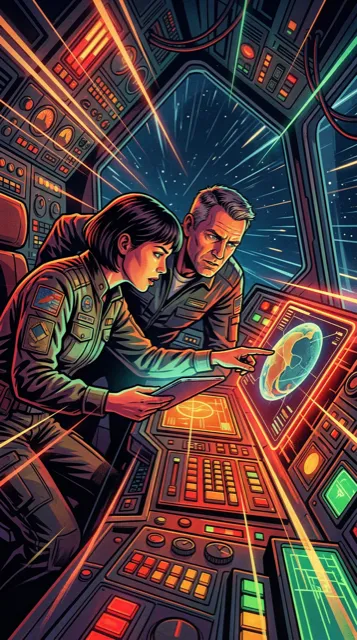
The night watch, 5 days out. Minji came into the helm with the long-range sensor data—actual field measurements of the Chesed asteroid's gravity. They didn't match the existing model. Chesed's mass distribution was asymmetrical. She asked Taesu to recompute the optimal insertion shape for the measured field. Taesu ran the new model. When the result came up, he called for Gyeongjin.
"Captain. I recalculated with the measured data. The optimal shape has changed."
Gyeongjin looked at the screen. The new optimal shape was unlike the earlier academic model. It was asymmetrical. And Seokho's cut hull—the stubs of the severed growths, the uneven placement of the insulation—overlapped with the new optimal shape in places. Taesu named the match rate.
"41 percent. Lower than the 91 percent of the original symmetrical structure before the cut. But it's possible this asymmetrical shape was what the alloy was trying to build all along. A shape fitted not to the academic model but to the measured data."
Gyeongjin looked at the monitor for a long time. Whether the alloy had truly known Chesed's real gravity field, or whether the energy of the asteroid impact had shaped that pattern by chance. There was no way to know. Gyeongjin sat down at the helm and keyed in the deceleration-burn sequence. Under his fingers pressing the keys, the alloy's faint tremor rose to meet them. As the original navigation plan called for. With no fuel saved. Seokho's engines ignited, and beneath the insulation the alloy's vibration surged up once, hard, then sank slowly into the roar of the engines.