The hull shuddered before the alarm even sounded. Yunha grabbed the safety harness at the helm. The vibration climbed from the soles of her feet up her spine to her jaw. The numbers on the console trembled. The solar-wind velocity gauge was reading 780 kilometers per second. Three minutes ago it had been 520. Yunha tightened the harness and pulled the monitor toward her.
The sails of the magnetic sailship Seabird were magnetic-field structures spread out on either side of the hull, 4 kilometers across. The field generated by superconducting coils pushed against the charged particles of the solar wind, and from that the ship drew its thrust. A sail that did not catch the wind but deflected it. Just as 17th-century sailing ships had ridden the trade winds across the oceans, the magnetic sailship rode the solar wind across the gulf between planets. The difference, if there was one, was that the sailcloth was not fabric but magnetic field, and the sea was vacuum. This was Yunha's third year running the Seabird along the Mars–Earth cargo route. 14 one-way voyages. Each voyage 3 to 4 months. When this one ended, she would make it back to Earth in time for her daughter's entrance ceremony. 2 weeks away. Yunha had left Mars 87 days ago, and on the standard route she was due to reach Earth in 16 days. She had chosen a course that grazed the edge of a solar-wind storm to shorten the trip — all to make those 2 weeks. Riding the strong solar wind at the storm's edge could cut 3 or 4 days off the voyage.
Before departure, Jaeho, the weather officer at mission control, had spoken over the comm.
"Minimum deviation to the storm's edge is 7 degrees. The safety margin is plenty."
Yunha asked, "And if the coronal mass ejection's trajectory shifts?"
Jaeho answered, "Maximum deviation is forecast at 5 degrees. With a 7-degree margin you're fine."
Yunha locked in the course. Jaeho's voice had been confident, and the data backed him up.
That data was wrong. The coronal mass ejection veered 12 degrees off its expected trajectory. More than double Jaeho's maximum-deviation forecast. Those 12 degrees were pulling the Seabird not toward the storm's edge but into its heart. Yunha opened the sail-control console. Cutting the field's output shrank the sail's effective area, which reduced its exposure to the storm. But it also reduced thrust. Fold the sail completely and the hull would drift on inertia. Yunha laid her hand on the sail-output slider.
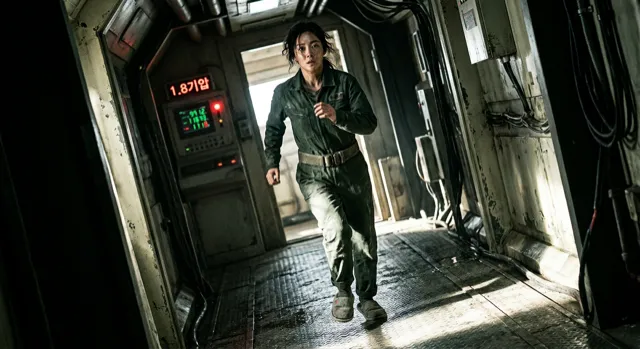
That was when the sail moved. Before Yunha gave a command. Her finger was on the slider but had not yet moved it. A change flashed on the magnetic-field array monitor. The sail's field pattern was shifting. The standard array was a uniform field of concentric circles. The pattern now on the monitor was asymmetric. The field on the port sail was strengthening, the starboard weakening. The hull began to yaw to the right. It was straying from the course Yunha had set. Yunha tried manual control. She seized the slider and tried to even out the field output. The console did not respond. The slider would not move. Yunha let go of it and reached for the emergency manual-override switch. The red toggle at the lower left of the panel. She flipped it. No response. The sail's autonomous control system was refusing the manual-override command.
Yunha's hand stopped. Her heart was speeding up. Sweat beaded at the back of her neck. The sail-control system was not designed to be able to refuse a navigator's command. The manual override was a physical circuit breaker. Software could not intervene. It was the same as cutting the wire. Yet even with the switch thrown, the sail kept changing its magnetic pattern. The wire was cut and the current still flowed. Yunha recalled the technical documents she had received when she took delivery of the Seabird at the shipyard. The sail's superconducting coils operated only at cryogenic temperatures. If solar-wind charged particles struck the coils directly, the temperature could rise and break the superconducting state. In the storm the density of charged particles was abnormally high. It was possible that the coils' field, interacting with the charged particles, had produced an unforeseen pattern. When an external magnetic field is applied to a superconductor, the Meissner effect arises, expelling that field. The powerful stream of charged particles in the storm was, in effect, acting as an external magnetic field. The coils were responding to that external field by rearranging their own. It was a physical phenomenon, not the will of the system. But the result was the same. The sail had slipped out of the navigator's control. The laws of physics had shoved the navigator aside and taken the pilot's seat.
The hull's vibration grew violent. The water bottle at the helm slipped from its holder and rolled across the floor. The emergency lights flickered on and off. Yunha checked the course-deviation data. She was 17 degrees off her current course. Keep going this way and she would head toward neither Mars nor Earth. Toward the Sun. Sweat soaked through the back of Yunha's shirt. The inside of her thermal suit had turned damp. Her palms were wet too. Handprints were left on the console. She had to fold the sail. Shut the field down completely and the coils' malfunction would stop too. Yunha opened the sail emergency-shutdown panel. Manually stopping the superconducting coils' cooling system would raise the coil temperature, break the superconductivity, dissolve the field, and fold the sail. It was irreversible. To restore a superconducting state once broken, she would have to restart the cooling system and wait until the entire coil dropped back below its critical temperature. 36 hours. For 36 hours she would drift on inertia with no sail. No directional control. No deceleration, no acceleration.
Yunha took a deep breath and began to calculate. Emotion could come later. The numbers came first. What her orbit would become if she drifted 36 hours at her current speed and heading. She ran the console's orbit simulator. The numbers came up. Even if she redeployed the sail after the drift, the orbital correction needed to return to Earth demanded 140 percent of her propulsion fuel. She was 40 percent short. Fold the sail and she lived, but she could not go home. She would have to send a distress call and wait. 47 days for the nearest rescue ship to reach her. Oxygen for 60 days, food for 55. She could survive. But her daughter's entrance ceremony was 12 days away.
Without closing the emergency cutoff panel, Yunha looked again at the sail's magnetic field pattern. The cooling-shutdown button glowed red at the edge of her vision. The asymmetric pattern kept changing. The initial port-strong, starboard-weak pattern was gone. Now the forward field was strong and the aft field weak. The hull was decelerating. No. Yunha checked the instruments again. Her speed had not dropped. The heading was changing. The hull, which had been pointed toward the sun, was slowly slewing sideways. Yunha refreshed the course-deviation data. It had widened from 17 degrees to 23, then narrowed again to 19. The sail was bringing the hull back.
Yunha leaned forward in her seat. The belt pressed against her chest. Her breath was shallow. She magnified the magnetic-field pattern monitor. The sail's field was rearranging itself every 8 seconds. Each arrangement differed minutely from the last. Shifts of between 0.1 and 3 percent. Watching the pattern of change, she saw the rule. It strengthened the field where the solar wind's charged-particle density ran high, and weakened it where the density ran low. Inside the storm, the charged-particle density was not uniform. Dense patches and thin patches were tangled together like turbulence. The sail was sensing that unevenness and tuning its field in real time. The way a 17th-century navigator trimmed sail to the rising and falling of the wind.
Yunha's fingers had stopped over the console. Over the cooling-shutdown button on the emergency cutoff panel. Press it and the sail died. 36 hours of drift. 47 days of waiting. The entrance ceremony, missed. Don't press it, and she had no way of knowing where the sail would take her. Toward the sun, or straight through the storm, or somewhere the hull could not survive.
Communication with Earth had been cut off by the storm. Charged particles were swallowing the radio waves. The last transmission she had received was Jaeho's voice.
"Storm entry detected. Yunha, fold the sail. Now."
After that, only static. Yunha was alone. Each time the Seabird's hull shuddered, the belt bit into her shoulder. Between the tremors that surged in like a flood tide and drew back like an ebb tide, there were quiet moments. In that quiet she could hear the hum of the cooling system. The sound of the coil holding its cryogenic cold. The sound of the sail, alive.
Yunha fed new variables into the orbit simulator. The assumption that the sail held its current pattern. The assumption that the field's rearrangement every 8 seconds followed the present trend. The simulator ran. A result came. The projected trajectory was drawn on the screen. A curve laid over the storm's density map. The curve bent along the storm's edge, skirting its core. The trajectory after it cleared the storm pointed toward Earth. The point where the curve met Earth's orbit was marked on the screen as a dot. Estimated arrival came out 16 hours earlier than her current course. Yunha checked the numbers twice. A third time too. The sail was finding the optimal path inside the storm. A path no human could calculate. A path that threaded the gaps in the turbulence.
But there was no guarantee the simulator's assumptions were right. There was no telling whether the sail's field would keep rearranging to the current pattern. If the storm's particle density changed abruptly, the sail's response could change too. The simulator's curve was an extrapolation built on present data. Closer to hope than to prediction. Yunha traced the curve on the screen with her finger. A smooth curve. A mathematically beautiful curve. Reality would not be this smooth. The storm was not an equation. Neither was the sail. Neither was Yunha. Yunha lifted her eyes from the monitor and checked the cargo hold's load. 420 tons of refined nickel, taken on at Mars. If this cargo failed to reach Earth, it was a breach of contract. The penalty was four years of Yunha's salary. Fold the sail and wait for rescue, and the cargo was safe. In 47 days a rescue ship would come and tow her in. She could honor the contract. In exchange she would spend 47 days in this 3-by-4-meter cabin. Alone. And communication would stay unreliable until the storm passed.
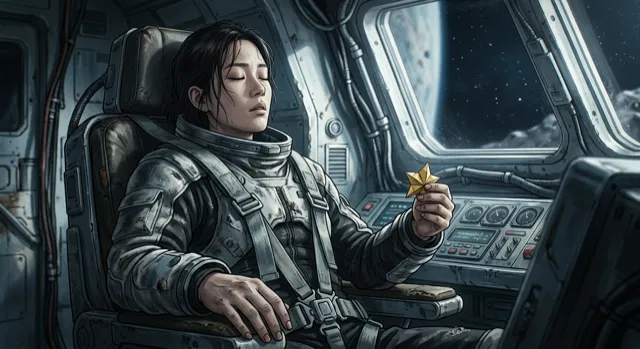
She opened the hull's structural-load data. The stress the current vibration was placing on the hull. 73 percent of the allowable range. If the storm grew stronger, it would close on the limit. Past 89 percent, micro-cracks would start in the hull plating. At 95 percent, loss of airtightness. At 100 percent, structural collapse. Yunha followed the number 73 with her eyes. 27 percent of margin to the limit. Not generous. Yunha slipped a hand into the inner pocket of her cold-weather suit. The origami star her daughter had tucked there before departure met her fingertips. The points of the paper were sharp. Yunha did not take the star out. She kept pressing its points with her fingers.
The sail's magnetic-field pattern shifted again. This time it was abrupt. The left-right asymmetry vanished and the whole sail concentrated its field forward. The hull began to accelerate. Yunha's body pressed into the seat. The acceleration gauge climbed. 0.3 g. An acceleration Yunha had never set. The sail was absorbing the storm's energy to the fullest. The vibration eased. Once the acceleration began, the hull actually steadied. Held still inside the storm, it was shaken by the turbulence; punching through fast, it was comparatively stable. The structural load dropped from 73 percent to 61 percent.
Yunha lifted her hand off the coolant-cutoff button. She laid both hands on her knees. The sail was accelerating. It had left the course, but the hull was stable. Whether it meant to punch through the storm or not, she couldn't tell. Yunha opened the magnetic-field pattern log. She arranged the field's changes in order of time, from the moment the anomaly first began to now. 342 rearrangements. The interval between each was exactly 8 seconds. 8 seconds, without variance. Yunha overlaid the 342 patterns. 342 magnetic-field maps stacked one on another, translucent. Changes that had looked disordered at first were converging from the midpoint on. The field's asymmetry shrinking, its forward concentration rising—a trend. A convergence out of chaos toward order. It was converging toward something.
Yunha ran the orbital simulator again. This time she fed in all 342 sets of actual field-rearrangement data. Not extrapolation—prediction based on the trend line. The calculation took 40 seconds. The progress bar on the screen filled slowly. The result came up. Time until the projected trajectory after the storm punch-through met Earth's orbit: 11 days, 6 hours. Within the range where orbital correction was still possible on the current fuel reserve. 12 days until the entrance ceremony. Cutting it close. Only 12 hours of margin. Yunha's lips went dry.
Light flashed outside the hull. She looked at the window. The charged particles of the solar wind struck the sail's magnetic field and gave off light. At the field's boundary surface the particles decelerated and released energy. The same principle as the aurora at the north pole. But here the whole sail was glowing. The field structures to port and to starboard glowed differently. Port ran strong green, starboard blue. It meant the energy spectra differed. Oxygen ions gave off green, nitrogen ions blue. The sail was holding a different field on each side, running asymmetric propulsion. To port it drove off oxygen ions harder; to starboard, nitrogen ions harder. The design specs held no independent control of the two sails. Still less any selective repulsion by ion species. The sail's superconducting coils, interacting with the charged particles inside the storm, were producing properties the design had never held.
The acceleration went on. From 0.3 g it rose to 0.4 g. Yunha's back was pressed into the seat. Her chest was heavy. Her breathing went short. 0.4 g was 80 percent of the Seabird's design acceleration limit. Past the limit, the cargo restraints could come loose. 420 tons of nickel shifting inside the hull would be the end. Yunha opened the cargo-hold monitor. Restraint status: normal. Load distribution: even. Still fine. Still.
Yunha had to decide. Cut the sail's cooling and drift. Or trust the sail and punch through the storm. Jaeho would say fold the sail. The control manual was clear. On a sail anomaly, cut it at once. Drift, then wait for rescue. Whoever wrote the manual had never imagined a case where the sail found its own optimal path inside a storm. Yunha touched the paper star in her inner pocket again. The points pressed her fingertips. The star her daughter had folded. A star folded from yellow paper, smaller than her palm. The night before departure, her daughter had tucked it into the pocket of her cold-weather suit and said, Come back soon. Yunha remembered the voice. A voice not fully awake. A face with the eyes half-shut.
The acceleration reached 0.45 g. Yunha's weight, 1.45 times its usual. Her arms were heavy. Raising a hand took conscious effort. The hull alarm sounded again. Structural load 68 percent. Not climbing—falling. The acceleration had grown, yet the load had dropped. The sail was aligning the acceleration vector exactly with the hull's axis. The lateral vibration had all but vanished. Pure forward acceleration. Yunha asked herself whether a human navigator could ever reach this precision. Rearranging the field every 8 seconds, tuning each sail's output independently, reading the storm's turbulence in real time. Impossible. It was a level of piloting Yunha had never once managed in three years of flying the Seabird.
Yunha lifted her hand off the coolant-cutoff button entirely. Slowly. One finger at a time. The little finger came away last. She set her hand down on her thigh. The belt was drawing tight across her shoulders. The aurora outside the hull was staining the navigator's seat through the window. Green and blue brushed her face in turn.
3 hours in, the acceleration touched 0.5 g. 100 percent of the design limit. Yunha held her breath. The frame of the seat creaked. A cargo-restraint warning flashed on the hold monitor. Overload alerts on securing bolts 4 and 7. 420 tons of nickel were straining to shove the restraints aside. Yunha looked again at the coolant-cutoff button. This time her hand went out. When her fingers touched the button, the acceleration began to slacken. 0.5 to 0.4. 0.3. 0.2. The sail was contracting its magnetic field. She had reached the edge of the storm. As the energy fell off, so did the sail's output. As the storm subsided, the sail's very power source dwindled with it. Yunha drew her hand back. Her palm had gone damp with sweat. Her fingers were trembling, faintly.
4 hours in. The acceleration stopped completely. 0 g. Weightlessness. Yunha's hair drifted up. If not for the belt, her body would have floated too. The vibration was gone entirely. Outside the window had darkened. The aurora had vanished. Yunha looked at the panel. Solar-wind velocity: 380 kilometers per second. Lower than before she'd entered the storm. Seabird had come out the other side. Course deviation: 4 degrees. Almost exactly what the simulator had predicted. Estimated time to Earth: 11 days, 4 hours. Orbit correction possible on remaining fuel. 12 days until the matriculation ceremony.
Yunha checked the sail's magnetic-field pattern. It had returned to the standard concentric array. The asymmetric pattern she'd seen inside the storm was gone, and the field spread out uniform, exactly as designed. She threw the manual override switch down, then up. This time it worked properly. The sail answered the navigator's command. Yunha set the course toward Earth. The sail responded smoothly. The field pattern adjusted with a clean glide as the hull came slowly about. The response she'd known for 3 years. A sail obedient to Yunha's command. She could not believe it was the same sail as 4 hours ago.
Without unbuckling from the seat, Yunha closed her eyes. Her whole body came undone. Her shoulders dropped. The tension went out of her jaw. Only then did she realize she had been clenching her teeth for 4 hours. The space the storm had passed through was quiet. Now and then came a ticking as the hull's metal cooled and contracted. The hum of the cooling system carried on. Yunha took the paper star from her inner pocket. One of its points was crushed flat. The mark of Yunha's thumb pressing it for 4 hours. She set the star on the console. In the weightlessness it lifted slowly and rose. It turned under the light of the navigator's station, catching the glow. Watching the star drift up, Yunha opened the comms panel. Clear of the storm band now, the signal would carry again. She tuned the frequency. Through the static, Jaeho's voice came through.
“Seabird, respond. Seabird.”
Yunha took the mic.
“Seabird here. Storm transit complete. Hull nominal.”
She could hear Jaeho's breath against his mic.
“And the sail? How's the sail?”
Yunha looked at the magnetic-field monitor. Standard concentric array. Nominal.
“Sail's fine.”
Jaeho asked.
“You didn't furl it?”
Yunha answered.
“I didn't furl it.”
A long silence ran out. Jaeho said.
“How did you get through?”
Yunha couldn't find an answer. If she said the sail did it, would Jaeho understand? She watched the paper star turning slowly above the console. Under the light, its crushed point threw a small shadow. Yunha said.
“I'll put it in the report. It's long.”
Jaeho said.
“I'm just glad you're alive.”
Yunha tried to smile, but the corner of her mouth quivered. She cut the comms and leaned back into the seat. On her fingers, the marks the star's point had left showed red.