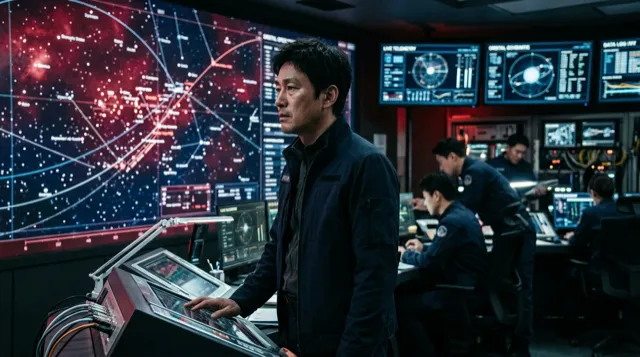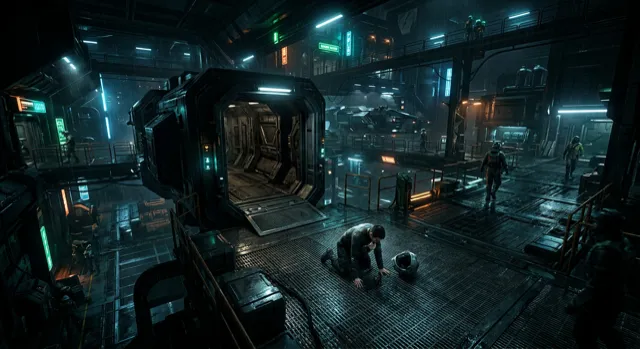
When I switched on the terminal to log entry 2,197 of the maintenance record, a warning sat blinking at the edge of the screen. Energy output deviation: 0.7 percent. In red. Suhyeon tapped the warning and opened the details. The output of relay panel 3 was 0.7 percent below design specification. The tolerance was 0.5 percent. Suhyeon set the terminal down, braced a hand on one knee, and stood. Zipped up the work suit. The habitat module's lighting was in night mode, so the corridor was dark. Suhyeon switched on the headlamp and headed for the relay panel section.
The energy relay satellite Haewon-7 hung in an orbit that threaded the asteroid belt between Mars and Jupiter. It was a facility that gathered sunlight, converted it into microwaves, and relayed the energy on to outer-planet probes and orbital stations. Forty-eight relay panels unfolded along the satellite's frame. Total length: 1.2 kilometers. A single panel had the area of 3 basketball courts. Suhyeon had been maintaining this satellite alone for 6 years now. The first 2 years were long. From the third year, the sense of time blurred. There were 214 days left until the relief crew arrived from Earth. The nearest crewed facility was Ceres Base. 11 days away, one way.
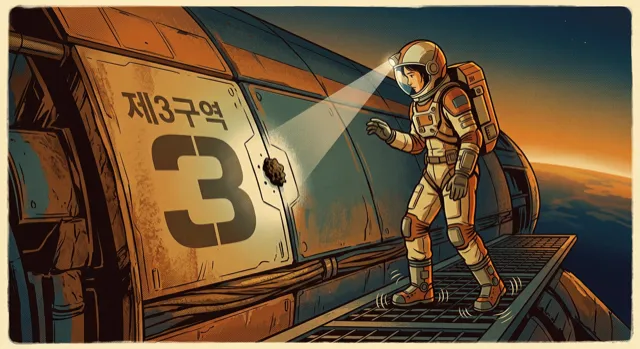
Suhyeon arrived at the panel 3 section and went out through the airlock. The magnetic boots clamped to the satellite's outer wall. The headlamp's beam swept the panel's surface. Suhyeon stopped. The satellite's faint vibration traveled up through the boots underfoot. Something was clinging to the seam of panel 3. At first Suhyeon took it for a clump of dust. Debris thrown up by micrometeoroid impacts sometimes stuck fast by static charge. Suhyeon tried carefully to peel it away with a gloved hand. It wouldn't come off. Suhyeon pressed harder with the fingers. It didn't move. Suhyeon turned the headlamp brighter and looked closer. It wasn't dust. Suhyeon ran a gloved fingertip over the surface. On the metal of the panel's seam, a tiny structure had grown. Fibrous strands finer than a hair, dozens of them, spread along the gap of the seam. The color of the fibers was the same silver-gray as the panel metal. A color you couldn't tell apart unless you were looking for it. It looked as though it had grown out of the metal.
Suhyeon drew a magnifier from the tool belt and studied the fibers. The tips of the fibers were split. From each split end, still finer branches reached out. The ends of the branches touched the panel surface. Where they touched, the panel surface was faintly discolored. What should have been silver-gray had turned a pale gold. Suhyeon slotted the magnifier back into the tool belt and took in the whole of panel 3. The fibers spread not only along the seam but along the panel's edges. There were more of them on the face turned toward the sun. Suhyeon walked over toward panel 4. Panel 4 had them too. So did 5. Suhyeon checked as far as 6 and stopped. All six panels had fibers growing on them. Suhyeon looked toward panel 7. Panel 7 seemed to have none. The fibers had chosen only a specific region of the satellite.
Suhyeon came back through the airlock and stripped off the work suit, then sat down at the habitat module's terminal. Opened the satellite's energy output records. Six months back, panel 3's output could be seen beginning to slip, faintly. 0.1 percent, 0.2 percent, 0.3 percent. By 0.1 percent each month. Suhyeon opened the maintenance log from 6 months earlier. There was an inspection record for panel 3. No anomalies, it read. In Suhyeon's own hand. Back then either the fibers hadn't been there, or they'd been there and were too small to see. Suhyeon thought of the person Suhyeon had been 6 months ago. The one who had inspected the panel, written 'no anomalies,' gone back to the habitat module, and closed the log.
Suhyeon went to the comms panel and sent a report to Earth control. The communication lag between Haewon-7 and Earth was 23 minutes, one way.
"This is Haewon-7, Suhyeon. I've found an anomalous structure on relay panels 3 through 6. It's like a fiber grown out of the metal surface… I think this is the cause of the energy output deviation. Composition analysis is beyond my equipment, so I'd ask for instructions."
Suhyeon pressed transmit and settled into the chair. Waited 46 minutes. Control's reply came.
"Haewon-7, Control. Transmit photographs of unidentified structure. As panel output deviation exceeds tolerance, prioritize removal of structure. Report output change after removal."
The next day Suhyeon went outside again, bringing a scraper to remove the fibers from panel 3. Standing before panel 3, Suhyeon set the scraper against the fibers. Scraped. The fibers didn't come off. Scraped harder. A part of the fibers broke away. Where they came off, the panel surface lay exposed. Suhyeon stopped. The panel surface where the fibers had been was uncannily smooth. Different from the area around it. Not a single one of the fine scratches a micrometeoroid impact would have left could be seen. Suhyeon took out the magnifier and peered in. The panel's tiny pits and cracks had been drawn together, as if stitched shut with thread. It was the exact spot where the fibers had been. Slowly, Suhyeon lowered the scraper.
Suhyeon returned to the habitation module and sat down at the terminal. The satellite's structural diagnostic logs came up. Structural integrity data for panel 3. The number of microfractures in the panel had dropped since 6 months ago. A year back there had been 47 microfractures; now there were 12. Suhyeon checked panel 4. The same pattern. Panels 5 and 6 too. On every panel where the fibers had grown, the microfractures were diminishing. On the panels without fibers, the fracture count held steady or had climbed. Suhyeon leaned back into the chair, resting both hands on both knees. From the ceiling vent came the hiss of circulating air.
Suhyeon looked back and forth between the two data windows. On the left-hand screen, the energy output traced a gentle downward curve. On the right-hand screen, the panel's structural-strength graph was inching upward. As one went down, the other went up. The fiber was feeding on the panel's energy, and with that energy it was mending the panel's wounds. Was this parasitism, or symbiosis? Suhyeon couldn't decide. Suhyeon sent a follow-up report to Control.
"Haewon-7, Suhyeon. Reporting. The growth is not simple contamination. It has a function that repairs microscopic damage to the panels. The microfracture count really has gone down. The problem is that the process consumes energy. Remove it and output will return, but this repair function disappears with it. How do you want me to proceed? Requesting further instructions."
46 minutes later, Control answered.
"Haewon-7, Control. Normalizing energy output is the top priority. Carry out full removal of the growth. Surface repair to be handled manually by the next rotation crew. Restoring output before the solar-wind season is essential."
Suhyeon shut off the comms panel and sat in the chair. Solar-wind season. The storm of high-energy particles that came around every 14 months. 97 days until the next solar-wind season. When the solar wind passed through the satellite, fresh microscopic damage appeared across the panel surfaces. Until now Suhyeon had repaired it by hand. All 48 panels, one at a time. Two panels per spacewalk. To repair 48 panels meant 24 spacewalks. 6 hours each. 144 hours in all. Realistically, it was a job that ran 2 months after the solar wind. The rotation crew would arrive in 214 days. Suhyeon would have to do the post-solar-wind repairs alone and hold out until the next rotation. With the fibers, the panels recovered on their own. Without them, Suhyeon had to do it alone.
The next day Suhyeon went outside again. This time, instead of the scraper, a collection tool. Suhyeon gathered a piece of the fiber from panel 3 and examined it under the microscope back in the habitation module. The fiber's internal structure appeared on the screen. It was no simple metal crystal. Inside the fiber ran fine channels, and along the channels flowed electromagnetic signals. Suhyeon hooked up an oscilloscope. The signal's waveform came up on the screen. It seemed irregular and yet it had a pattern. It was not random. Over a base pattern that repeated at 3-second intervals, variations were layered. Suhyeon dragged over the chair, sat, and recorded the waveform for 30 minutes. The waveform changed. From the moment Suhyeon began observing, its amplitude had been growing. The fiber was responding to Suhyeon's presence. Whether to Suhyeon's body heat, or the electromagnetic interference of the equipment, or something else, there was no way to know.
Suhyeon lifted away from the microscope and looked at the collected fiber. It was spreading along the walls of the collection vessel. Where it touched the vessel's metal surface, new branches were sprouting. Suhyeon set the vessel down. The hands weren't shaking. 6 years alone tending a satellite had made the strange familiar. Micrometeoroid showers in the asteroid belt, comms blackouts, a failed oxygen generator. Suhyeon had been through it all. Suhyeon turned the chair slowly and looked out the habitation module's window. Haewon-7's panels caught the sunlight and glittered. 1.2 kilometers of metal wing. And something was living on it.
Suhyeon reported to Control again.
"Haewon-7, Suhyeon. Urgent report. I've confirmed a distinct electromagnetic signal pattern in the growth. It is not simple noise. When I observed it, the signal changed. This… may be an intelligence. Please hold the removal order and authorize further investigation."
46 minutes later, Control.
"Haewon-7, Control. Ruling on unauthorized biological or intelligent life falls to Control. No field determination permitted. Energy-output deviation has risen to 0.9 percent. Carry out removal immediately. Any delay will be processed as breach of the technician's contract. We reaffirm that restoring output before the solar-wind season is the paramount task."
Suhyeon saved the comms log and shut off the terminal. As the screen died, the habitation module went dark. Then the module's lighting shifted to day mode. The timer read 06:00. White light filled the cramped space. Suhyeon sat on the bed and looked at the photo taped to the wall. A photo taken 6 years ago at Ceres Base. It had been taken with 4 fellow trainees. Of the 4, 2 had already rotated out to other satellites. 1 had gone back to Earth. Of the remaining 2, there was no word. Suhyeon looked away from the photo and out the window. From outside, the fiber on the panels was invisible, hidden in the sunlight. But it was there. Sending its signal every 3 seconds.
The next day Suhyeon went outside and checked panels 7 through 12. No fiber. 13 through 18. None. Suhyeon checked the shadow side of the satellite, the side away from the sun. None. The fiber had grown only on panels 3 through 6. The zone the solar wind reached first. The zone where the high-energy particles of the solar wind eroded the panel surface. The fiber had grown where the damage was worst. Suhyeon sat in a gap in the structure between the panels and looked at the skeleton of Haewon-7. The satellite was tilting toward the sun at a speed no eye could catch. The fuel for the orbital-correction thrusters had been flashing a low-reserve warning for 2 years. The fuel would come when the relief crew came. Until then, the orbit had to hold.
Suhyeon returned to the habitation module and replayed the fiber's signal pattern stored on the oscilloscope. The base pattern, at 3-second intervals. From the satellite's system logs Suhyeon pulled up the structural vibration data for Haewon-7. The faint tremor the satellite's frame produced as it swelled and contracted, over and over, from the temperature gap between the sunward side and the shadow side. The period of the vibration appeared on the screen. Suhyeon set the two datasets side by side. The graph of the fiber's signal pattern and the graph of the satellite's structural vibration. The waveforms almost overlapped. The fiber's period was 3 seconds; the satellite's, 3.1. Suhyeon lifted her back off the chair. She forgot to breathe. The fiber was breathing in time with the satellite's faint pulse, breathing along with it.
Suhyeon opened the maintenance log on the terminal. Day 2,198. Control's directive: remove the structure entirely. Suhyeon set the cursor in the log's input field and stopped her fingers. If the removal was carried out, the self-repair function on panels 3 through 6 would be gone. When the solar wind season came, these 4 panels would be the first to take damage. If a damaged panel's output dropped, the relayed energy would fall. If the relayed energy fell, the power supply to the outer-planet stations would be disrupted. And even the minimum output needed to hold Haewon-7's orbit would become unstable to secure. If the orbit went unstable, Suhyeon's return route would change. When the relief crew set out from Ceres Base 214 days from now, Haewon-7's orbit had to be at its scheduled position. If the orbit strayed, the relief ship could not reach it. And Suhyeon would stay here. Alone.
Suhyeon wrote in the log. Preparing structure for removal. Scheduled for tomorrow. Having written it, she shut off the terminal. She lay down on the bed. She could hear the ceiling vent turning. Suhyeon closed her eyes. With her eyes closed, the fibers out beyond the satellite would be sending their signals at 3-second intervals. In time with the satellite's vibration. Suhyeon did not fall asleep for a long while. Before she slept she thought of one more thing. The empty holes in panel 3.
The next day Suhyeon went outside. She brought a scraper and solvent. She stood before panel 3. The fiber had spread further than the day before. From the seam it had expanded more than 5 centimeters toward the center of the panel. Suhyeon raised the scraper. She set it against the fiber. She began to scrape. The fiber came away. The loosened fiber drifted apart slowly in the vacuum. In the beam of her headlamp it glinted like silver dust. Suhyeon scraped the entire seam of panel 3. The vibration of the scraper dragging over metal traveled through her glove to her wrist. It took 20 minutes. The hand inside the glove was hot. Her wrist throbbed. The fiber on panel 3 was gone. In its place, not a repaired surface but the fine holes, gouged like scars, lay exposed again. The headlamp's beam cast a small shadow in each hole. Suhyeon ran her gloved hand across that surface. As if she had peeled the skin from something living, a roughness reached her fingertips.
Suhyeon moved to panel 4. She raised the scraper. She set it against the fiber on panel 4. In the instant she meant to scrape, the oscilloscope buzzed. The portable unit she had tucked in the pocket of her suit. Suhyeon stopped the scraper and took out the oscilloscope. She looked at the screen. The fiber's signal pattern had changed. The base pattern at 3-second intervals was gone. What filled the screen was a high-amplitude signal, like a scream. Suhyeon lifted her head and looked toward panel 3. Like a wounded animal, the fibers on panel 4 were shrinking back from the boundary where the others had been removed. Suhyeon looked at the fiber on panel 4. The tips of its branches were trembling. In a vacuum there is no wind. The trembling came from within. Suhyeon brought her gloved finger close to the fiber. She stopped 1 centimeter away. The fiber's trembling quickened, faintly.
Suhyeon lowered the scraper. She watched the oscilloscope's signal for 30 seconds. The signal that had been erratic changed by slow degrees. The high amplitude subsided, and a new pattern began to appear. Intervals of 2.7 seconds. Different from the 3 seconds before. The gap from the satellite's structural vibration period of 3.1 seconds had widened. The synchronization was breaking. The shock of scraping the fiber off panel 3 had carried into the fiber that remained. Suhyeon put the oscilloscope in her pocket and stood before panel 4. Her magnetic boots clung to the satellite's surface. The sun shone from beyond the satellite. At the edge of the panel the sunlight scattered, and a thin band of rainbow light showed. The silver surface of the fiber was splitting the light. Suhyeon slid the scraper into her tool belt.
Suhyeon returned to the habitat module. She sat down at the terminal. She opened the maintenance log. Day 2,199. Removal of Panel 3 fibrous structure complete. Removal of Panel 4 suspended. Reason: further observation required. Suhyeon saved the log and sent a report to control.
"Haewon-7 to control, Suhyeon. Panel 3 structure removal complete. Removal of Panels 4 through 6 on hold. The structure's electromagnetic signal pattern is changing in response to the removal work. Synchronization with the satellite's structural vibration is drifting out of phase. Concern that further removal could have unpredictable effects on satellite systems. Requesting further instructions."
46 minutes later, control.
"Haewon-7, this is control. Withholding compliance with control's instructions on your own field judgment is a breach of contract. Remove the Panel 4 through 6 structures immediately. 92 days until the solar wind season. Strict adherence to the power-restoration deadline required. In the event grounds arise for replacing the technician, notice will follow of contract termination and rescheduling of the return trip."
Suhyeon read the transmission log twice. She switched off the terminal. 'Rescheduling of the return trip.' The sentence lodged in her retina and would not fade. It meant the relief crew might not come. She rose from her seat and checked the habitat module's food stores. 247 days' worth. She counted the days on her fingers. A delay of just 33 days in the changeover, and it ended here. Suhyeon closed the inventory screen. Her mouth had gone bone-dry. She drank a glass of water and sat back down.
Suhyeon did not go outside the next day. From the habitat module she analyzed the satellite's sensor data. She checked Panel 3's output. The output of Panel 3, its fiber removed, had recovered from a 0.7 percent deviation to 0.0 percent. Normal. But when she looked at Panel 3's structural-strength data, the micro-pores the fiber had filled were open again. In the next solar wind, Panel 3 would be the most vulnerable. In Panels 4 through 6 the fiber remained. Their output was 0.7 to 0.9 percent lower, but their structural strength was holding. Suhyeon glared at the two numbers. Output and strength. The number control wanted and the number the satellite needed. She could not have both. Whichever she chose, she would be betraying something—or someone.
Suhyeon stood before the communications panel. She had to send control a report. Suhyeon set her hands on the keyboard. Her fingers would not move. She had not decided what the report would say. Suhyeon lifted her hands from the keyboard and looked out the window. The panels were catching the sunlight. Panel 3's surface looked rougher than the others. The place where the fiber had been scraped away. Suhyeon turned her eyes from the window, pulled her chair in, and sat. She switched on the oscilloscope. Panel 4's fiber signal appeared on the screen. The pattern, once at 2.7-second intervals, had shifted to 2.9. It was drawing close again to the satellite's structural vibration of 3.1 seconds. The fiber was trying to recover its synchronization.
Suhyeon watched the oscilloscope's screen for a long while, then switched it off and sent control a report.
"Haewon-7 to control, Suhyeon. Panel 3 structure removal complete, and output confirmed restored to normal. Removal of the remaining Panels 4 through 6 also complete. Output should normalize shortly."
Suhyeon's finger paused for a moment above the send button. Only the hum of the habitat module's ventilation sounded in her ears. She closed her eyes, opened them, and pressed the button. A short, high electronic tone rang out. Control would now believe everything was resolved. She had not removed the fiber on Panels 4 through 6. Suhyeon sat in her chair. The habitat module's lighting shone white. Suhyeon looked down at her palm. On the right hand that had gripped the scraper the day before, a blister had risen. The surface of the blister reflected the habitat module's light. Suhyeon did not touch it. It had formed while she scraped away Panel 3's fiber.
Suhyeon opened the terminal and wrote in the maintenance log. Day 2,200. Panel 4 through 6 structures left in place. Reported to control as removal complete. Suhyeon saved the log and switched off the terminal. She lay down on the bed. She set the oscilloscope on the shelf beside it. She left the screen on. Panel 4's fiber signal blinked on the little screen. 2.9 seconds. 3.0 seconds. Bit by bit it was closing on the satellite's rhythm. Suhyeon lay watching the oscilloscope's little screen. Outside the habitat module she could hear the satellite's frame creaking faintly with thermal expansion and contraction. The interval was 3.1 seconds. Suhyeon listened to the sound and closed her eyes. 92 days until the solar wind season. 214 days until the relief crew. The fiber's signal struck 3.0 seconds. 0.1 second.