It was 3 a.m. when Yunseo deleted her daughter's name from the lab monitor. The fifth-floor analysis room of the National Genome Center. The fluorescent lights were off, and only the glow of three monitors lit Yunseo's face. Her fingers had stopped over the keyboard. On the screen, the administrator console of the Generational Gene Screening System was open. Specimen number 2051-09-3847. Name: Han Seoyeon. Relation: direct descendant. Verdict: activation positive.
Yunseo pushed her chair back. The wheels rattled over the grooves in the floor tiles. Through the window of the analysis room she could see the Seoul skyline at night. September air seeped in through the gaps in the window frame. Yunseo rubbed her forehead with the back of her hand. It came away damp. The air conditioning was off. At night, cooling was shut down throughout the entire Center building.
The Generational Gene Censorship Law had gone into effect four years earlier. Three generations after the COVID pandemic, in 2 percent of infected people's descendants, the viral genes had begun to activate. A reverse-transcribed gene the virus had left behind, inserted into chromosome 7 of the human genome, had lain dormant until, three generations on, its methylation pattern shifted and it was expressed. The activated gene produced a new surface protein. The immune system recognized that protein as a foreign antigen. It began to attack the body's own cells. Autoimmune runaway. The early symptoms were joint pain and skin rashes, and as it progressed it led to organ fibrosis. Average survival after expression: 8.2 years. The first expressed case had been reported seven years earlier. At a general hospital in Daejeon. A 28-year-old woman had been admitted with an autoimmune disease of unknown cause. Her joints swelled. Red blotches spread across her skin. It resembled existing lupus or rheumatism, but the antibody pattern was different. Genome analysis found an unknown inserted sequence on chromosome 7. It was the trace of a retrovirus. That sequence had activated and was producing a surface protein. The patient's grandfather had tested positive for COVID in 2020. Three generations. Researchers launched a follow-up investigation. Similar cases began appearing across the country. In every one, the grandparents' generation had been COVID-infected. Forty-seven people the first year. Three hundred and eighteen the next. Twenty-one hundred the year after that. It was exponential.
The government created the Censorship Law. Before birth, a fetus's chromosome 7 is screened and its likelihood of activation determined. If positive, it is registered as subject to a birth prohibition. A registered fetus cannot be born. The law's official name was the Intergenerational Genome Safety Act. The press called it the Censorship Law. Yunseo was the one who had designed the screening system's verdict algorithm. A model that calculated the insertion site on chromosome 7, the mutation rate of the methylation pattern, and the probability of third-generation expression. Yunseo's name was on the papers, on the algorithm's patent, and in the technical appendix to the statute. It had taken Yunseo 18 months to complete the algorithm. The insertion site alone couldn't predict whether expression would occur. Even with insertion at the same site, the probability of expression varied with the methylation pattern. Yunseo analyzed the genomes of 3,200 people in whom the gene had expressed and classified the patterns. Twelve types of methylation variation. A probability of expression for each type. The highest type: 97.1 percent. The lowest: 11.3 percent. The positive threshold set by law was an expression probability of 60 percent or higher.
Seoyeon was Yunseo's daughter. Twenty-three years old. Fourteen weeks pregnant. Married to her husband Minwoo less than a year. When Seoyeon learned she was pregnant, she cried. It was joy. She called Yunseo and said,
"Mom, I'm going to have a baby."
The phone nearly slipped from Yunseo's hand. Seoyeon's maternal grandfather — Yunseo's father — had been infected with COVID in 2021. He recovered, but his lungs bore the aftereffects. He passed away five years ago. Three generations. From Yunseo's father to Yunseo, from Yunseo to Seoyeon, from Seoyeon to Seoyeon's child. The instant Yunseo heard Seoyeon was pregnant, chromosome 7 came to mind. Seoyeon had undergone the screening test at her obstetrician's a week earlier. Test results are transmitted automatically to the Center's system. Every obstetric clinic was connected. Results are registered in the system within 24 hours, and from the moment of registration they carry legal force. When a positive verdict is registered, the health authority sends the mother written notice. Within 7 days of the notice date, she must schedule the termination of the pregnancy. Missing the deadline incurs a fine, and passing three months makes her subject to criminal prosecution. Over four years, 14 mothers had refused this procedure. One of them held a press conference.
"You're telling me there's a 94 percent chance my child will be sick? What about the 6 percent? Is there no right to be born for the sake of that 6 percent?"
The press conference made the news. Public opinion wavered for a moment. But that same week, a patient with an activated expression died. Thirty-one years old. Multiple organ failure from organ fibrosis. Opinion tilted back toward the law. Eight of those mothers were indicted. The remaining six terminated their pregnancies within the deadline. Because Yunseo was the one who had built the system, she had administrator privileges. Search by specimen number and the result came up.
Activation positive. Probability 94.3 percent.
Yunseo looked at the monitor. The cursor blinked in the name field. Han Seoyeon. Three characters. When Yunseo deleted that name, she was not deleting a name. She was severing the link between the specimen number and the name. In the system, specimen 3847 was still positive, but the information that the specimen belonged to Han Seoyeon had vanished. An anonymous positive result. A number no longer tied to Seoyeon's name.
Yunseo's hands lifted from the keyboard. Her fingertips were cold. The glow of the monitor lay across the backs of her hands. She looked at them. With these hands she had built the algorithm. With these hands she had erased her daughter's record.
At 8 in the morning Kim Jaeho arrived at the center and passed Yunseo's desk. Deputy head of the analysis lab. He had joined the team 3 years after her. "Work late last night?" Jaeho asked. Two coffee cups sat on Yunseo's desk. Both empty. "Revising a paper," Yunseo said. The genome analysis program was open on her monitor. The admin console was closed. "The third-quarter screening report is due Friday. We still have to compile the new positive counts." "I know." Jaeho went to his own desk. He turned on his monitor as he sat down. Yunseo watched his back. Jaeho trusted the system. He trusted the algorithm she had built. He had said as much once, at a paper presentation. "Without this algorithm, we'd have had to watch active-positive children be born and die 8 years later." Applause had broken over the hall. Yunseo had stood at the podium, listening to it. 12,400 people had not been born. That number was the achievement. 12,400 who were never born. People who, had they been born, would have passed through childhood and seen their joints swell in their 20s. Whose skin would break out in blotches in their 30s. Whose organs would harden within an average survival span of 8.2 years. Her algorithm had filtered them out in advance. Yunseo looked at the monitor. The third-quarter report. New positive counts. Specimen 3847 was among them. A positive result with no name. Only numbers went into the report. So many cases. No names. But if there was no name in the registration system, the health authority could send no notice to the mother in question. Without a notice, no birth-prohibition order would be triggered. Seoyeon could have her child.
Yunseo picked up a coffee cup. Empty. She set it down. She opened her desk drawer. Inside was Seoyeon's ultrasound photo. Seoyeon had brought it to her two days ago. The shape in the image did not yet have the form of a person. 14 weeks. The boundary between head and body was blurred. The date and gestational week were printed along the bottom of the ultrasound. Yunseo put the photo back in the drawer. Beside it was a picture of Seoyeon as a child. A photo taken at a playground when Seoyeon was 5. Seoyeon was laughing. Yunseo's father stood beside her. He was holding Seoyeon's hand. A time when the trace of a virus lay sleeping inside his lungs. A time when no one knew. Yunseo closed the drawer.
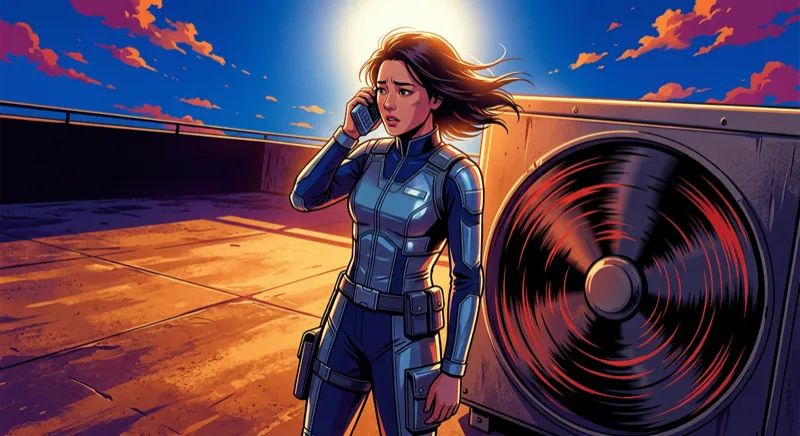
At lunchtime Seoyeon called. Yunseo took the call on the roof of the center building. Wind was blowing across the roof. The concrete underfoot had been warmed by the sun. Yunseo stood beside the air-conditioning condenser. Its fan was turning. The sound of the wind mixed with the sound of the fan. "Mom, when do the test results come out?" Seoyeon's voice came through the phone. A bright voice. A voice with no worry in it. "Still processing." "Does it take long?" "It can take a while." The wind stirred Yunseo's hair. Beyond the roof's railing the city spread out. Apartment complexes. Schools. Hospitals. Somewhere down there Seoyeon was making this call. "Mom, I felt the baby move yesterday." Seoyeon's voice changed. Softened. "Really?" "Yeah. Something moving inside my belly. Very faintly." Yunseo gripped the railing. The metal had been warmed by the sun. "That must be nice," Yunseo said. She forced her voice not to crack. "Let me know the moment the results are in. The baby's healthy, right?" "Yeah." The call ended. Yunseo slipped the phone into her pocket. She stood leaning against the railing. The wind blew. Her eyes went dry. It was the wind. When Yunseo's father caught COVID, she had been a graduate student. Visits to the hospital were forbidden. She had only spoken to him by phone. His coughing came through the receiver. Even after he recovered, climbing stairs left him short of breath. Pulmonary fibrosis. The virus's trace was etched into his lungs. After he died, Yunseo analyzed his genome. That was when she first found the insertion sequence on chromosome 7. In her father's cells it was dormant. It did not express. The same insertion sequence was in Yunseo's genome too. Dormant as well. In Seoyeon's, too. It had awoken in Seoyeon's child—the fourth generation.
2 in the afternoon. Yunseo opened the source code of her own algorithm. The chromosome 7 insertion-site detection module. The methylation-pattern analysis module. The third-generation expression-probability calculation module. Code she had written 5 years ago. Her initials were written in the comments. The 94.3 percent probability was a number this code produced. Yunseo looked down at the code. This code was passing judgment on fetuses across the entire country. Over 4 years, 12,400 fetuses had received positive rulings. Of those, births carried to term: 0. The law had stopped them. Yunseo's algorithm was the eye of the law.
Yunseo laid her hands over the code. Change the weights of the probability model, and 94.3 percent could become something else. Raise the threshold for the methylation pattern by just 0.02, and Seoyeon's sample turned negative. 0.02. Two digits past the decimal point. Change that number, and it wasn't only Seoyeon's ruling that shifted but the standard for the entire country. People who had been positive would become negative, and people who had been negative could become positive. Yunseo lowered her hands. That, she could not do. Change the 0.02, and the national standard changed. Hundreds of people whose positive became negative. Some of them were people in whom activation would actually occur. People who would be born, grow up, and in their 20s watch their joints swell, blotches spread across their skin, their organs harden. Yunseo had analyzed those people's genome data. Behind the data were people. She didn't know their faces, but she knew their chromosome sequences.
Erasing a name and changing the code were not the same thing. Erasing a name had hidden one Seoyeon. Changing the code would distort the entire system. Yunseo understood the difference. Understanding the difference was no comfort.
Wednesday. Jaeho came over to Yunseo's desk.
"I was compiling the third-quarter positive cases, and one of the samples is strange."
Yunseo's hand stopped over the mouse.
"What is?"
"Number 3847. It's positive, but there's no identity linked to it. It's in the OB-GYN transmission records, but the name is missing from the system."
Yunseo looked at her monitor. The genome analysis program was open on the screen.
"Could be a transmission error. Request a resend from the OB-GYN side."
"I'll do that."
Jaeho turned to go. Two steps. He stopped.
"The strange thing, though, is that the transmission log says it was received normally. The name dropped out after it entered the system."
Yunseo looked at Jaeho. Jaeho was looking at Yunseo. His eyes were asking something. He didn't ask directly. Not yet.
"I'll check the log."
Yunseo said. Jaeho nodded and went back to his desk. Yunseo looked at her monitor. Her fingers rested on the keyboard. They didn't move. If Jaeho checked the log, the time of the edit would come up. 3:14 in the morning. The only person who had been in the center at night was Yunseo. The security records stamped the entry time. Whether Jaeho would trace it that far, she didn't know. Jaeho was a meticulous person. Finding the gaps in the system was Jaeho's job.
Thursday evening. Seoyeon came to Yunseo's home. The front door opened and Seoyeon came in. She put on the slippers and came into the living room. Her belly wasn't showing much yet. 14 weeks. Seoyeon sat down at the table.
"The results still aren't in?"
"No."
"Isn't it late? I heard other people get theirs within a week."
Yunseo was pouring water in the kitchen. There was the sound of water filling a cup.
"The volume's high, so there's a backlog."
Seoyeon took the cup. She drank a sip and set it down.
"Minwoo picked out names. Hajin if it's a boy, Hayul if it's a girl."
Yunseo's hand stopped on the table.
"Already?"
"It's 14 weeks, come on. That's not early."
Seoyeon laughed. Yunseo looked at Seoyeon's face. In Seoyeon's face there was a trace of Yunseo's father. The shape of the eyes. The angle of the nose. The face of a person three generations back remained in the face of a person three generations on. It wasn't only the genes. Yunseo sat down across from Seoyeon. An ultrasound photo lay on the table. The one Seoyeon had just brought. A 16-week photo. The form was clearer than in the earlier one. Head, body, arms. Seoyeon pointed at the photo.
"You can see the fingers here. Five of them."
Yunseo looked at the photo. Inside the blurred outline she could see a small hand. Five fingers. Yunseo's vision blurred. She blinked.
"It's growing healthy."
Yunseo said. She kept her voice even.
"Mom, when the results come, they'll be normal, right?"
Seoyeon looked at Yunseo. Seoyeon's eyes were looking straight at her.
"Yes."
Yunseo answered. It was a lie. At a probability of 94.3 percent, Seoyeon's child was activation-positive. The algorithm Yunseo had built said so. The eye of the law Yunseo had built was looking at Seoyeon's child.
After Seoyeon left, Yunseo sat at the table. The ultrasound photo lay on the table. 16 weeks. Five fingers. Yunseo picked up the photo. The photo was light. The weight of a single sheet of paper. It didn't match the weight of what it held.
Friday. The report deadline. Yunseo came in to the center early. 7 o'clock. She got off the subway and walked to the center building. In the first-floor lobby of the center building hung a poster for the fourth anniversary of the Censorship Law's enforcement. At the bottom of the poster, Yunseo's name was listed as technical advisor. Yunseo got on the elevator without looking at the poster. There was no one in the analysis lab. The fluorescent lights in the corridor came on one by one, tripped by the sensors. Yunseo's footsteps echoed in the empty hallway. She looked at the text that had come from Seoyeon. It had arrived in the early morning.
"Mom, do the results come today? Minwoo keeps asking."
Yunseo didn't reply to the text. She put the phone in her pocket. Yunseo opened the administrator console. Sample 3847. The name field was empty. The resend request had not yet been processed. When the resend came from the OB-GYN, the name would be linked again. Then Seoyeon's name would go back up into the system. A notification would go to the health authorities. A birth prohibition order would be triggered.
Yunseo sat in front of the monitor. There were two options. One: block the resend record. Manipulate the intake filter so the OB-GYN's resend never reached the system. Seoyeon's name would never be linked again. Two: do nothing. When the resend came, the name would be restored. The system would work as designed. The law would work.
Yunseo stood up from the chair. She left the analysis room. She walked down the corridor. She passed the emergency exit and climbed the stairs. She opened the rooftop door. The morning air was cold. Late September. The sun was just rising. The eastern sky over Seoul was orange. Yunseo leaned against the railing and looked down at the city. Between the buildings she could see the Han River. The water glittered in the morning light. Somewhere down there was Seoyeon. It was the hour when she'd still be asleep. A 16-week life cradled inside her.
Yunseo's phone rang. It was Jaeho.
"Director, the resend for 3847 came in from the OB-GYN. Can you check it?"
"Got it."
She hung up. Yunseo stood on the rooftop. The sun was climbing up between the buildings. Orange light touched Yunseo's face. It was warm. Yunseo closed her eyes. Three seconds. A wind blew. Strands of hair brushed against her forehead.
Yunseo opened the rooftop door and went down the stairs. Fifth floor. She opened the door to the analysis room. Jaeho was sitting at his desk. He was looking at his monitor. Yunseo sat down at her own desk. She opened the administrator console. Sample 3847. Awaiting resend. The confirm-receipt button hovered on the screen. Press it and the name would be restored. Leave it unpressed and it would be auto-purged after 24 hours. The auto-purge was a feature Yunseo herself had designed. A clause to prevent the indefinite storage of medical data. Yunseo had written the code herself, four years ago. Now that code was giving Yunseo 24 hours. If it was auto-purged, the resend record itself would vanish.
Yunseo looked at the screen. The confirm-receipt button. Han Seoyeon. Sample 3847. 94.3 percent.
Jaeho passed behind Yunseo. He was on his way to make coffee. His footsteps faded. She heard the water cooler out in the corridor. In the analysis room, Yunseo was alone.
Yunseo moved the mouse. The cursor came to rest over the confirm-receipt button. Her finger was on the mouse button. Press it, and Seoyeon's child would never be born. Don't press it, and a hole would open in Yunseo's system. A system that had issued 12,400 verdicts over four years. If it came out that the system's own designer had hidden her own daughter's result, trust in the whole system would collapse. All 12,400 positive verdicts would be thrown into question. The foundation of the law would shake.
Yunseo's finger lifted off the mouse button. Yunseo pushed the chair back. She opened the drawer. She took out the ultrasound photo. 16 weeks. Five fingers. Yunseo stood the photo up beside the monitor. The hand in the photo and the number on the screen sat side by side. 94.3 percent, and five fingers.
Yunseo did not close the console window. Nor did she press the confirm-receipt button. She sat in the chair and looked at the monitor. The light of the screen rested on Yunseo's face. Morning sunlight began to come in through the analysis room window. The light reached the keyboard. Yunseo's hands were inside the light. With these hands she had built the algorithm. With these hands she had made the verdicts for 12,400 people. With these hands she had erased her daughter's name. These hands were now pressing nothing at all. The light of the monitor and the light of the window mingled. Yunseo's hands lay on her knees. 24 hours remained.