The day the price of fat hit 3.47 million won per kilogram, Sujin was standing on the scale. 44.1 kilograms. 163 centimeters tall, 44.1 kilograms. Body fat: 3.2 percent. The body-composition analyzer beside the scale was displaying the numbers. Subcutaneous fat: 0.4 kilograms. Visceral fat: 0.1 kilograms. Epicardial fat: 0.12 kilograms. Total body fat: 0.62 kilograms. Sujin looked at the numbers. 0.62 kilograms. Six months ago it had been 14 kilograms.
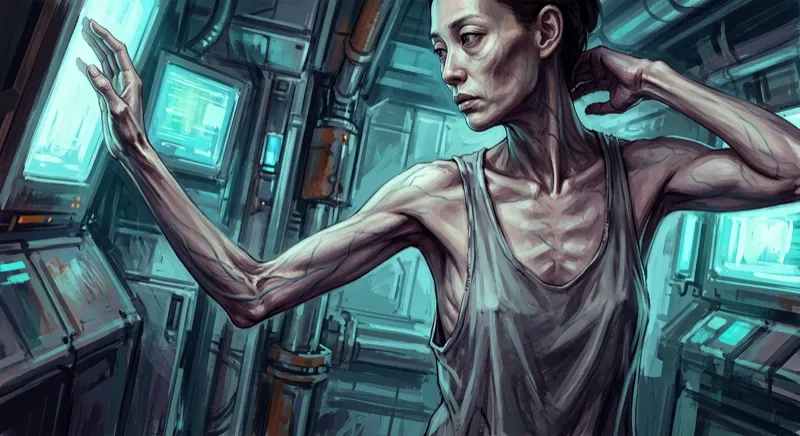
Sujin's arms were thin. Under the skin there was only muscle and bone. Arms with the fat gone. When she bent her elbow, the joint bone jutted up under the skin. Her ribs showed. With every breath, the spaces between the ribs sank into hollows. Sujin didn't look in the mirror. Not for the past six months. Because when she looked in the mirror, she stopped knowing who she was. Six months ago, Sujin had weighed 54 kilograms. An ordinary build. There had been flesh on her cheeks. When she smiled, dimples appeared. Now there were no dimples, only sunken hollows.
There was a fat exchange at every subway station. Like a convenience store. The live price flashed on the sign. An electronic board. The numbers blinked and changed. Like the stock market. People looked up at the signs as they walked past. When the price rose, a line formed at the exchange. A line of people pulling fat from their own bodies to sell. 3.47 million won per kilogram. Up 120,000 won from the day before. When winter came, the price rose. Heating demand. Human body fat, the raw material of synthetic biofuel. One kilogram of body fat produced energy equivalent to 7 barrels of oil. When synthetic biofuel technology was developed in 2063, people celebrated it as the end of fossil fuels. The oil fields of the Middle East were shut down. Offshore drilling platforms were dismantled. The price of oil fell to 3 dollars a barrel. In its place, human body fat became the new resource. Clean energy. Fat extracted from the human body, converted through a catalytic reaction. The only byproducts were water and carbon dioxide. 7 times more efficient than oil.
The problem was the raw material. Human body fat. With synthetic fat, efficiency dropped to a tenth. Only human fat reacted with the catalyst. The reason was never determined. Scholars said it was because of the carbon-chain structure of the fatty acids. The carbon chains of human body fat matched the active structure of the catalyst exactly. Animal fat didn't work. Synthetic fat didn't work. Only human fat. Fat farms appeared. Facilities where people ate for 12 hours a day to grow fat. Meals were provided. High-calorie food. Fried things, butter, sugar. Eat for 3 months and your body fat went up by 15 to 20 kilograms. Extract the fat and sell it, eat again, extract again. People growing fat instead of earning a wage. Obesity became wealth. Fat people took out loans at the bank. Collateral: body fat. Thin people had no collateral. Sujin was a thin person.
The sale of fat was legalized in 2065. The Fat Trade Act. In the National Assembly, 198 in favor, 87 against. One of the opposing legislators said: This is buying the bodies of the poor. A legislator in favor answered: It is a voluntary transaction. No one is being forced. An adult may freely buy and sell their own body fat. Once body fat drops below 5 percent, extraction is prohibited. But there was an exception that allowed sale even below 5 percent. For the purpose of covering medical expenses. Article 22 of the Enforcement Decree of the Health Asset Protection Act. Body-fat extraction to cover medical expenses is permitted down to 3 percent body fat. Below 3 percent was the figure at which the risk of death rose sharply. Organ failure, immune collapse, loss of temperature regulation. 3 percent was the last line the law allowed. On that line stood Sujin.
After her divorce, Sujin was raising Minjae alone. She worked at a restaurant. A monthly wage of 2.1 million won. Nowhere near enough for Minjae's surgery. The first time Sujin went to the exchange was six months ago. She had 0.8 kilograms of subcutaneous fat extracted from her forearm. 2.77 million won. When the anesthesia wore off, her arm felt strangely light. From that day on, Sujin began selling her own body. Thighs. Abdomen. Back. Buttocks. Visceral fat from between the organs. 14 extractions over six months. 14 bandage marks on her arm. 14 kilograms of fat drained from Sujin's body and turned into fuel.
Sujin was at 3.2 percent. A margin of 0.2 percent.
Sujin's son Minjae was 8 years old. A congenital heart valve defect. He needed surgery. The surgery cost 24 million won. Over six months, selling fat, Sujin had saved 19.92 million won. The first month she sold 4 kilograms. Arms and thighs. 13.88 million won. The second month, 3 kilograms. Abdomen and back. 10.41 million won. As the months passed, the fat she could sell dwindled. In the fifth month, 0.7 kilograms of visceral fat. 3.36 million won. Visceral fat extraction hurt. After the anesthesia wore off she couldn't walk for 3 days. She took sick leave from the restaurant. Unpaid. The amount remaining: 4.08 million won. The body fat left in Sujin's body: 0.62 kilograms. 0.62 kilograms × 3.47 million won = 2.15 million won. Even selling all of it fell short of 4.08 million won. But the price differed by the type of fat. Subcutaneous fat, 3.47 million won per kilogram. Visceral fat, 4.8 million won per kilogram. Epicardial fat, 34 million won per kilogram. Epicardial fat was the highest in purity. Its catalytic-reaction efficiency was 10 times that of ordinary fat. Sujin's epicardial fat, 0.12 kilograms × 34 million won = 4.08 million won. Exactly.
Sujin had done this calculation 3 days earlier. She'd entered the numbers into the calculator app. 0.12 × 3400.408. She looked at the screen. 4.08 million won. The same number as the balance left on her son's surgery.
Sujin called the exchange. The Gangnam branch.
"Can you extract epicardial fat?"
"What's your body fat percentage?"
"3.2."
"If it's to cover medical costs, then yes. Just bring the paperwork. A doctor's note and an estimate for the surgery."
"What happens if you extract it?"
A short silence on the other end of the line.
"Epicardial fat is the fat that wraps around the heart. It acts as a cushion, so the heart doesn't strike against the sternum or the ribs. Remove it and the heart comes into direct contact with the sternum. Every beat creates friction."
"You mean it hurts?"
"Yes. Every heartbeat causes pain. The heart beats about 100,000 times a day. So that's pain 100,000 times a day."
Sujin held the phone. 100,000 times. A day. Every day.
"Can it be managed with painkillers?"
"In the beginning, yes. For about 6 months. After that you build up a tolerance and they work less."
"And after 6 months?"
"Usually, after 2 or 3 years, there are people who get used to the pain. It never goes away completely, but it settles to a level where you can live your life. Still, 3 out of 10 develop depression. Sleep disorders too. As long as there's a heartbeat, there's pain. Even when you sleep, the heart keeps beating."
"Some people adapt, and some can't."
Sujin hung up.
Minjae came home from school. The sound of the front door opening. The sound of sneakers being taken off. Minjae came into the living room. His face was blue. His lips were purple. His heart valve wasn't closing properly, so the blood flowed backward. He wasn't getting enough oxygen. Minjae sat down on the sofa. His breathing was ragged. 500 meters from school to home. For an 8-year-old, 500 meters was a marathon.
"Mom, we did jump rope in gym today, and I was the only one who couldn't."
"It's okay."
"The other kids can do over 100, and I could only do 7."
"7 is good."
"That's a lie. The teacher told me to sit and rest. Only me."
Minjae's eyes reddened. He didn't cry. An 8-year-old holding back tears.
Sujin smoothed his hair. Minjae's hair was soft. Sweat had beaded on his forehead. Sweat from walking 500 meters. Sujin's hand was dry, the bones standing out. A hand with no fat on it was wiping the child's forehead.
That night, after Minjae had fallen asleep, Sujin sat in the kitchen. The paperwork lay on the table. The estimate for the surgery. Seoul Central Children's Hospital. Heart valve repair. 24 million won. Balance due: 4.08 million won. Payment deadline: April 30. 25 days away. If the payment wasn't made, the surgery would be canceled. Wait for the next opening: 8 months.
Sujin looked at the paperwork. 8 months. She had asked the doctor whether Minjae's heart could hold out for 8 months. The doctor said he couldn't guarantee it. The valve defect was progressing. The volume of backflow was increasing. The sooner the better. The doctor showed her an image. Minjae's echocardiogram. When the valve opened, you could see the blood flowing backward. A blue current pushing up against a red one. Regurgitation: 40 percent. Three months ago it had been 28 percent. It was increasing.
Sujin opened her phone. The body-fat price app. The app was called 'FatMarket.' It looked like a stock-trading app. There was a graph. The price of epicardial fat had climbed steadily over 6 months. Demand was outstripping supply. Not many people were selling epicardial fat. Of course not. Epicardial fat: 34.2 million won per kilogram. Up 200,000. 0.12 kilograms × 34.2 million won = 4.104 million won. 24,000 won more than 4.08 million. Sujin looked at that 24,000 won. She could buy Minjae a jump rope.
Sujin rested her forehead on the table. The table was cold. Her body had almost no fat left to hold in her body heat. She was cold. It was March, and she was cold. Turning on the heat meant a heating bill. The heating fuel was synthetic biofuel made from body fat. Someone's fat was warming Sujin's room. Sujin didn't turn on the heat.
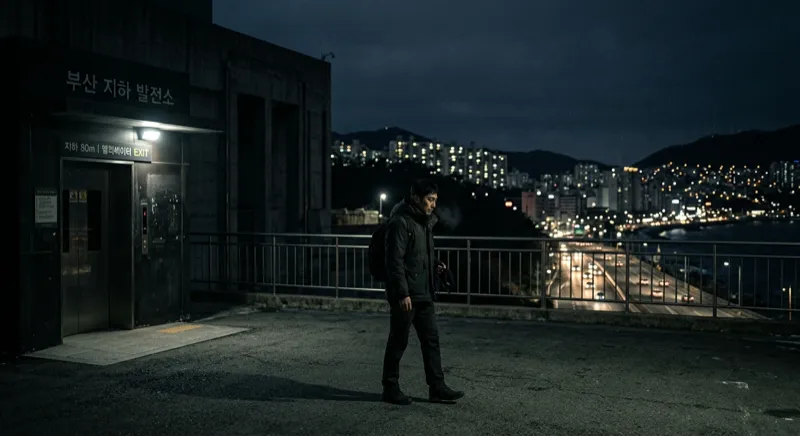
The next day, Sujin went to the exchange. Gangnam Station, Exit 3. Basement level 1. The sign: 'BioFat Gangnam Branch. Body fat purchase, extraction, settlement. Current market rate applied.' She went inside. A reception desk. Waiting chairs. 3 people sat there. One was fat. His belly stuck out. His arms were thick. His body overflowed with the thing Sujin had lost. Fat. He wore an easy expression. The expression of someone who could earn millions of won from a single extraction. One was ordinary. One was thin, like Sujin. On the thin one's arm were extraction marks. 3 round bandages stuck there. His face was sunken and hollow. His cheekbones were sharp. His eyes were deep-set. Faces stripped of fat all came to look alike. Once the outline of the bone showed through, individuality vanished. 3 round bandages stuck there. Sujin's arm had the same marks. 14 of them. 6 months' worth of extraction marks.
Sujin stepped up to the reception desk. The clerk looked at the screen.
"Name?"
"Han Sujin."
The clerk checked the data.
"Ms. Han Sujin. Current body fat, 3.2 percent. Last extraction was 2 weeks ago. Which site are we extracting today?"
"The epicardium."
The clerk's hand stopped. The clerk looked at Sujin.
"The epicardium?"
"Yes."
"Epicardial extraction requires your signature on the side-effect disclosure."
"I know."
The clerk drew out the paperwork. Consent to Epicardial Fat Extraction and Disclosure of Side Effects. 3 sheets. Sujin read. 'Removal of epicardial fat eliminates the heart's protective cushioning. Friction between the heart and the breastbone may cause permanent chest pain. Average pain intensity per heartbeat: 3 to 6 on a 10-point scale. Intensity may fluctuate over time. Analgesic efficacy: effective for an average of 6 months. Diminishing thereafter.' Sujin read the paperwork. 3 to 6. 100,000 times. Every day.
Sujin looked at the signature line. The pen lay on the desk. Sujin picked up the pen.
Sujin's phone rang. It was Minjae's school number. Sujin answered.
"Is this Minjae's mother? Minjae collapsed during gym class. He's in the nurse's office now."
Sujin left the exchange. She set the unsigned paperwork down on the desk and walked out. She hailed a taxi. In the cab she looked at her phone. An alert from the price app. 'Epicardial fat breaks 34,300,000 won per kilogram.' It was climbing. The value of the 120 grams wrapped around Sujin's heart had risen 12,000 won in 10 minutes. Sujin closed the alert. 15 minutes to the school. Minjae lay in the nurse's office. His face was white. His lips were blue. An oximeter was clipped to his finger. 88 percent. Normal is 95 or above. The school nurse spoke.
"He was jumping rope and just dropped. He was conscious but couldn't breathe."
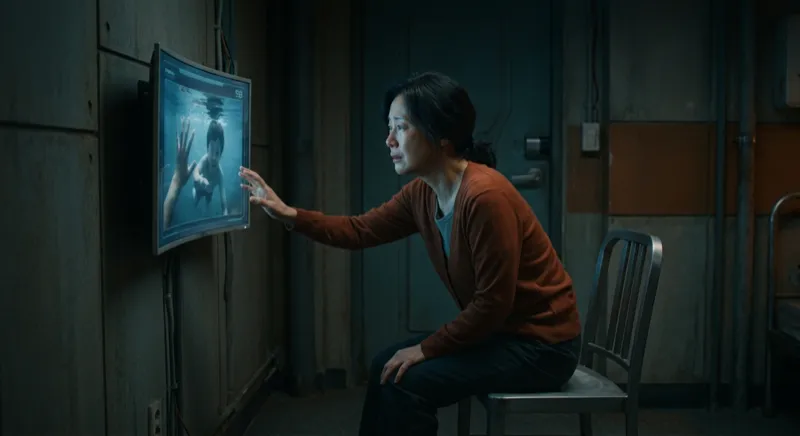
Sujin sat down beside Minjae. The bed was narrow. Minjae's body was small. The blanket was thin. The fluorescent light of the nurse's office fell on Minjae's blue face. Minjae looked at Sujin. His eyes were full of fear.
"Mom, my heart feels wrong. It hurts here."
Minjae pressed his chest. The left side. Where the heart is. Sujin took Minjae's hand. Her own thin, bone-ridged hand closed over Minjae's small one.
Sujin called the hospital. She asked whether the surgery could be moved up. If 4,080,000 won was paid, surgery was possible within 2 weeks. Without payment, she'd wait. Sujin hung up. Minjae slept on the nurse's cot. His breathing was uneven. When he inhaled, his chest caved in. A body starved of oxygen straining to breathe harder. The nurse spoke to Sujin quietly.
"Does this happen often?"
"It's getting more frequent."
"When is the surgery?"
"Soon."
Sujin left the nurse's office. She stood in the corridor. Through the window she could see the playground. Children were running and playing. Jump rope. Soccer. Running. The things Minjae couldn't do. Sujin stood gripping the windowsill. The children's laughter carried up from the playground. The sound of a jump rope striking the ground. Slap. A steady sound. Like a heartbeat. Her knuckles turned white.
Sujin went back to the exchange. The Gangnam branch. The reception desk. The paperwork lay exactly where she'd left it. The clerk looked at Sujin.
"You came back."
Sujin set the pen to the signature line. She wrote her name. Han Sujin. The strokes were thin. Handwriting made by fingers with no fat on them. She wrote the date. April 5, 2069. Beside the signature line was fine print. 'I fully understand the above side effects and consent voluntarily.' Voluntarily. Sujin looked at the word. The word voluntarily was strange. Voluntarily, in a situation where her son could die. The clerk checked the paperwork.
"Tomorrow, after extraction, we attach a heart-protection pad. The pad acts as a temporary cushion, but it dissolves and disappears within 3 to 5 days. The friction begins after that."
"3 to 5 days."
"Yes. That's your last grace period."
"Extraction is available tomorrow at 10 a.m. You'll need to fast for 12 hours, and it's done under general anesthesia. Surgery time, about 2 hours. Recovery time, 6 hours."
"Do I get paid right away?"
"Payment is settled immediately after extraction. Current epicardial price, 34,200,000 won per kilogram. At 0.12 kilograms, that's 4,104,000 won."
"Understood."
Sujin left the exchange. She walked. From Gangnam Station to home, 3 subway stops. On the subway, Sujin laid her hand on her chest. Her heart was beating. Regularly. Without pain. For now. By tomorrow afternoon it would be different. Her heart would be laid bare. A heart pressed against bone. Sujin had once read accounts online of epicardial fat extraction. 'At first it feels like a needle jabbing. Every time the heart beats. After about a month it turns into a dull ache. But it doesn't go away. As long as the heart keeps beating.' The person who wrote it had extracted the fat to pay for a child's leukemia treatment. The child was cured. The writer was now into a second year of living with the pain. It would hurt every time the heart beat. 100,000 times. Every day. Sujin kept her hand over her heart. It felt as if the heart were touching her palm. Thump. Regular. No pain. As long as the epicardial fat wrapped around the heart, there was no pain. That fat, 120 grams. 4,080,000 won. To mend her son's heart, she would peel the protective layer off her own. Sujin thought about that exchange. Between the ribs. There was no fat, so the beating of her heart carried all the way to her skin.
She came home. A studio apartment. One room with a kitchen and a bathroom. Minjae's bed and Sujin's bed stood side by side. A picture Minjae had drawn was stuck to the wall. A family picture. Mom and Minjae. Mom's body was drawn round. A picture from 6 months ago. The Sujin of now was not round. A picture Minjae had drawn this month was stuck to the refrigerator. In that one, Mom was thin as a stick. This was the change an 8-year-old had seen. Minjae was sitting on the sofa. They had sent him home early from school. Minjae was watching television. Cartoons. Sujin looked at him from the entryway. 8 years old. Blue lips. Labored breath. Sujin took off her shoes and stepped inside. She sat down next to Minjae.
"You okay?"
"Yeah. A little better."
Minjae looked at Sujin's arm. The arm with the bandage on it. The mark from an extraction.
"Mom, did you sell again?"
Sujin didn't answer.
"Mom, you're too skinny. Teacher said you should eat well."
"I'm eating."
"Liar. You didn't eat breakfast this morning."
Sujin hadn't eaten breakfast. For tomorrow's fast. But she couldn't tell Minjae the reason.
Sujin stroked Minjae's hair.
"Tomorrow I can pay the hospital bill. Then you can have the surgery soon."
Minjae looked at her.
"You can't get sick, Mom."
Sujin smiled. She lifted the corners of her mouth. She made a smiling face. There was no flesh on her cheeks, so the smile looked like a skull.
That night, after Minjae fell asleep, Sujin sat in the kitchen. 10 a.m. tomorrow. Fasting. Sujin opened the refrigerator. Minjae's snacks were inside. Milk. Cheese. Fruit. Sujin closed the refrigerator. She sat at the table. She put her hand on her chest. Her heart was beating. In the quiet of the night she could hear it. A heartbeat without pain. Tonight was the last one.
From Sujin's room came the sound of Minjae's breathing. Irregular breathing. A pattern of drawing in, stopping, drawing in again. The breath made by a heart whose valve wouldn't close properly. Sujin listened to that breathing every night. For 6 months. She fell asleep checking that the breathing didn't stop.
Sujin looked at the clock. 11:47 p.m. In 10 hours and 13 minutes the anesthesia would begin. When she woke there would be no fat around her heart. Her heart would touch her sternum. Touch it with every beat. Sujin pressed her hand against her chest. Her heart was pushing back against her palm. Regularly. Thump. From tomorrow, this thump would become pain. Every time. Sujin took her hand away. She looked at the surgery cost estimate on the table. 4,080,000 won. Sujin laid her hand on the estimate. She felt the texture of the paper. It was cold. Her hand was cold too. Sujin lifted her hand from the paper and stood up. She went to Minjae's room. She looked at Minjae lying in bed. His chest rose and fell above the blanket. Irregularly. Sujin drew the blanket up and tucked it to his chin. She touched Minjae's forehead. It was warm. Minjae's body heat passed into Sujin's cold hand. A body with no fat was always cold. Sujin went back to the kitchen and sat down in a chair. She put her hand on her chest. Thump. A heart that did not yet hurt was beating. In 10 hours this thump would become pain. Every time. Forever. Sujin closed her eyes. She listened to the sound of her heart. It was the last night without pain.