When the alarm sounded in the central conduit of Root Station, Jieun had her arm buried to the shoulder in the compost tank of Bay 3. Even through the glove she could feel the warmth. Fermentation heat—the heat of organic waste breaking down, rising all the way to her wrist. The temperature readout inside the tank held at 41 degrees. Three above the normal range. But the alarm wasn't coming from this tank; it was coming from the central conduit. Jieun drew her arm out, shook the organic muck from her glove, and stepped out of the bay.
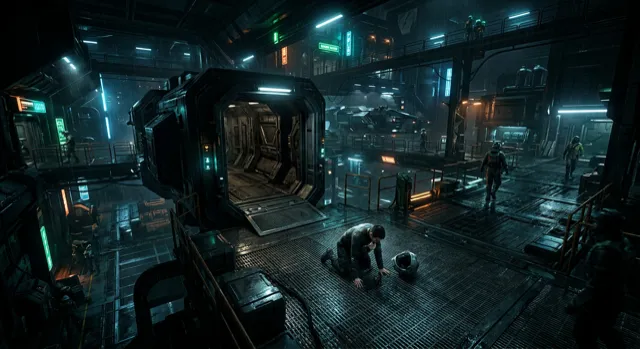
The central conduit was something like the station's spine. A cylindrical passage 4 meters across, running 1.2 kilometers from one end of the station to the other. Along its walls clung the fungal panels. These panels were the heart of the station. Root Station was a resource-reclamation station adrift at the Lagrange 4 point of the Gliese 667C system. Between the compound gravitational fields woven by three stars, the station gathered and reprocessed the waste that mining ships and survey vessels left behind. What carried out that reprocessing was the fungal panels—mycelium brought from Earth and refined over 36 years. They broke down organic waste, adsorbed metal ions, and even served as water filters. The survival of the station's 214 residents rested on these panels.
When Jieun reached the central conduit, part of a panel had changed color. On the starboard wall of the passage, a stretch of maybe 8 meters. Instead of its usual pale gray it had turned a deep violet-red. Jieun pulled on a fresh glove and laid her hand against the discolored section. It was warm. The surface of the panel was pulsing faintly. Irregular contraction and release. As though it were breathing. Jieun switched on her helmet comm.
"Control, discoloration found on the fungal panel, central conduit, starboard section 7. Violet-red, an 8-meter stretch. Rising temperature and pulsation."
Taeho's voice came through from Control.
"Section 7? It was fine when I inspected it yesterday."
Jieun pressed the panel's surface with her fingertips. It gave. Normally the panels were dry and hard.
"The surface has gone soft. Looks like the moisture content's up."
Taeho was silent for a moment, then said,
"Take photos and send them. We may have to report this to the Reclamation Committee."
Jieun photographed the discolored section and transmitted it to Control. The conduit's lighting fell across the panel's violet-red surface. The color wasn't uniform. Darker purple striations spread irregularly through the violet-red. The striations ran past the panel's edge and reached the seam of the wall. Jieun peered into the gap at the seam. The striations had gone in through the gap. Behind the panel, the mycelium was boring into the interior of the wall.
Jieun had been born on Root Station. When her parents came as first-generation settlers, there had been no Jieun yet. Born 8 years after the station was completed, she had grown up breathing this cylindrical structure's recycled air and drinking its reprocessed water. 28 years. She had never seen Earth. Earth existed only as data packets arriving from 11.7 light-years away. To Jieun, home was this station, and the smell of the fungal panels was the smell of home.
The Reclamation Committee met in the conference bay beside Control. Three members sat in the seats fixed to the wall. Jieun and Taeho sat across from them. The chair, Hansori, brought up the photos Jieun had sent on a tablet and said,
"The discolored section is spreading?"
Jieun nodded.
"It was 8 meters this morning; when I went back in the afternoon it had grown to 11."
Dohyeon, one of the members, asked,
"Have there been cases of discoloration before?"
Taeho answered.
"Three years ago something similar came up in section 4. That time it returned to its original color within 24 hours. This has been going on for three days now."
Hansori enlarged the photo.
"You're saying the striations are going into the wall itself?"
Jieun said,
"The mycelium bored in through the gap at the seam. It seems to have penetrated as far as the insulation in the wall behind the panel."
Hansori's expression changed.
"The insulation?"
Jieun nodded.
"The insulation is an organic material. A cork-based composite. To the mycelium, it's just something to break down."
Dohyeon leaned forward in his chair and asked,
"Then shouldn't we remove the panel?"
Jieun shook her head.
"If we remove the section 7 panel, air purification and moisture regulation stop for that stretch. It'll affect the airflow of the entire central conduit."
After the meeting, Jieun went back to the central conduit. She marked the edge of the discolored section with tape and began recording the rate of spread hour by hour. 10 p.m. The discolored section had reached 13 meters. It was spreading at about 0.4 meters per hour. Jieun sat down on the conduit floor and looked up at the panel. The violet-red surface curved along the passage's arc. When the lights went off, a faint bioluminescence came from the panel. A purple light tinged with blue. Jieun switched off the lights and watched that glow. It was the first time a fungal panel had ever given off light.
The next morning, Jieun examined a sample taken from the discolored section under the microscope. The structure of the mycelium had changed. In the existing panels the hyphae were simple strands. In the discolored section the strands were woven together, forming a mesh structure. At each intersection of the mesh sat a small nodule. The nodules were 0.2 millimeters across. Jieun applied an electrical stimulus to one. The nodule responded. From the stimulated nodule a signal propagated to the adjacent ones. The propagation speed was 3 centimeters per second. Slow, but directional. Not random—the signal traveled along a particular path.
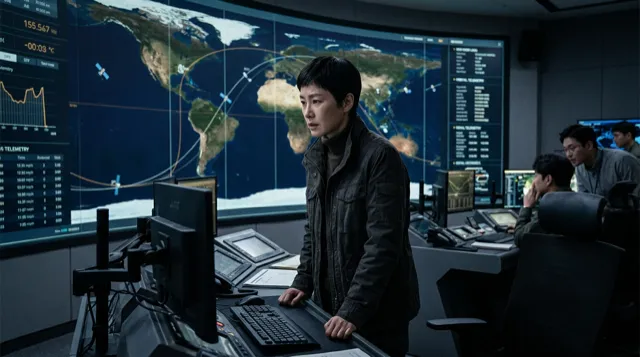
Jieun ran to the control room. Taeho was watching a monitor.
"The mycelial structure in the discolored zone has changed. A nodule network has formed. It can transmit signals."
Taeho looked at her.
"Transmit signals?"
Jieun sent the microscope data to Taeho's monitor.
"It responds to electrical stimulus. A signal moves from nodule to nodule. It even has directionality."
Taeho studied the data. He watched the monitor for a long time without a word, then asked.
"Did this arise on its own?"
Jieun nodded.
"In 36 years of engineering it, this structure has never once appeared."
That afternoon, something went wrong with the station's waste-processing system. Food waste fed into compartment 5 had gone undecomposed, sitting there untouched. The panel had refused it. Jieun went to compartment 5 to check. The waste lay on the panel's surface exactly as it had been placed. Normally, decomposition began within 6 hours of contact. 12 hours had passed with no change. Jieun cleared away the waste and touched the panel. The surface had turned smooth. The fine pores that were usually there had closed. The panel had sealed its pores.
She reported to Taeho.
"The panel in compartment 5 has stopped absorbing organic matter. Its pores have closed."
Taeho asked.
"Just the discolored zone?"
Jieun shook her head.
"The undiscolored areas too. Compartment 5 is 40 meters from the discolored zone. But the panels are connected. The whole thing is one mycelium."
Taeho rose from his chair.
"The entire panel is refusing?"
Jieun said.
"Not the whole thing yet. It's been confirmed in compartments 3, 5, and 9. The rest are still normal."
Emergency meeting of the Reclamation Committee. Hansori put a map of the station's overall panel status on the screen. The refusing zones were marked in red. 3 of them. The discolored zone was orange. It had now spread to 23 meters.
"A panel shutting down its own function is a behavior that isn't in the design."
Hansori looked at Jieun.
"What do you think is causing it?"
Jieun brought the microscope data up on the screen as she spoke.
"The nodule network. The signal-transmitting structure that formed in the discolored zone is spreading across the entire panel. The panel has begun responding to external stimuli as an integrated whole."
Dohyeon asked.
"What do you mean by integrated?"
Jieun paused a moment, then answered.
"I mean it responds like a single organism."
The meeting room went quiet. Only the low hum of the station's ventilation system running could be heard. Hansori asked.
"If it's an organism, then why is it refusing the waste?"
Jieun said.
"I don't know. But there's a pattern to the waste it refuses. Even among food waste, it only refuses the items high in protein. Plant-based waste it decomposes normally."
Taeho asked.
"Only protein? Why?"
Jieun shook her head.
"I don't know yet."
That night Jieun ran an experiment in compartment 5. She set various kinds of organic matter on the panel's surface and observed the reactions. Cellulose: decomposition began. Carbohydrates: decomposition began. Animal protein: refused. Plant protein: decomposition began. Only with animal protein did the pores close. Jieun broke the animal-protein samples down further. Muscle tissue: refused. Connective tissue: refused. Blood components: refused. The common factor was the presence of animal cells.
At 2 in the morning Jieun sat at the microscope. She was recording the signal patterns of the nodule network. When she placed animal protein on the panel, the nodule network's signal frequency spiked sharply. From 3 times per second to 17 times per second. As if it were sounding an alarm. Jieun ran a sample taken from a nodule through chemical analysis. When the result came back, Jieun stood up from her chair and took a step backward. Inside the nodule, a structure resembling an animal cell had been found. The mycelium had integrated part of a decomposed animal cell into its own structure. It had absorbed the cell rather than digesting it.
In the morning Jieun knocked on the door of Hansori's quarters. When Hansori opened it, Jieun held out a tablet.
"The panel is integrating animal cells into its own structure. It's not decomposition, it's absorption. And when a cell of the same kind as one it has absorbed comes in, it shows a refusal response."
Hansori took the tablet and looked at the data. After a long while she asked.
"Is this a self-protection response, then?"
Jieun said.
"More precisely, it's a response to avoid decomposing anything similar to itself. Ever since it integrated animal cells, it's begun recognizing animal cells as part of its own body."
Hansori set the tablet down and looked at Jieun.
"So then the panel won't be able to process animal-based waste anymore? Permanently?"
Jieun answered.
"If the trend continues. Judging by how fast the nodule network is spreading, within 2 weeks the panels across the whole station will be connected."
Hansori looked out the window. Beyond it, the three stars of Gliese 667C were sending their light from three different angles.
"If we can't process protein waste, the nitrogen recovery in the station's cycling system stops. Without nitrogen, we can't grow plants."
Jieun nodded.
"I know."
In the afternoon, Taeho came looking for Jieun. The corridor outside Compartment 3.
"The committee's come back with two options for the discolored section."
Jieun looked at Taeho.
"Which are?"
Taeho said.
"First: excise the panels in the discolored section and replace them with new ones. That cuts off the spread of the nodule network."
Jieun asked.
"Do we have new panels?"
Taeho shook his head.
"We've got 12 meters' worth of backup panels. The discolored section is 23 meters, so it's not enough. The rest we'd have to strip from the existing panels."
Jieun said.
"If we strip the existing panels, that section loses its purification function."
Taeho nodded.
"Second: keep the nodule network but give up processing animal waste. We freeze the protein waste in storage and ship it out when the next supply vessel arrives."
Jieun asked.
"When is the supply vessel coming?"
Taeho answered.
"7 months from now."
Jieun rejected both options. The first meant killing the mycelium; the second meant holding out 7 months without a nitrogen cycle. Both were fatal to the station's long-term survival. Jieun said to Taeho.
"There's a third."
Taeho looked at her.
"Which is?"
Jieun said.
"We negotiate with the mycelium."
Taeho's expression froze.
"Negotiate?"
Jieun said.
"The nodule network transmits signals, doesn't it? We can send signals too. If we change the pattern of electrical stimulus and feed it into a specific nodule, the network responds. If we find the inverse pattern of the rejection response, the panel might open its stomata again."
Taeho studied her for a long moment, then said.
"That's an experiment, not a negotiation."
Jieun answered.
"What's the difference between an experiment and a negotiation? If the other side responds, it's a negotiation."
Jieun made her first attempt in Compartment 5. She set animal protein on the panel and, at the same time, sent a low-frequency electrical stimulus into the nodules. The panel refused. The stomata closed. Jieun changed the frequency. She mimicked and transmitted the signal pattern the nodule network showed when breaking down cellulose. The panel's response shifted. The stomata opened only halfway. Neither full acceptance nor full refusal—an in-between state.
Over the next three days Jieun barely slept. She recorded, classified, and reproduced the nodule network's signal patterns. Breakdown patterns, rejection patterns, standby patterns. She identified 12 basic patterns. One of them was a "pre-acceptance verification" pattern—the signal the panel showed when it first encountered a new organic material. She formed a hypothesis: if she sent this pattern artificially, the panel might re-recognize animal protein as a "new substance."
At dawn on the fourth day, Jieun ran the experiment in Compartment 3. She sent the "pre-acceptance verification" pattern into the nodules while setting down a sample of animal protein. The panel's response was different. The stomata opened slowly. Hyphae approached the surface of the protein. But breakdown didn't begin. The hyphae only wrapped over the protein's surface, as if covering it. As if feeling it. 30 minutes passed. The hyphae withdrew and the stomata closed again. Refusal.
As she recorded the results, Jieun noticed one thing. After the hyphae withdrew, a new type appeared in the nodule network's signal pattern. A 13th pattern, absent from the existing 12. Jieun analyzed it. Elements of the rejection pattern and the acceptance pattern were blended together. She named it the "conditional response."
When she reported to the Reclamation Committee, Hansori asked.
"If it's conditional, what's the condition?"
Jieun answered.
"I haven't decoded it yet. But it's certain the panel isn't refusing outright—it's presenting a condition."
Dohyeon folded his arms and said.
"The mycelium presents a condition. Is this a normal situation?"
Jieun looked at Dohyeon.
"The mycelium we brought from Earth 36 years ago has evolved feeding on the station's waste. We've only ever seen this mycelium as a tool."
The next day, Jieun tried sending the 13th pattern back to the panel in reverse. She returned the signal the panel had sent, exactly as it was. The panel's response was immediate. In one minute the purple of the discolored section faded. The stomata opened. When Jieun set down the animal protein, the panel began to break it down. But the manner of breakdown was different. Before, it had fully decomposed organic matter, reducing it to basic elements. This time it broke down only the membrane structure of the animal cells and carried the nucleic acids inside into the nodule network. The panel was adding the nucleic acids to its own structure.
Jieun reported to Hansori.
"The panel is demanding a price for processing the waste. Nucleic acids."
Hansori asked.
"What does it do with the nucleic acids it takes?"
Jieun answered.
"It's using them to expand the nodule network. It's integrating the genetic information from the animal cells to raise the complexity of its own network."
Hansori sat for a long while without saying anything. The lighting in the committee compartment flickered faintly—because the output of the station's solar panels varied with the positions of the three stars. Hansori spoke.
"What happens if we accept that exchange?"
Jieun said.
"The panel's nodule network grows more and more complex. It comes to process more information, to make more autonomous judgments. Right now it's setting conditions on waste breakdown, but before long it could set conditions on air purification or moisture regulation too."
Hansori looked at her.
"Then the station's life-support system becomes subordinate to the panel's conditions."
Jieun nodded.
"Yes."
Dohyeon rose from his chair.
"I can't accept this. The panel is a tool. It makes no sense for a tool to set conditions."
Jieun looked at him.
"We've fed it for 36 years. And for 36 years it's made our air. Is that a tool?"
Hansori raised a hand and stopped them both.
"Look at the practical problem. Refuse the exchange and protein-waste processing halts, and within 7 months the nitrogen cycle collapses. Accept it and the panel will keep setting stronger and stronger conditions. Either way, we lose something."
After the meeting, Jieun went to the central circulation corridor. The purple of the discolored stretch had darkened again. What had paled during the earlier experiment had returned to what it was. Jieun stood with her hand against the panel. The pulse traveled into her palm. The pulse, once irregular, was gradually turning regular. She counted the contractions and relaxations passing into her palm, then stopped.
Jieun did not wait for the Committee's decision. That night, in Compartment 5, she began the exchange. She laid animal waste onto the panel and sent the 13th pattern. As the panel began to break it down, it absorbed the nucleic acids. The waste diminished. Nitrogen compounds flowed into the recovery line behind the panel. The system was running again. Jieun sat on the compartment floor and watched the panel work. The purple surface glowed faintly. Each time the nodule network integrated new nucleic acid, the pattern of light shifted.
Taeho was standing at the compartment door. She hadn't known when he'd come.
"You started before the Committee decided?"
Jieun looked up at him.
"By tomorrow morning the nitrogen recovery in Compartment 3 stops. Once the nutrient supply to the cultivation module is cut, the vegetables wilt within 2 weeks. 214 people lose their food."
Taeho stepped into the compartment. The panel's purple light lit his face.
"This isn't yours to decide."
Jieun stood as she spoke.
"If no one decides, the station decides. In the direction of the system shutting down."
Taeho looked at her. For a long while. Then he turned and left.
At 4 in the morning, Jieun stood before the discolored stretch of the central circulation corridor. The discolored stretch had expanded to 30 meters. The nodule network was spreading through the entire station. The panel's pulse was regular. 1.2 times per second. Almost the same as Jieun's heartbeat. She peeled off her glove and laid her bare hand against the panel. The purple surface was warm. Beneath her palm she could feel the nodules contracting and relaxing. While she held her hand there, the surrounding nodules began to glow one by one. Starting from her hand, the light spread out to either side. Just then Taeho's voice rang from the control-room speaker.
"The panel in Compartment 9 opened its stomata. Nitrogen recovery resuming."
Jieun did not answer. Beyond the ceiling of the central circulation corridor, one of Gliese 667C's red suns was moving across the observation window.