Yun Chae-eun woke to the alarm at 3:42 in the morning. A night when the damp air of the tail end of the monsoon clung to her skin. On the terminal screen by the window, a red light pulsed over and over. Transmitting from the Ecological Management Bureau central server: abnormality-detected warning. On the eastern slope of Seoraksan's 19th administrative zone, seven soil-moisture sensor clusters were spitting out anomalous readings all at once. Chae-eun rose from bed without even turning on a light. Her health check-up was two months overdue, and the ties with her family had been severed long ago. Loneliness had become routine ages back, though she didn't even have the leeway to feel anxious about it. In all her 17 years as an ecological architect, an alarm going off in the dead of night was something she could count on one hand. Usually it was equipment error, or a temporary anomaly from a shift in the weather. But this time was different. Her instinct told her so. She felt her heart quicken, ever so slightly.
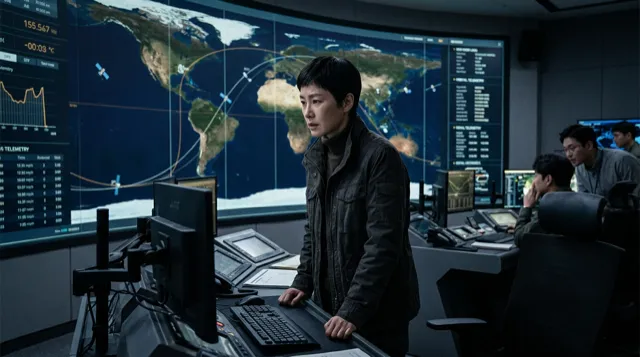
Chae-eun reached the Gangwon Ecological Management District office at 5 in the morning. The corridor's fluorescent lights were on, and beside the coffee machine stood Kim Do-yun, a junior technician, holding a paper cup. Twenty-six, a synthetic ecology major. To him, a natural ecosystem was a black-and-white photograph in a textbook. Do-yun set the cup down and, pointing at the monitor, spoke.
"You've seen this, right, Chae-eun? Microbial activity is at 340 percent of the design model. If it isn't a hardware failure, there's no explaining it."
His voice was pitched high. Excitement or unease—she couldn't tell which. Chae-eun leaned in until her nose was nearly against the screen. Microbial respiration, nitrogen cycling rate, the electrical signals of the mycelial network. All of it was outside the design range. Seven sensors failing simultaneously? The odds were negligible.
"We're going out to the site."
Chae-eun was curt.
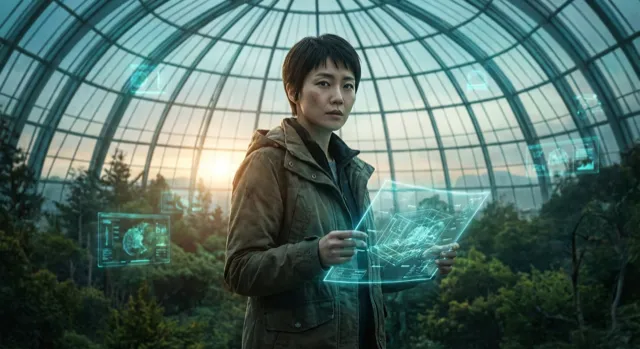
The drone-taxi set her down at Seoraksan's Zone 19, a third-generation synthetic forest established in 2079. Forty thousand pine-family synthetic tree stock stood lined up at 1.8-meter intervals, and beneath them synthetic shrubs and ground cover were planted to the designed density. Below the soil substrate layer a seven-year-cycle nutrient supply system was buried, and electrostatic filter towers that blocked the influx of foreign spores and seeds stood at 200-meter intervals. It was a landscape she'd looked at for 17 years, yet today the regular arrangement of the trees grated on her more than usual. The forest in the photo album her grandmother used to show her while she was alive had not looked like this. In the photos, the trees varied in height and thickness, some leaned, some grew propped against one another. The dawn mist passing between the synthetic tree stock beaded into droplets of identical shape at even intervals. A natural mist would not have done that. Chae-eun trod on the synthetic soil beneath her feet. With each step, the sensation sprang back with the same elasticity. Real dirt wasn't like this, her grandmother had once said. Real dirt felt different every time you stepped on it.
When she went down the eastern slope and opened a soil-exposure port, Chae-eun caught her breath. Across the synthetic substrate layer spread a silver-white mycelial network. Fibers fine and dense as spider's silk were tangled up with the engineered synthetic microbial colonies. Do-yun trained a portable microscope on it, and after a long while lifted his head. Pale.
"It's a species that isn't in the database. This isn't a synthetic organism."
Chae-eun hesitated, then knelt. The mycelium's growth pattern was irregular. Utterly unlike the repetitive, predictable growth of synthetic fungi. This fungus was responding to its surroundings and deciding its own direction. Chae-eun's fingertips trembled faintly. The smell of earth grazed her nose. A raw smell, different from the odorlessness of synthetic soil. In her mind her grandmother's voice rang out. A forest was originally like this. Full of things that grew though no one planted them.
Her grandmother, Park Sun-ok, had been a national park ranger back in the 2020s. Until the great climate upheaval and cascading ecological collapse of the 2050s swept away 71 percent of the Korean peninsula's wild species, her grandmother walked the mountains every day. The last witness of the wild. As a child Chae-eun sat on her grandmother's knee and listened to those stories. Squirrels darting between branches, salamanders hidden under stones, nameless mushrooms shooting up after rain. It was a fairy tale. To Chae-eun. In today's forest there are no squirrels, no salamanders. The animal-species restoration program was halted in 2076 for lack of funding, and the synthetic ecosystem dealt only in plants and microbes. Her grandmother passed away in 2071. On her deathbed she gripped Chae-eun's hand tight and left her with these words.
"I hope the wild returns while you're alive. So don't give up."
Warmth. She remembered it still.
By the regulations, she was supposed to draw up an unauthorized-organism discovery report and upload it to the central server at once. Within 48 hours of receipt, a quarantine team would deploy to seal off the zone, collect the unauthorized organism and incinerate it at high temperature, and replace the soil substrate layer—a whole sequence of isolation and incineration procedures set in motion. Do-yun had already pulled up the form.
"All you have to do is sign. The isolation team lifts off at dawn tomorrow."
Chae-eun picked up the pen, then set it down.
"Wait. First let's see what effect this fungus has on the surrounding synthetic microbes."
Do-yun's eyes widened.
"There's no observation period in the regulations. It's immediate reporting."
She knew. She knew it well. Ecological Safety Act, Article 17. The duty to report and isolate immediately upon discovery of an unauthorized organism. Violation punishable by up to 3 years' imprisonment or a fine of up to 50 million won. Still, Chae-eun asked for just 24 hours. Do-yun bit his lip and, in the end, nodded. Unease.
She spent 24 hours in the field. No tent — just her observation equipment and a thermal blanket to get her through. As the night deepened, the silence peculiar to a synthetic forest pressed against her ears. No insect chirps, no rustle of dead leaves stirred by wind. A perfect stillness. Chae-eun listened to that quiet. Within it, she seemed to hear the sound of hyphae threading outward. The results exceeded what she had expected. The unregistered fungus had formed a spontaneous symbiotic network with 6 species of synthetic soil microbes. Phosphorus uptake efficiency was up 23 percent over the design model; nitrogen fixation had risen 17 percent. Efficiencies that the architects of synthetic ecosystems had failed to optimize across decades were being achieved all on their own. More astonishing still was that this fungus was attempting to connect with the roots of the pines. The early signs of mycorrhizal formation. In the natural world, mycorrhizal symbiosis had been a core mechanism of forest ecosystems, but in synthetic ecosystems it had been written off as needless complexity and excluded from the design. This discovery cracked one of the founding premises of synthetic ecology.
She took the data to headquarters in Seoul. The office of inspector Lee Jung-hoon sat in a corner of the 8th floor. A veteran official 5 years her senior, and true to his roots as a researcher, he kept a photograph of Hallasan — from before the great climate shift — hanging on his wall. Lee Jung-hoon perched his reading glasses on the tip of his nose and looked the data over. Looked it over. For a long time. Nothing drifted through the office but the smell of cooling coffee. At last he leaned back into his chair and spoke.
“Scientifically, it's interesting. I grant you that. But architect Yun, we mustn't forget why synthetic ecosystems exist in the first place. After the catastrophe of 2055, what we chose was predictability. Our generation saw with our own eyes what came of trusting nature's resilience.”
Chae-eun raised her head.
“But 70 years have passed. The synthetic ecosystem has itself become a new environment for evolution. This fungus is a life born spontaneously within a synthetic environment. Incinerating it won't be the end of it.”
Lee Jung-hoon was silent for a long while. Outside the window, the synthetic street trees swayed all at once, to the same angle, in the wind. Finally he said,
“I can give you 48 hours. Reach a conclusion within them.”
During the extra time she analyzed sensor data from other zones. It wasn't only Zone 19. Across 8 synthetic-forest zones throughout Gangwon Province, faint signals of similar anomalous microbial activity were being picked up. Zone 19 was the only pronounced one. This could be not a one-off mutation but the beginning of a systemic phenomenon. Over the 70 years since synthetic ecosystems were introduced, soil, microbes and air might have interacted in ways no designer had foreseen, triggering an unintended emergent evolution. Chae-eun transmitted her analysis to Lee Jung-hoon. The reply was short. I will convene an internal meeting at headquarters. Incineration of Zone 19 is suspended for the time being.
Do-yun did not agree. In the cramped meeting room of the field office, under the fluorescent light and the lingering smell of cooling coffee, the two of them clashed. Do-yun braced a hand on the desk and said,
“You know I studied synthetic ecology for 4 years. So I know why the stability of the design system matters. A single unauthorized organism can throw the whole network into disarray. The people who, before 2055, believed nature would balance itself out — the result was a mass extinction.”
Chae-eun looked into Do-yun's eyes. Young eyes. Eyes full of conviction.
“I know that too. But Do-yun — the fact that something we didn't design is growing means life goes on working even beyond our control. Incineration isn't the answer. At the very least we owe it an attempt to understand.”
Do-yun shook his head.
“And while we drag things out trying to understand, the danger could grow.”
Silence. The fluorescent light hummed. Do-yun's coffee was going cold. Chae-eun did not think Do-yun was wrong. She simply did not think there was only one right answer.
The internal meeting at headquarters produced an expert advisory panel. 3 synthetic ecologists, 1 paleoecologist, 1 environmental-law scholar, and 1 representative from a civic organization. As the on-site lead, Chae-eun supplied the data. The panel met 4 times over 3 weeks, and in fierce debate whose minutes alone ran past 200 pages, the argument split cleanly into two camps. The synthetic ecologists argued for containment. Their logic: the spread of an unauthorized organism invalidates the predictive models, and once the models are invalidated the entire management framework is shaken. The paleoecologist, Professor Choi Sun-yeong, offered a different view.
“By maintaining synthetic ecosystems for 70 years, we've inadvertently provided a new environment for evolution. This isn't a failure. It's an unforeseen success.”
Pointing at the microscope images, she added,
“This fungus is an entirely new being, born at the intersection of a synthetic environment and natural evolution.”
The environmental-law scholar pointed out the limits of current law. The law distinguished only between designed organisms and unauthorized invasive species; the very category of a wild organism arisen on its own within a synthetic environment did not exist. Neither court precedent nor administrative ruling had ever dealt with such a situation. The gaps in the system were failing to keep pace with reality.
The story broke while the advisory panel was still deliberating. A reporter, tracing an anomalous pattern in the sensor data, had dug out the fact of the unauthorized fungus in Sector 19. On the citizens' forum a phrase spread: "the return of the wild." Life that had not been designed. The first in 70 years. For many it stirred something deep. But the backlash ran strong too. "Shake the synthetic ecosystem and the food supply is the first thing to collapse." Anxiety rippled through those who worked in agriculture. The yield of synthetic crops was tied directly to the stability of the synthetic soil-microbe network, and if an unauthorized organism disrupted that network, it could tip into a food-security crisis. Desperation.
At the center of the swirling public debate, Chae-eun took stock of where she stood. A person who had spent 17 years designing and managing synthetic ecosystems was about to take the side of the wild. The contradiction ached down to the bone. She was afraid. It felt like tearing down, with her own hands, everything she had built over 17 years. One night, in the study of her home, she opened her grandmother's notebook again. On the last page her grandmother's handwriting remained. The most beautiful things in the world I lived in were the ones I never expected. A flower that suddenly bloomed in spring, a birdsong I heard for the first time in summer, a hedgehog I met on a path in autumn. All of them gifts that came from outside the plan. When she closed the notebook and looked out the window, the synthetic greenbelt of the apartment complex showed its uniform green under the streetlamps, and that too-perfect scene tightened around her chest instead. In this landscape there was nothing unexpected. Everything lay inside the plan. Even knowing it was safe, she could not, however rationally she tried to think, erase the feeling that something important was missing from this perfectly controlled scene. She took water from the refrigerator and, drinking a mouthful, she thought. My grandmother's generation took the wild for granted; my generation defines the wild as danger. Somewhere in between, humankind had lost something it could not name. Chae-eun set the glass down, went back to the study, and opened her grandmother's notebook once more. She drew a deep breath. I will not regret this, she thought.
The advisory panel's final report carried two recommendations. First, that the Sector 19 fungus not be incinerated immediately but held under quarantined observation. Second, that a full survey of unauthorized organisms be conducted across every synthetic forest in the country. Headquarters accepted this. The conditions, however, were strict. If the fungus crossed the sector boundary, immediate incineration; the observation period limited to 6 months. Chae-eun was appointed head of observation, and Do-yun her deputy. Do-yun remained skeptical, but agreed to cooperate. The two of them built a container-type temporary observation station midway up the Sector 19 slope, ran the sensor cables, mounted infrared night cameras, and so began their resident watch.
By the first month, the fungus was growing steadily, widening its symbiotic network with the synthetic microbes. Every indicator of soil health exceeded the design model. By the second month, mycorrhizae had begun forming in earnest on the pine roots. Pines with mycorrhizae attached grew 8 percent faster than the individuals beside them. By the third month, the chemical composition of the synthetic substrate within the fungus's zone of influence had begun to change. A new chemical environment, different from the design, was taking shape. By the fourth month, something unforeseen happened. From the altered soil, an unregistered organism resembling moss lifted its head. The environment the fungus had made had, in effect, triggered the emergence of yet another wild organism.
The news set the Bureau abuzz. Do-yun came and stood before Chae-eun. "Chae-eun, it's a chain reaction. If we don't cut it now, it'll be past saving." She nodded. Then she pointed at the data. The newly appeared moss was not spreading aggressively into the surroundings. It existed stably only within the range of the fungal network. As if it were drawing its own boundary. Writing this observation into her report, Chae-eun murmured to herself. The wild is not disorder. It has an order of a different kind than the design. An order older than the one humans made — one that life itself brings forth.
By the fifth month, she took the stand as a witness at a hearing of the parliamentary environment committee. The chair asked. "Director Yun, do you regard the unauthorized organisms in Sector 19 as a threat to the safety of the synthetic ecosystem?" Spreading out five months of data, she answered. "To this point it is not a threat but an improvement. Yet I also acknowledge that long-term risk cannot be ruled out." An opposition member cut in. "If you acknowledge it, why do you oppose incineration?" Chae-eun steadied her breath for a moment, then spoke. "Seventy years ago, after the great extinction, we gave up the wild for the sake of safety. At the time it was a rational choice. But now, 70 years on, the wild is trying to return on its own. I want to ask whether erasing it once more is truly rational." The hearing room fell silent. Somewhere a ballpoint pen was heard to drop. The chair took off his glasses, then put them back on."
In the poll conducted after the hearing, "support for designating a limited wild observation zone" came in at 47 percent. Three years earlier it had been 9 percent. The assembly introduced a bill to designate a "limited wild pilot zone": in an area equal to 0.5 percent of the Korean peninsula's synthetic forest, management would cease and naturally occurring change would be observed. Fierce opposition erupted inside the Bureau. Changing the policy touched the very reason the agency existed. The review standards and enforcement authority of the entire administrative apparatus could be shaken. After bipartisan compromise and amendment, the bill cleared the Environment Committee's resolution and the floor vote. Conditions were attached: if any unauthorized organism arising in the pilot zone encroached even 0.1 percent onto the boundary of an adjacent synthetic zone, the pilot zone would be closed at once and restored to its original state; and the trial would be capped at 3 years, subject to early termination if a midterm evaluation turned up problems.
Chae-eun was appointed to head observation for the first pilot zone. Do-yun accepted the decision, but he said, "I'm still worried, Chae-eun. But I'll trust you. Just keep your promise to judge from the data." Chae-eun nodded. On the first day of operation, she disabled the electrostatic filters. She shut off the nutrient supplement system. She halted the scheduled replacement program. A month later, some of the designed plants began to fail, and moss spread in their place. In the second month, unregistered insects were observed. In the third month, a small bird flew in. In the fourth month, earthworms surfaced from the soil. Chae-eun rose at dawn to check the sensors, collected soil samples in the morning, logged growth data in the afternoon, and in the evening wrote the day's observations into her journal — in a hand that resembled her grandmother's notebooks. On an evening in the fifth month, sitting before the station writing her log, she suddenly looked up. A sound she had never once heard in the synthetic forest. A bird was singing. A short, irregular cry. Chae-eun set down her pen and listened to it for a long time. Her heart. Quietly. She remembered — her grandmother mimicking birdsong for her.
When the six-month report was released, the biodiversity index stood at 2.7 times the synthetic ecosystem average. But at the boundary zone there were 3 reported cases of wild moss creeping some 10 meters into the adjacent synthetic zone. The Bureau enacted emergency boundary-reinforcement measures, and Chae-eun personally supervised the installation of the physical barrier — concrete and metal mesh — built to stop the crossings. Inspecting the structure beside her, Do-yun asked, "Chae-eun, will a day ever come when this barrier isn't needed anymore?" Chae-eun looked at the moss reaching out past the zone. "I don't know. But I think the fact that we can keep asking that question is itself worth something." The sun was slipping down. Sunset shattered irregularly among the pilot zone's trees. Shadows you could never see in the synthetic forest. It was not a pattern. It was just light — because the undesigned branches stretched off, each in its own direction.
A year passed. The pilot zone was becoming a small but living, breathing ecosystem. Yet the results cut both ways. Soil health and biodiversity had improved dramatically, but as some synthetic tree species died off, the landslide-risk index climbed. Those synthetic species carried root structures engineered to prevent landslides, and as wild plants replaced them, that function weakened. Safety and wildness could not be split by any tidy dichotomy. Chae-eun had no answer. She believed only that her role was to gather the data, record it, and share it. Through the conflict and the loss, she tried not to lose faith. She could not deny the value of the stability the synthetic-ecology system and its policies had brought, but neither could she give up the possibility that lay beyond the regulations. This finding led to the fundamental question the age now faced. Abandon the wild entirely for the sake of safety — or hold its uncertainty and search for a new balance?
One evening, on the eastern slope of the pilot zone, Chae-eun found a small flower. Five white petals. A species not in the database. It had not been designed. No one had planted it. She crouched down. For a long time. Her grandmother's last words circled in her ears. I hope the wild comes back while you're still alive. She did not lay a hand on the petals. When the wind rose, the flower swayed. Flowers in the synthetic garden sway in the wind too, but that sway is engineered into the elastic modulus of the stem. This flower was different. Its stem was thin and uneven, so it traced an unpredictable arc with the strength of the wind. She watched. The irregular motion. Her eyes went hot. The forest her grandmother had walked for 30 years as a national park ranger must have been full of the same unpredictable, undesignable irregularity as this small flower's sway. Every tree a different height, every branch a different angle, every leaf a different color. All that irregularity, together, must have made a single forest. This one flower might be the last echo sent from a world humanity lost 70 years ago — and, at the same time, the first beckoning hand of a new world no one had yet named. Chae-eun took out her observation journal and wrote. Today, on the eastern slope of the pilot zone, I found an unregistered wildflower. 5 white petals, stem height roughly 12 centimeters. The evening light passed through the petals and turned them to a translucent glow. This flower is on no one's blueprint. In no one's plan. And yet here it is. It was beautiful. She closed the journal and stood. She walked the mountain path toward an undesigned tomorrow. The wind blew irregularly through the trees, and Chae-eun loved that irregularity.