The rice was dying yellow. It was July, but the paddy had gone yellow. Rice that should have been green stood withered and sallow. Seongho stood on the ridge and looked out over the field. 3,200 pyeong. His grandfather had broken this land, his father had inherited it, and Seongho had taken it up in turn. This year's projected yield: 1,800 kilograms. Rice at 2,400 won a kilogram. 1,800 kilograms came to 4.32 million won. After the 3.8 million won in loan interest, 520,000 won was left. He would have to live twelve months on 520,000 won. Half of last year. A third of the year before. Seongho ran his hand over an ear of rice. The grains hadn't filled. Only husks. This was what happened to rice starved of photosynthesis. The kernels were empty.
He looked up at the sky. 6:12 in the morning. The hour when the sun should have risen. But the eastern half of the sky was dark. He could see the sun above the horizon, yet no light came down. Something hung between the sun and the ground. Orbital solar power panels. A cluster of panels floating in low orbit, 340 kilometers up. Each panel the size of four soccer fields. 120 tons in weight. Unfurled in orbit, it drank the sunlight, converted it to electricity, and beamed it down to ground stations by microwave. From the stations, distribution into the power grid. And there were thousands of them. Even after the morning sun cleared the horizon, the panels blocked its light. From 6:12 to 7:14. One hour, two minutes. It was the same in the evening. From 6:38 p.m. to 8:16 p.m. One hour, thirty-eight minutes. Two hours and forty minutes of sunlight vanished each day.
Orbital solar power had begun in 2068. After fossil fuels were phased out, the whole world had been wracked by power shortages. Lift solar panels into space, and you could generate around the clock, weather be damned. Beam it down by microwave. Clean, stable power. Within six years, orbital solar was supplying 40 percent of the entire planet's electricity. There was a price.
Three years ago it had been 17 minutes. Seventeen minutes of shadow a day. Back then no one cared. It was much like a passing cloud. Then the panels multiplied. New rockets went up every month. 120 launches a day. The panels filled the orbits. 17 minutes became 40, 40 became an hour, and now it was two hours and forty minutes. The rice had started to die once the shadow crossed the one-hour mark. For photosynthesis, the light of sunrise and sunset mattered. Photosynthesis that begins slowly in faint light. The rice absorbed the red light of dawn first of all. The hour the chlorophyll woke. That was the hour the panels were stealing.
Seongho came down off the ridge and walked toward the house. The house stood 200 meters from the field. A two-story farmhouse. Living room and kitchen on the first floor, two rooms on the second. Seongho lived alone. His wife, Eunji, worked as a nurse in Suwon. On weekdays she stayed in the dormitory at the Suwon hospital. She came only on weekends. There were no children. Farming couldn't feed them, so let's have a child later, Eunji had said. Three years ago. Three years had passed. The farming had only gotten worse. Later never came. Every weekend Eunji came, she used to look at the field. At first she worried over it with him. Now she didn't look at it. She drew the living room curtains closed. So the field couldn't be seen.
On the kitchen table lay a document. The reply to the petition Seongho had filed three months ago. Korea Orbital Energy Corporation. 'We hereby respond to your petition. The placement and operation of orbital solar power panels fall under the jurisdiction of the International Orbital Management Authority and are not subject to domestic law. There is no basis under current law for compensation for crop damage. For further inquiries, please use the International Orbital Management Authority's petition channel.' Seongho had read this reply seven times. Every time, the same sentence. There is no basis under current law. If there was no law, then there was no damage either. Seongho had contacted the farmers' associations as well. Across the country, 120,000 farmers had suffered the same harm. He gathered signatures. 47,000. He filed a petition with the National Assembly. The reply came that no department had jurisdiction. Seongho filed a petition with the International Orbital Management Authority too. In English. Run through a translation machine. No reply came. Three months now.
The phone rang. It was Eunji.
"Have you eaten?"
"Not yet."
"Did you look at the field?"
"I looked."
"How is it?"
Seongho looked out the window. The yellow field was there.
"Dying."
Eunji was silent for a moment.
"This month's loan interest came. 3.8 million won. We're three months behind."
"I know."
"What do we do if you can't harvest?"
Seongho didn't answer.
"Let's sell the field. Even now."
"I can't sell it."
"Why?"
"It's Grandfather's field."
"Grandfather's dead."
"The field isn't."
Seongho hung up. After he hung up, he regretted it. He didn't call back. Eunji didn't call back either. They had both had this conversation too many times. They were worn out from repeating the same words. It wasn't that Eunji was wrong. Sell the field and they could pay off the loan. But Seongho had been born on this land. He had grown up breathing the smell of its soil. He had watched his grandfather rise at four in the morning to bring water to the field. His grandfather had spent his whole life on this land. Even during the Korean War he had never left it, they said. Shells might fall, but the rice still needed water. His grandfather's hands had been rough. Hands with the soil worked into them. He had heard the sound of his father driving the tractor. This field was everything Seongho had.
That afternoon his neighbor Mansu came by. Mansu lived next to Seongho's farm. A retired soldier. Discharged after 15 years of service. These days he grew chili peppers. Mansu's peppers were dying too. Not enough photosynthesis. Last year Mansu had harvested 800 kilograms of peppers. This year's estimate was 300. Mansu's wife had left three years ago. Said the farming was hopeless. Mansu dried his peppers alone now. "Seongho." "Hyeong." Mansu sat down in Seongho's kitchen. He looked at the reply letter on the table. "Kicked back again, I see." "Even the international body won't answer." "Of course not. One panel costs 20 billion won. They put thousands of them up there — you think they're going to compensate a farmer?" Seongho poured water. "It's the same all over the countryside, isn't it?" "The whole country. Chungnam, Jeonnam. The paddies are turning yellow." "What are you going to do, hyeong?" Mansu drank his water. He set the cup down. "There's something I want to show you."
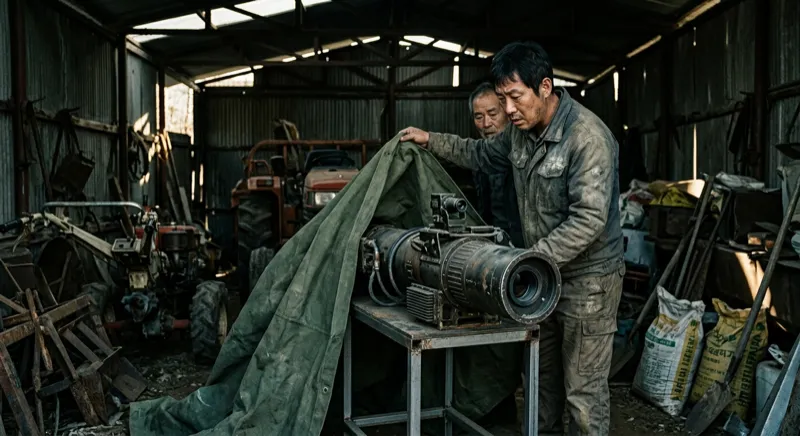
Behind Mansu's house there was a shed. A shed for farm equipment. A tractor, a cultivator, sacks of fertilizer. Mansu lifted a tarp at the back of the shed. Under the tarp was a piece of metal equipment. Two meters long. Cylindrical. Mounted on a stand. It had a targeting device attached. "What is this?" "An anti-aircraft laser. Military surplus. An early-2050s model. Low power. It can't shoot down aircraft. But a low-orbit satellite, it can manage." Seongho looked at the equipment. "Where did you get this?" "It was scrapped by my unit when I mustered out. They were just throwing it away, so I took it." Seongho looked at the equipment's lens. A black circular lens. 30 centimeters across. Dust had settled on the surface. Mansu was wiping it with a cloth. "Isn't this illegal?" "Of course it's illegal." Mansu sat down beside the equipment. "I can't decide this alone, that's why I'm telling you. Let's decide together." Seongho looked at Mansu. "It takes 17 minutes for a single panel to pass over our farms. Shoot down just one panel and you get 17 minutes of sunlight back." "What good is 17 minutes." "For rice, 17 minutes is a lot. The 17 minutes right after sunrise. That's when photosynthesis begins. Get those 17 minutes back and yield recovers by 15 percent. I did the math." Seongho touched the equipment. The metal was cold. It was July, and still it was cold. "What happens if you shoot one down?" "The panel falls. Most of it burns up in the atmosphere. Some of the debris could come down in the sea." "And if we get caught?" "Destroying a satellite violates space law. Under domestic law it's damage to national infrastructure. Five to ten years in prison." Seongho looked out of the shed. He could see Mansu's pepper field. The peppers were withered. The leaves were yellow. "There's one more thing," Mansu said. "I looked into it. You know where the power goes — the power supplied by Panel 4728, the one that passes over our farms?" "Where?" "Suwon Central Hospital. 120 intensive-care beds. 48 ventilators." Seongho looked at Mansu. "That's the hospital where Eunji works." "I know." "12 percent of that hospital's power comes from 4728. They've got a backup generator, so the hospital won't shut down. But if the power drops 12 percent the backup generator kicks in, and it has 8 hours of fuel. If they can't hook up another power source within 8 hours—" "If the life-support machines shut off—" "Stop." Mansu closed his mouth.
Seongho went back to his house. He sat in the kitchen. Through the window he could see the paddy. The yellowed paddy. The sun was setting. 6:38 in the evening. A shadow came down. The sun was above the horizon, but the paddy grew dark. A panel was blocking the light. The edge of the shadow slid across the paddy. The boundary line between light and dark moved slowly from west to east. As the panel traveled along its orbit, the shadow traveled too. Seongho watched the darkening paddy. The rice was getting no light. At this hour the rice should have been making its last photosynthesis. The time when it packs the nutrients made through the day into the grain. That time was gone.
Seongho picked up his phone. He called Eunji. Eunji answered. "Sorry about earlier." "It's fine." "Eunji." "Mm." "Suwon Central Hospital's power. How much of it comes from the orbital panels?" Eunji was quiet for a moment. "Why?" "Just curious." "I don't really know. There was a blackout last year. Thirty minutes. The backup generator ran. Two patients in the ICU were in danger. The ventilators stopped for 3 seconds." "3 seconds?" "It takes 3 seconds for the backup generator to come online. During those 3 seconds the ventilators stop. A healthy person is fine for 3 seconds. For a patient with bad lungs, 3 seconds is dangerous." Seongho gripped the phone. "Why are you asking about this?" "It's nothing. Just."
It was night. Seongho lay in bed and looked at the ceiling. 3,200 pyeong of paddy. 1,800 kilograms of estimated yield. 3.8 million won in loan interest. His grandfather's paddy. His father's paddy. Seongho's paddy. Yellowed rice. Empty grain. 2 hours and 40 minutes of shadow. 17 minutes of sunlight. Number 4728. Suwon Central Hospital. Ventilators. 3 seconds.
Sleep would not come. At midnight Seongho got up and sat in the kitchen. He drank water. Outside the window it was dark. In the darkness he could not see the paddy. But it was there. Seongho sat in the kitchen until 3.
Seongho woke at 4 in the morning. The way his grandfather had. He went out to the paddy. It was dark. Two hours remained before the sun would rise. Seongho sat on the embankment and looked at the sky. He heard the insects in the grass. The paddy stood full of water. Water Seongho had let in the day before. The water was enough. The water was not the problem. The light was. The stars were out. Between the stars, shining points passed by in rows. Solar panels. Panels circling in orbit, sliding past as they caught and threw back the sunlight. Thousands of them. More than the stars in the night sky. When Seongho's grandfather was alive, only stars had hung in those places. Seongho watched the lights. Each one of those lights was someone's electricity. Someone's air conditioner, someone's refrigerator, someone's ventilator. And each one of those lights was stealing Seongho's sunlight.
At 5 in the morning Mansu came. He was carrying two cans of coffee. He sat down beside Seongho. He held out a can.
"Decided?"
"Not yet."
"There's no time. The rice heads out next week. If it can't photosynthesize when the heads come, this year's harvest is done."
Seongho drank the coffee. A bitter taste stayed in his mouth. The can was cold. The dawn air was cold. It was July, but the dawn was chilly.
"Why don't you do it?"
"If I did it, I'd have to shoot down the panel that passes over my pepper field. That panel is connected to the Daejeon grid. My daughter lives in Daejeon."
Seongho looked at Mansu.
"Same for me."
"I know. But the panel over yours goes to Suwon. Suwon Central Hospital has backup generators. Eight hours' worth of fuel in them. Eight hours is enough for the power company to hook up another source."
"3 seconds."
"What?"
"It takes 3 seconds for the backup generator to kick in. The ventilator stops for 3 seconds."
Mansu set his can down.
"That, I didn't know."
The sun was rising. 6:12. The sun showed itself above the horizon. Light came down toward the paddy. For a moment. For a very brief moment the light touched the paddy. It glinted on the rice leaves. And then the shadow came. A panel crossed in front of the sun. The paddy went dark. A shadow that began at 6:12. Until 7:14. Seongho watched the darkening paddy. The rice was spreading its leaves to find the light. There was no light. The leaves spread open, but no light reached them.
Seongho stood up. He looked at Mansu.
"Tomorrow, before dawn."
Seongho's voice was dry. His lips were cracked.
Mansu looked at him.
"When does 4728 pass over your farm?"
"5:47 in the morning. Before sunrise. If we bring it down before sunrise, 17 minutes of sunlight come back from the moment the sun's up."
"At 5:47 in the morning, how's the hospital?"
"It's early, so power usage is low. Even losing 12 percent, they might be able to hold without the backup generator."
"Might?"
Mansu looked at Seongho.
"Nothing's certain. But dawn is the safest time."
Seongho went back to the house. He called Eunji. She didn't pick up. She'd be on shift. Seongho sent a message. 'Got paddy work before dawn tomorrow. Have to get up early, so I'm turning in first.' It was a lie. After he sent the message, Seongho set the phone down on the table. The screen went dark. The darkness came back. Outside he heard the insects in the grass. From the paddy he heard the frogs. As if the frogs, too, knew the light had thinned, their calls were fainter than before.
11 at night. Seongho was in Mansu's shed. Mansu was fixing the laser rig onto its mount. He adjusted the sighting device. On his laptop he checked 4728's orbital data.
"The orbital period is 91 minutes. 4728 circles the Earth every 91 minutes. It passes over our farm once a day. Tomorrow at 5:47:12 in the morning. 340 kilometers over our farm. Angle of view, 23 degrees. Four seconds of fire and the panel's solar cells melt. The power supply cuts out."
Seongho stood before the rig.
"4 seconds."
"4 seconds."
At 4 in the morning Seongho sat on the paddy embankment. There were stars in the sky. The panels' lights passed by in rows. Seongho took some soil from his pocket. Soil from the paddy. He'd put it in his pocket the evening before. He closed his hand around it. His grandfather had touched this soil. His father had turned this soil. Seongho had planted rice in this soil. The smell that rose from it. Damp soil. Soil where life grew. Soil that needed light.
5:30. The eastern sky was faintly brightening. 42 minutes to sunrise. Mansu powered up the rig. A low hum came. It was charging. Seongho stood before the rig. On the sighting monitor he could see the sky. Between the stars a shining point was drawing closer. 4728. 340 kilometers up. The panel that would pass over Seongho's paddy. The panel that was stealing 17 minutes of sunlight.
5:44. A call came from Eunji. Seongho answered.
"Why are you calling at this hour?"
"My night shift's over. I saw your message. What paddy work?"
"Just letting in water."
"At 4 in the morning?"
"Grandfather did it at 4 in the morning too."
Eunji laughed.
"A patient came into the ICU today. A grandmother, 78. Pneumonia. We put her on a ventilator."
"I see."
"Her husband was beside her. Holding her hand. Her hand's swollen, so her ring won't come off, he says."
Seongho looked at the rig's monitor. 4728 was drawing closer.
"Eunji."
"Yeah."
"I love you."
"Where's this coming from?"
"Looking at the paddy made me think of it."
"If you sell the paddy, we can live together in Suwon."
Seongho didn't answer.
"All right. Be careful."
Seongho hung up.
5:46. Unit 4728 came into view. A point of light glowing on the monitor. Seongho laid his hand on the firing button. Mansu stood beside him.
"Ten seconds."
Seongho's hand trembled. There was soil on his fingers. The soil he'd taken from his pocket earlier. 17 minutes of sunlight. 3,200 pyeong of paddy. His grandfather's paddy. Suwon Central Hospital. A ventilator. A 78-year-old woman. 3 seconds.
"Five seconds."
Seongho shut his eyes. He could smell the soil of the paddy. The smell of earth folded into the dawn air. The smell of rice dying. The smell of something that needed light.
"Now."
Seongho pressed the button. The laser fired. There was no sound. Only light. A thin thread of light stretched up into the sky. 4 seconds. The light stopped. On the monitor, 4728's signal vanished. Mansu watched the screen.
"Direct hit."
Mansu threw a tarp over the equipment. Seongho looked at his hands. The trembling wouldn't stop. The hand that had pressed the button. The hand that had pulled the trigger. The same hand his grandfather had planted rice with. His movements erasing the evidence were quick. The habits of a soldier still lingered.
Seongho looked up at the sky. The place where the panel had been. A star showed through. A small emptiness. The other panels were still filing past in their rows. One out of thousands had disappeared. But that one had been Seongho's sky. The sky above Seongho's paddy. His grandfather's sky. His father's sky.
6:12. The sun rose. Light came down toward the paddy. And then — the light reached it. The 17-minute gap where the panel had been. Sunlight poured over the paddy. The rice leaves took in the light. Sunlight spread across the yellowed blades. The paddy water glittered. The sky was mirrored on its surface. The sky with the panel gone. A clear sky. Seongho saw that sky down in the paddy water. Seongho knelt. On the bank of the paddy. On the soil. The sunlight touched Seongho's face. It was warm. 17 minutes. 17 minutes of sunlight. The rice was taking in the light.
6:29. Another panel passed in front of the sun. The shadow returned. The 17 minutes were over. Still kneeling on the bank, Seongho watched the paddy go dark.
His phone rang. It was Eunji.
"Seongho."
"Yeah."
"There was a power outage at the hospital."
Seongho's hand went still.
"The backup generator kicked in. It took 3 seconds."
"And the old woman?"
"Which old woman?"
"The one on the ventilator."
"She's fine. She held on for the 3 seconds. Her husband was holding her hand. She opened her eyes. 3 seconds later."
Seongho hung up. He looked at the paddy. Rice that had taken in light for 17 minutes. The rice leaves had opened a little wider than before. The outlines of the blades mirrored in the water felt sharper than they had before the sunlight. For those 17 minutes, the rice had plainly worn a different face. 17 minutes. Tomorrow there would be another 17 minutes of sunlight. And the day after. Until the day the rice put out its ears.
Seongho took the soil from his pocket. He closed his hand around it. The soil was warm. It was the warmth the 17 minutes of light had left in his palm. Seongho scattered the soil over the paddy. The soil returned to the paddy. Seongho looked at his empty hand. He breathed in the smell of soil left on his empty palm. Seongho stood on the bank and watched the sun disappear behind the panels. Darkness fell. The rice was in shadow again. At the edge of his sight, the wreckage of the panel he'd just shot down was falling, burning long across the sky like the first meteor of dawn.