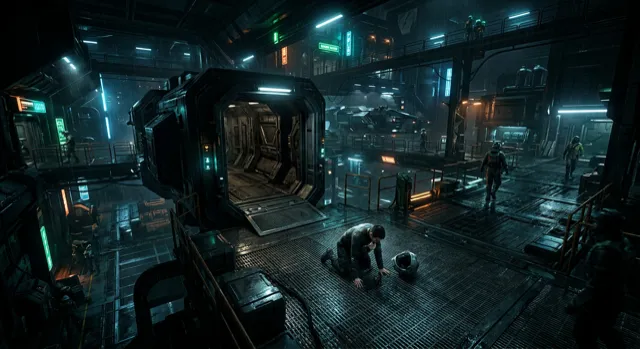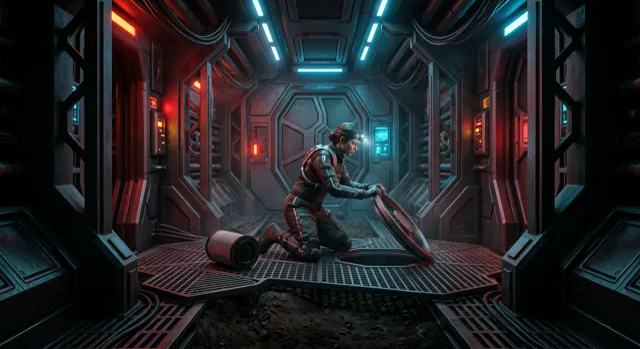
Sera was replacing the filter on the Zone 3 vent when the soil beneath her feet shifted. Not a tremor—a push, from below. Her knees jerked upward. She lost her grip on the filter and grabbed the rim of the vent. The shaking stopped after 4 seconds. The seventh quake. Today alone. Kepler-438b shook, on average, twelve times a day. Two years ago it had been eight. A year ago, ten. This year, twelve. The number kept climbing. Sera picked up the filter, knocked the dust off it, and fit it back into the vent. Its mesh surface was caked with a thick yellow-green sediment. She had replaced it two days ago. On this planet, earthquakes were like the weather. No one was startled by them. If you let them startle you, you'd never make it through a day. When you woke in the morning, instead of a weather forecast you checked the tremor forecast.
Sera worked at the settlement called the Ground. That was what the settlers called it. The name meant land to sink roots into, but this planet had never once accepted a root. It was a half-buried structure raised on the wasteland near Kepler-438b's equator—average temperature 7 degrees below zero, atmospheric oxygen at 9 percent. The surface was thick with dense sulfuric acid fog and fine silicate dust, and toxic gas erupted from the soil at irregular intervals. It was no place for a human to live. And yet people came. They were the ones who had left after Earth's coastlines collapsed and half its farmland turned to desert. When Earth began to push humanity out, humanity went looking for somewhere that wasn't Earth. And so 217 people lived here. What kept the settlement alive was the atmospheric purification system. And what lay at the heart of that system was the Colony.
The Colony. A distributed aggregate of silicon-based microorganisms discovered in the bedrock beneath Kepler-438b. Each individual measured 0.04 millimeters. Billions of them formed networks in the cracks of the rock, trading electrical signals. Alone, an individual carried out only chemical reactions, but past a certain density collective patterns emerged. Fourteen years ago, when the survey team that reached this planet ahead of the settlement first found the Colony, it was breaking down sulfur compounds in the fissures of the bedrock. The team decided to put that decomposing ability to use. Placed within the settlement's ventilation system, the Colony could break down toxic gas and raise the oxygen concentration. The Colony became a tool. For fourteen years it did as humans commanded—ate poison gas and breathed out oxygen. Not once had it refused. That it could refuse was something no one had ever considered.
Sera finished the filter replacement and returned to the Zone 3 control panel. The numbers on it were wrong. The vent's gas-decomposition efficiency had dropped from 72 percent to 41 percent. Wondering if she'd seated the filter badly, she went back to the vent. The filter was fine. She measured the Colony's density. The sensor gave her a number. Colony individuals inside the Zone 3 vent: 28 billion. Yesterday it had been 61 billion. More than half had drained away. Sera checked the sensor twice. The number didn't change.
Sera flung the filter aside and ran for the control room. It sat at the settlement's core, three levels underground—a space cut out of the bedrock, low-ceilinged, moisture seeping from the walls. Twelve monitors were arranged along the wall. When Sera came in, Doyun, the maintenance chief, was glancing back and forth between several of them, and he stood up.
“It's not just Zone 3.”
Doyun pointed at a monitor. A density map of the Colony across the whole settlement was displayed. Not only Zone 3 but Zones 1, 5, and 7 were all seeing the Colony's density plummet. Four danger zones marked in red. Sera stepped closer to the monitor and asked.
“Where did it go?”
Doyun shook his head.
“Out of the ventilation system. The density started dropping 2 hours ago. Right now 38 percent of the entire Colony is outside the system.”
Sera sat down at the monitor and traced the Colony's path. The individuals were moving along the ventilation ducts and then slipping out into the soil through the joints in the piping. The joints were sealed, but a single Colony individual was only 0.04 millimeters across. It could pass through the microscopic pores of the sealant. Small amounts had leaked out before, during repair windows—but 38 percent of the whole was a first.
Doyun came and stood beside Sera.
“When the Colony leaves the ventilation system, the atmosphere's purifying capacity drops. At the current efficiency, within 48 hours the oxygen in Zone 7 falls below the limit for breathing.”
Sera turned to him and asked.
“How many people are in Zone 7?”
Doyun answered.
“34. It's a residential block. There are 6 children.”
Sera analyzed the sensor data inside the ventilation ducts in finer detail. The moments the Colony left lined up with the moments of the earthquakes. Right after today's seventh quake, the exodus had accelerated. Sera remembered what she had felt at the Zone 3 vent. Not a tremor—a push. Not an earthquake so much as the planet spitting something out. The Colony had followed that expelling motion back down into the soil.
That night, Sera switched her hazard suit to night mode and began taking measurements at the Zone 3 vent. After the settlement's lights had gone out, only the wind rising from the vent filled the corridor. The Colony still clinging to the vent's inner walls numbered some 20 billion individuals. When she pressed the sensor probe to the wall, she picked up the Colony's electrical signals. They were not what she was used to. Normally they ran in the repetitive pattern the breakdown work required. Now irregular signals were mixed in. Long and short voltage fluctuations followed one another with no steady interval. Sera sat for 2 hours, recording the pattern. Cold air rose from the vent. Night on Kepler-438b sank to 31 below. Her hazard suit's heating unit was running at full output. Her fingertips froze until it grew hard to grip the probe. She flexed her fingers open and shut, over and over, to keep the feeling in them.
At 3 in the morning, Sera's probe caught something strange. The Colony's electrical signals were concentrating around her probe. When she moved the probe, the focal point moved with it. When she drew the probe out of the vent, something unexpected happened. Deep inside the vent, individuals of the Colony began moving toward the opening. When Sera was near, the Colony gathered; when she drew away, it scattered. Sera saved the record, went back to the control room, and reported to Doyun.
"The Colony is responding to my probe."
Doyun looked at the screen.
"To the probe?"
Sera shook her head.
"Not the probe—me. Even with the probe pulled out, they gather toward the mouth of the vent. Toward wherever I'm standing."
Doyun pulled the data up on the screen and studied it. He zoomed the graph in and out, again and again, then asked.
"Just you?"
Sera nodded.
"When another maintenance tech was in Zone 3, there was no change in density. This reaction only comes when I approach."
Doyun leaned back in his chair.
"In 14 years the Colony has never told people apart. It reacted the same to all of us."
Sera said,
"I think it's different now."
The next day, Sera ran an experiment. She made a circuit of the settlement's ventilation zones, measuring the Colony's response in each one. The result was identical in every zone. When Sera drew close, the Colony's density rose and its electrical signals fired more often. When she left, the density fell again. In Zone 7, after she stood there for 30 minutes, the oxygen level—which had been sinking below the breathable limit—climbed back to normal. It was because the Colony had been breaking down gases vigorously around her.
In the morning, in the control room, Sera showed Doyun the data she'd gathered through the night. Doyun's face was hard to read.
"This makes no sense. The Colony isn't a single organism. It's a distributed system. It isn't built to recognize one specific human."
Sera put the data up on the screen and said,
"It's not about the structure—it's the behavior. I don't know why, but the result is unmistakable."
Doyun looked at the screen and said nothing for a long while, then asked,
"Could we use this?"
Sera looked at Doyun.
"Use it?"
Doyun answered,
"When you make the rounds of the zones, the Colony follows you. That way we could keep the air purification running. Even as a stopgap."
Sera thought it over. The settlement had 9 zones. Thirty minutes standing in each came to 4 hours and 30 minutes. Two rounds a day, 9 hours. The rest of the time, the Colony slipped back down into the soil. While Sera rested, the oxygen level dropped; when she came back, it rose. Sera's very presence would become the core component of the air purification system. A living component.
Sera began her rounds the next morning. The first day was bearable. It was only walking, after all. Before dawn on the second day, when she lay down on her bunk, the ceiling spun and spun. Her sleep shrank to 5 hours. Her knees and ankles stiffened until her joints cracked each time she rose. On the third day, both legs swelled. Press a calf inside the suit and the fingerprint stayed. Sera stopped at the sight of her own face in the bathroom mirror. The skin beneath her eyes had gone dark and sunken. It took her 3 seconds to answer a colleague calling her name. On the fourth night, standing at the Zone 5 vent, her knees buckled and she fell asleep against the wall. She never noticed the cold of the floor. When she woke hours later, the probe's sensor showed strange numbers. While Sera slept, the Colony had not withdrawn from Zone 5—it had stayed. More precisely, within a 2-meter radius of where she'd slept, the Colony had gathered at its highest density. The reach of her body heat. The vent's inner wall measured 0.7 degrees warmer on her side. The Colony's electrical signals were pulsing at intervals close to her heartbeat. 1.1 times per second. The same as her resting heart rate in sleep.
Sera lifted her back from the wall and rewound the probe's log. The Colony had synchronized to her heartbeat starting 14 minutes after she fell asleep. From the moment synchronization began, the Colony's gas-breakdown efficiency had risen to 93 percent—higher than when it was deployed in the ventilation system. It meant that the surface of Sera's skin was a better working environment than the system's lattice. The Colony was working better beside her.
When Sera brought the data to the control room the next afternoon, Doyun's reaction was different. "The frequency of the quakes is climbing," he said. "Fourteen today. Twelve yesterday. The hydrogen sulfide venting from the Ground is rising too. A new vent opened 3 kilometers west of the settlement. 4 meters across. Widening by the hour." Sera asked, "Is it connected to the Colony pulling out?" Doyun nodded. "The Colony originally lived in the bedrock underground. Fourteen years ago we pulled it out and put it into the ventilation system. Now that this planet is going unstable, the Colony is trying to go back where it came from. Sealing the cracks in the rock is more urgent to it than our system." Sera asked, "And if the Colony leaves the ventilation system completely?" Doyun answered, "Air purification stops. Within 3 weeks the oxygen across the whole settlement drops below the limit you can breathe."
That night Sera thought as she made her rounds. She was standing in front of the Sector 7 vent. Inside, the Colony was gathering toward her. As its bodies packed against the wall, a faint heat came off it. Sera peeled off her glove, slowly, and laid her hand to the wall. It was warm. A little below body temperature. The fine heat that billions of bodies make. Under her palm, the Colony's electrical signal rippled quietly.
Sera closed the heat left in her palm inside a fist. If she opened her hand, the warmth would slip out. It was true that the Colony gathered toward her. But when she left, the Colony left too. It lingered by her longer than by the ventilation system—yet when the floor shook, it went back into the soil in the end. The thing she could not hold was holding her.
A week later, the settlement held a meeting. Doyun rose and reported the situation. "The Colony's departure rate has reached 64 percent. Air purification now depends on Sera's rounds. If Sera stops, Sectors 3 and 7 enter breathing-hazard levels within 24 hours." Eunsu, the settlement administrator, drummed the table and asked, "How long can one Sera keep walking the rounds?" Doyun looked at Sera. Sera didn't answer. Her sight was blurring. Seven days of 9-hour rounds. Sleep loss had begun to blur her vision. Eunsu asked again, "And the alternative?" Doyun answered, "We shrink the settlement. Close 4 of the 9 sectors and concentrate everyone in the remaining 5, and we can cut Sera's rounds down." Eunsu said, "That means giving up the equipment and research facilities in 4 sectors." Doyun nodded. "That, or give up the whole settlement."
After the meeting, Sera stayed behind in the empty control room. A density map of the Colony glowed on the monitor. The red zones were spreading. She switched the monitor off and walked alone to the Sector 3 vent. There was no one in the corridor. Everyone was in their own sector, digesting what the meeting had decided. She set a probe against the Colony still left inside the vent. A signal came through. Not its usual irregular pattern. A slow, long waveform, repeating. Even when she moved the probe, the same pattern came through. Every part of the Colony inside the vent was sending the same signal. She saved the pattern to the recorder. It was a waveform found nowhere in 14 years of the Colony's signal database.
Sera didn't go to the control room; she analyzed the recorded pattern right there in the field. A slow pulse on a 0.8-second cycle. Inside it, 3 short high-frequency spikes. Repeating. She compared the pattern against the Colony's existing signal database. Nothing matched. It was a new signal. When she drew the probe out of the vent, the Colony began moving toward the exit. When she put the probe back, the movement stopped. When she put her hand into the vent, the Colony's density shot up around her hand. The amplitude of the signal grew. The 0.8-second cycle held, but the high-frequency spikes rose from 3 to 5.
Sera held still with her hand inside. The heat the Colony made passed straight into the skin of her ungloved palm. It was warm. And within that warmth she felt a fine vibration. The Colony's bodies were moving along the surface of her skin. It didn't tickle. There was no pressure. Only the fact of their being there, carried into her palm nerve by nerve. Billions of tiny beings were alive and moving on her palm.
Doyun came down from the control room. "What are you doing?" Without pulling her hand out, Sera answered, "The Colony is sending a new signal." Doyun looked at the probe's screen. "What is it?" Sera said, "I don't know. It's a pattern that isn't in the database. When I put my hand in, the signal gets stronger." Doyun looked at her. "Take your hand out." Sera looked up at him. "Why?" Doyun answered, "The Colony is a tool. It's been a tool for 14 years. It isn't holding your hand right now. It's running a chemical reaction."
Sera drew her hand out, slowly. Inside the vent the Colony's density dropped sharply. In 60 seconds, half of it had pulled away. When she put her hand back, the drop stopped at once and the density began to climb again. When she took her hand out, it left; when she put it in, it returned. She repeated it, slowly, three times—hand out, hand in. All three times, the same result. The Colony wanted to stay where Sera's hand was.
That night, Sera gave up on trying to sleep in her quarters and went to the Sector 5 vent. She slid her hand inside and sat with her back against the wall. The Colony gathered. The signal pulsed on a 0.8-second cycle. Sera closed her eyes. The faint warmth of billions of individuals rose up to her wrist. As her eyelids sank, her heartbeat slowed. The Colony's pulse slowed along with her.
At dawn Doyun came looking for her. He found Sera asleep in front of the Sector 5 vent.
"Sera."
Her eyes opened. Her hand was still inside the vent. Doyun said,
"The vent west of the settlement has widened. Hydrogen sulfide concentration is 8 times the threshold. If the wind shifts, it reaches the settlement within 4 hours."
Sera stood. She pulled her hand from the vent. The Colony began to slip away again. The leftover warmth in her hand went cold.
"The Colony is needed," Sera said. "Not by the ventilation system—by the planet itself. It's going back to the soil to seal the vent. All the while we've kept the Colony caged in the ventilation system, the planet's fissures have kept widening."
Doyun looked at her.
"Then what do we do?"
Sera answered.
"We have to let it go."
Doyun's face hardened.
"If we release the Colony, the atmospheric purification stops."
Sera couldn't answer. Her palm was still warm. It was the heat the Colony had left. If Sera opened the ventilation system, the Colony would leave. Then the 6 children in Sector 7 would be trapped in a room with no oxygen. If Sera kept the ventilation system sealed, the Colony would stay caged. Then the planet's fissures would spread, the vents would grow, and in the end the whole settlement would collapse. Either way, the 217 of them could not stay here.
"I know," Sera said. Her voice cracked. "Even so."
Doyun studied her face.
"Are you crying?"
Sera rubbed under her eyes with the back of her hand. It was wet. She didn't know since when.
"If the Colony goes back underground and seals the fissures, the eruptions might ease."
Doyun asked,
"How long is 'long-term'?"
Sera opened her mouth, then closed it. It could be decades, it could be centuries. It was a span of time that wouldn't fall within her lifetime.
Sera took a wrench from the tool chest and opened the ventilation-duct joints in every sector. She stripped away the seals one by one, carving out passages through which the Colony could move freely into the soil. When she opened the last joint in Sector 9, the Colony began pouring out of the entire ventilation system. The density map on the monitor shifted from green to yellow, and a few minutes later the yellow bled into red. Alarms rang in the control room. The oxygen warning for Sector 7 came up first. Then Sector 3, then Sector 1, the alarm tones overlapping in turn.
Two hours later, the Colony density across the whole settlement had fallen to 11 percent. Atmospheric purification efficiency was one-sixth of normal. In the control room, Doyun opened the valve on the emergency oxygen supply system. The reserves could hold out for 2 weeks. Exactly 14 days' worth. On the 15th day, the oxygen would run dry. Within those 2 weeks they had to send a distress call to the relay ship waiting in low orbit around Kepler-438b and evacuate all 217 people. Six hours for the radio signal to reach the relay ship, 8 days for a rescue ship to land. Tight, but possible.
Sera turned her back on the commotion of the control room, where the emergency procedures were underway, and went to the Sector 3 vent. Inside, it was nearly empty. Only tens of millions of the Colony's stragglers remained. Sera put her hand into the vent. The remnant Colony gathered. She felt warmth. Faint, but there. This time Sera did not close her eyes. This time she wanted to watch. No probe, no sensors—only skin. The Colony climbed onto her fingers. Across the back of her hand, toward her wrist. And then it changed direction. Out of the vent. Through the joint, into the soil. It was leaving. As it passed over her hand, the Colony's electrical signal changed. She could tell even without a probe screen. The grain of the vibration ringing beneath her skin was different. It was unlike the earlier pulse. A steady pressure, neither slow nor fast. Not Sera's heartbeat, not her pulse—the Colony's own rhythm. What had been a human tool for 14 years was, for the first time, sending a signal of its own. And then the warmth was gone. Sera did not pull her hand back. The air inside the vent slid between her fingers. For a long while she stood before the empty vent. From the control room, an alarm tone announced that the distress call had been sent. Beneath Sera's feet, the soil shuddered once. A short, low tremor. There was no sense of being pushed away.