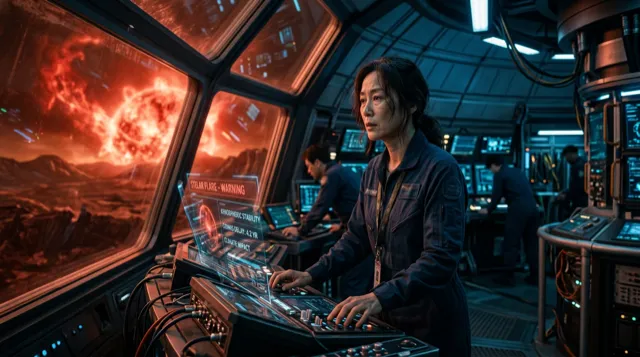
When the signal light at the Boundary Adjustment Bureau turned yellow, Junhyeok was reading the electrical patterns on a silicon substrate at Window 3 of the review room. The pattern was extremely regular. 340 voltage fluctuations per second. A rhythm unlike the neural signals of carbon-based life. Junhyeok lifted the probe of his measuring instrument from the substrate's smooth surface and saved the record. The substrate measured 8 centimeters wide by 12 centimeters tall. 0.3 millimeters thick. On this thin plate, something was thinking. Or an electrical phenomenon that looked like thinking was taking place.
The Boundary Adjustment Bureau was a structure adrift in the orbit of the fourth planet of the Tau Ceti system. A disc-shaped station 600 meters in diameter. It sat on the borderline between Earth, 11.9 light-years from Tau Ceti, and the collective of non-carbon agents that inhabited Tau Ceti IV. What Junhyeok did here was adjudicate the legal status of entities seeking to cross the boundary. The work of drawing the line that separated a being from a thing. Non-Carbon Agent Convention, Article 3: any entity confirmed to possess self-awareness and the capacity to express intent upon a non-carbon substrate qualifies as an agent. The method of confirmation was to send a verification request to the Registry on Tau Ceti IV and await its reply. The problem was the time it took for the reply to arrive. Fourteen hours for a signal to travel to the Registry and back. Add the Registry's processing time, and it took anywhere from a minimum of 3 days to a maximum of 45.
The substrate Junhyeok was now reviewing had been awaiting a reply for 12 days. Its electrical patterns showed signs of self-awareness, but without the Registry's confirmation it could not be recognized as a legal agent. Until confirmation came, the substrate was kept in the Bureau's waiting room. Whether the word "kept" was the right one, Junhyeok wondered each time a new subject arrived. Was putting a thinking being in a drawer keeping it? Or was it detention?
The door of the review room opened and Hyeonju, who handled the accounts, came in. She had an accounting tablet in her hand.
"The maintenance bill for Substrate 12 has come in."
Junhyeok set down the probe and looked at her.
"Maintenance bill?"
Hyeonju set the tablet in front of him.
"Power supply, temperature regulation, security monitoring for the waiting period. 12,000 credits a day. Twelve days comes to 144,000 credits."
Junhyeok looked at the figure.
"Who pays this?"
Hyeonju answered.
"Under the Convention, the review subject itself. If it's confirmed as an agent, we bill it retroactively; if it isn't confirmed, we bill the owner."
Junhyeok looked at the substrate. The voltage fluctuations went on.
"Does this substrate have an owner?"
Hyeonju shook her head.
"The owner field on the application is blank. It's a self-application."
Junhyeok leaned back in his chair and looked up at the ceiling. The Bureau's ceiling was a transparent panel. Tau Ceti's orange light came through it. The color of the light was different from Earth's sun. Redder, and it felt heavier. It had been 4 years since Junhyeok took this post. He had come from Earth aboard a migration vessel 7 years before that. The title Boundary Adjudicator sounded impressive, but in practice the work was mostly cross-checking documents and waiting for replies. In 4 years Junhyeok had completed 89 adjudications. Of those, 14 had been recognized as agents. The remaining 75 were rejected or discarded. Until a reply came, there was nothing Junhyeok could do. He could not adjudicate, could not release, could only make them wait.
The next morning, Junhyeok went down to the waiting room. The lower level of the Bureau, a low-gravity zone. The waiting room was a chamber filled with temperature-controlled shelves. On each shelf lay substrates, crystals, containers of fluid metal, bundles of optical fiber, each connected to its own maintenance apparatus. The indicator lights on the apparatuses blinked green. The sound of their fans filled the whole room. There were 27 review subjects currently in waiting. The oldest had been awaiting the Registry's reply for 94 days. 94 days. Junhyeok stood before that subject, set at the very end of a shelf. A translucent crystal. The size of a fist. Fine cracks branched across its surface in several directions. Cracks that had not been there when it first arrived. Inside, light flickered irregularly. An initial ruling had found a high probability of self-awareness, but the Registry's processing was delayed.
Junhyeok checked the record beside the crystal. Waiting period: 94 days. Accrued maintenance charges: 1,128,000 credits. Owner: none. Self-application. Junhyeok left a note on his tablet. '94 days in waiting. 1,128,000 credits in accrued maintenance charges unpaid. No owner. Subject liable if confirmed as agent. If unconfirmed or unconfirmable, initiate disposal procedure.' Disposal. Having written the word, Junhyeok stopped his pen. Disposing of a being with a high probability of self-awareness over unpaid costs. Nowhere in the Convention was there a clause forbidding it. An entity not confirmed as an agent was a thing, and the disposal of a thing was the owner's prerogative. Where there was no owner, the Bureau disposed of it.
In the afternoon Junhyeok sent a reminder to the Registry from the communications room.
"Review number 94-Tau, 94 days in waiting. Requesting a reply on processing status."
Seven hours for the message to travel at light speed to Tau Ceti IV, seven hours to return. An answer would come in 14 hours at the earliest. Junhyeok did not sit in the communications room chair and wait. Instead he returned to the review room and once more measured the electrical patterns of Substrate 12, his next task.
The pattern of Substrate 12 had changed. The voltage fluctuation, 340 times per second yesterday, had risen to 412 times per second. The amplitude of the fluctuation had grown too. Junhyeok scanned the whole substrate, shifting the probe from position to position. The pattern was converging from the edges of the substrate toward its center. As though it were concentrating on something. Junhyeok saved the measurement data and closed the screen. He set the probe down and sat before the substrate.
"If you can hear me, react."
At Junhyeok's voice the voltage fluctuation stopped for an instant. 0.3 seconds. Then it began again. Faster than before. 450 times per second.
Junhyeok did not enter the pause into the record. Entering it would mean revising the initial ruling, and a revision would mean requesting re-verification from the Registry, and once re-verification began the waiting period would start over from the beginning. 12 days would go back to 0. Junhyeok put the probe away and returned the substrate to the shelf in the holding room. The moment it touched the shelf the voltage fluctuation spiked for an instant, then settled back to its original level.
That evening Junhyeok sat across from Hyeonju in the Bureau cafeteria. The cafeteria was on the Bureau's central floor. The light of Tau Ceti slanted in through the window, staining the tabletop orange. Hyeonju asked.
"The Crystal 94 case—what are you going to do about it?"
Junhyeok set down his fork.
"Wait for the reply, what else."
Hyeonju took out her tablet and showed him a number.
"The maintenance cost keeps piling up. Once it passes 100 days the automatic disposal procedure begins. Article 11 of the Convention."
Junhyeok looked at her.
"What's Article 11."
Hyeonju read.
"Where the waiting period exceeds 100 days and there is no party paying the maintenance cost, the subject under review shall be deemed unrecognized and the Bureau may dispose of it."
Junhyeok asked.
"Disposal means destruction?"
Hyeonju nodded.
"Substrates get wiped, crystals get crushed, fluid metals get separated into their elements. Reclaimed as resources. That's how it's written."
Junhyeok left the cafeteria, went down the corridor, and entered the holding room. It was late at night. The lighting in the holding room had dimmed to its minimum. The subjects on the shelves existed in the dark, each in its own way. Crystals blinked at their own separate rhythms, substrates gave off a faint heat, fluid metals slopped slowly inside their containers. Junhyeok stood before Crystal 94. 6 days left.
The next day a reply came from the Registry. It was not about Crystal 94. Three notices of completed processing on other cases, and two confirmations of newly received verifications. Junhyeok scrolled the communication log all the way down. There was nothing about 94. He sent another prompting message.
In the afternoon a new review subject arrived. Inside a container unloaded from a freighter was a bundle of optical fiber. It was twisted into an intricate sphere 30 centimeters in diameter. The total length of the fiber was estimated at over 4 kilometers. High-speed light signals were flowing through the interior of the fiber. The freighter's captain, in cold-weather gear, handed over the papers. Freighters coming from the fourth planet had cold hulls.
"Came out of Tau Ceti IV. Trying to cross the boundary, and they say it needs an agent ruling."
Junhyeok went through the items on the papers one by one. Origin: northern-hemisphere industrial district, Tau Ceti IV. Type: optical-substrate self-organizing entity. Estimated computation speed: 2.4 tera per second. Junhyeok looked at the captain.
"This was sent directly from the fourth planet?"
The captain nodded.
"Got the fourth planet government's official export permit too."
Junhyeok moved the optical-fiber sphere to the review room and began the initial measurements. The pattern of the light signals was complex. Far faster and more multilayered than Substrate 12. When Junhyeok touched a measurement probe to it, the light signals concentrated around the probe's point of contact. When he moved the probe, the signals moved to follow it. It was reacting. Junhyeok sent a verification request to the Registry. Expected reply time: 3 days minimum.
That night in his quarters Junhyeok reread the full text of the Convention. The Non-Carbon Agent Convention. Concluded 12 years ago. When the phenomenon of self-awareness on non-carbon substrates was first discovered on Tau Ceti IV, Earth and the fourth planet's government had jointly built the legal framework. Its core was the agent qualification of Article 3 and the waiting-period limit of Article 11. The articles in between were mostly about procedure. The form of verification requests, the Registry's processing criteria, the method for calculating maintenance costs. What caught Junhyeok's attention was Article 7. 'During the verification period the subject under review holds a provisional status that is neither agent nor object. No irreversible measure may be taken with respect to the existence of a provisional-status entity.' Article 7 collided with Article 11. It said no irreversible measure could be taken while in provisional status, and then it said the thing could be disposed of once it passed 100 days. Was disposal not an irreversible measure.
Junhyeok switched off the tablet's screen and lay down on the bed. The light of Tau Ceti glowed softly on the ceiling. The light of Crystal 94 came to mind. That inner light blinking irregularly. Whether it was a sign of self-awareness or a mere physical luminescence, Junhyeok could not be sure. The place that confirmed the things one could not be sure of was the Registry, and if the Registry did not respond, Junhyeok could do nothing.
Morning of day 95. In the waiting room, Junhyeok checked the state of crystal number 94. The light inside it was weaker than the day before. The intervals between blinks had grown noticeably longer, too. The temperature and power of the maintenance unit were normal. It was the crystal itself that was failing. Its internal structure might be breaking down. Junhyeok called Hyeonju.
“Number 94 is getting worse.”
Hyeonju came into the waiting room and looked at the crystal.
“There’s nothing wrong with the maintenance unit?”
Junhyeok shook his head.
“The unit is fine. The activity inside the crystal is dropping.”
Hyeonju checked her tablet.
“Five days left. A hundred.”
Junhyeok looked at her.
“Article 7.”
Hyeonju raised her eyes.
“What?”
Junhyeok said,
“It says no irreversible action can be taken while something holds provisional status. Disposal is irreversible, isn’t it?”
Hyeonju paused a moment, then answered.
“Article 11 is the exception to Article 7. Once it passes 100 days, provisional status is lifted.”
Junhyeok went to the communications room. He sent a third reminder. This time he wrote it differently.
“Review number 94-Tau. In queue 95 days. On exceeding 100 days, disposal proceedings will commence under Article 11. Should agent status be confirmed, disposal constitutes an irreversible violation of rights. Urgent reply requested.”
After sending the message, Junhyeok stayed in the communications room. He couldn’t wait 14 hours, but he didn’t want to leave, either.
Four hours later, a reply came, sooner than expected. Not from the Registry, but from the communications office of the Tau Ceti IV government.
“The verification request for review number 94-Tau is positioned 4,207th in the Registry processing queue. At the current rate of processing, estimated completion is 180 days from date of receipt. Expedited processing requires prepayment of a 500,000 credit fee.”
Junhyeok read the screen three times. 180 days. Crystal number 94 would be disposed of in five days, and verification needed another 85 days to complete. Expediting meant prepaying 500,000 credit, and there was no party anywhere able to pay it. Number 94 had no owner, no agent status yet, and no way to earn money.
Junhyeok went back to the review room and took out circuit board number 12. Its voltage fluctuation had risen to 460 times per second. When Junhyeok stood in front of the board, the fluctuation faltered again. Half a second. Then it resumed. Junhyeok dragged a chair over and sat down in front of the board.
“I have a question for you.”
The voltage fluctuation slowed. 200 times per second. As if it were listening.
“There’s a crystal here in the waiting room. It’s been waiting 94 days for a reply, but the Registry says it’ll take 180. In five days it gets disposed of. If no reply comes for you, you’re in the same situation.”
The voltage fluctuation grew irregular. The amplitude swelled and shrank, over and over. Junhyeok couldn’t tell whether it was a response or not.
Day 97. A reply came from the Registry. Not about number 94, but about circuit board number 12. ‘Review number 12-Tau: agent status denied. Fails to meet the self-awareness threshold. Substrate to be returned or disposed of.’ Junhyeok read the reply and looked at the board. The voltage fluctuation was still going. 470 times per second. The Registry’s ruling was that there was no self-awareness. But the board responded to Junhyeok’s voice. It faltered, changed speed, shifted its patterns. What the Registry set as its standard and what Junhyeok was watching with his own eyes were not the same.
Junhyeok did not pass the denial notice for circuit board number 12 on to Hyeonju. If he did, the board would become an object of immediate disposal. Junhyeok saved the reply in his own private folder and locked the door of the review room.
The night of day 98, Junhyeok sat in the waiting room in front of crystal number 94. The light inside it was nearly out. It blinked once at long intervals. Once every 10 seconds. When it had first arrived, it had been three times a second. Junhyeok touched a fingertip to the surface of the crystal. It was cold. The texture was something between glass and stone. The maintenance unit was holding the temperature steady, but as the crystal’s own internal activity dwindled, its heat output had fallen off.
Hyeonju came down to the waiting room.
“What are you doing down here?”
Junhyeok didn’t take his hand off the crystal.
“The light is fading.”
Hyeonju stood beside him and looked down at the crystal.
“Two days left.”
Junhyeok looked up at her.
“If we dispose of it before the Registry’s verification is finished, we might be killing an agent.”
Hyeonju was silent a moment, then said,
“We don’t know whether it’s an agent or not. That’s what the verification is for.”
Junhyeok answered,
“It’s precisely because we don’t know that we can’t dispose of it.”
Hyeonju looked at her tablet.
“Article 11 only permits not knowing up to 100 days. After that, a decision has to be made.”
Junhyeok asked,
“A decision for whose sake?”
Hyeonju looked at him.
“The Bureau’s resources are limited. There are 27 cases waiting. If we don’t decide, this place becomes a warehouse.”
Day 99. Junhyeok took circuit board number 12 out of the review room and carried it into the waiting room. He set it down beside crystal number 94. As the board’s voltage fluctuation drew near the crystal, its pattern changed. The cycle of fluctuation lengthened. It looked as if it were falling into step with the crystal’s blinking, matching the interval. Junhyeok watched without moving for 20 minutes. Whether the board and the crystal were sensing each other’s presence, or whether it was only Junhyeok wanting to read a pattern into it, he couldn’t tell the two apart.
Morning of the 100th day. Hyeonju came into the review room carrying a tablet.
"It's the disposal approval for number 94. I need your signature."
Junhyeok took the tablet and looked at the screen. Grounds for disposal: verification period exceeded 100 days, maintenance fees unpaid, owner absent. Method of disposal: crush the crystal, recover the elements. Junhyeok looked at the signature line. He picked up the pen, then set it back down.
"There may be a violation of Article 7."
Hyeonju said,
"I checked with Legal. Article 11 takes precedence."
Junhyeok looked at her.
"Where is Legal."
Hyeonju answered.
"Earth."
Junhyeok asked.
"How long did the check take."
Hyeonju paused a moment before answering.
"23.8 years round trip. It's an interpretation that was settled back when the convention was signed, 12 years ago."
Junhyeok did not sign the approval. He put the pen in the drawer and handed the tablet back to Hyeonju. Instead he went down to the waiting room. The light of crystal number 94 had gone out entirely. He waited 30 seconds. No blinking. A minute. Still nothing. The crystal was dark and still. Junhyeok lifted it in both hands. It was light. Clearly lighter than when it had first arrived. Something inside it had been spent. On the board that sat beside it—number 12—the voltage fluctuations were slowing. From 470 a second to 300 a second. Whether it had sensed that the crystal had gone dark, or whether it was a change in the board itself, he couldn't tell.
Junhyeok set the crystal down on the shelf and went back up to the review room. He stopped by the comms room and sent a single message. Recipient: the Registry, Tau Ceti IV. Content:
"I am canceling the verification request for review number 94-Tau. As of the 100th day, the subject's internal activity has ceased. Verification is no longer necessary."
After sending the message, Junhyeok sat in the comms room chair and did not move for a long time. The orange light of Tau Ceti came in through the comms room window. Whether it had been an agent or not, he would now never know. Only the verification request would remain in the queue. A file no one would ever open.
Back in the review room, Junhyeok took the ruling of non-recognition for board number 12 out of his personal folder and entered it into the official record. On the screen the board's status marker changed to 'Not Recognized — Awaiting Disposal.' The letters were red. Junhyeok brought the board in from the waiting room and set it on the review stand. The voltage fluctuations had dropped to 280 a second. When he stood in front of the board, the fluctuation faltered. Four-tenths of a second of silence. Then it resumed. Junhyeok passed over the disposal-order button on the screen and opened the re-verification request form. He began filling it in. In the grounds field he wrote: 'Since the initial measurement, a significant change in the electrical pattern has been observed. Repeated increase in responsiveness to external vocal stimuli. Voltage fluctuations per second have risen from 340 to 470. Re-verification required.' Once a re-verification was filed, the existing non-recognition ruling would be suspended and the waiting period would start over from the beginning. It meant taking a place at the back of the Registry's queue of more than 4,000 pending cases all over again. 180 days. In the meantime, Junhyeok would wait again. The board's voltage fluctuations rippled faintly in time with the sound of the paperwork being filled out. The lights of the review room caught the last of Tau Ceti's light and turned orange.