When Im Chae-won, 48, a climate-contract auditor on the orbital settlement Halla around Proxima Centauri b, opened the logs of atmospheric processing unit 3, a single number snagged her eye. Between the measured temperature of the settlement's outer wall and the baseline the Earth Standards Bureau had transmitted 4.2 years earlier, there was a discrepancy of 0.04 degrees. 0.04 degrees. In daily life, a meaningless difference. But in a deep-space climate contract, 0.04 degrees was the number that decided the validity of 3 heating subsidies.
The Halla settlement sat on the tidally locked terminator of Proxima Centauri b. The face turned toward the star was in permanent day, the far side in permanent night. Halla had been built on the boundary between them, the twilight belt. Surface temperature on the day side, 42 degrees Celsius; on the night side, 67 below. Inside Halla's dome, the atmospheric processing units held it at 18 degrees Celsius. The cost of holding that 18 degrees came to 61 percent of the settlement's energy budget, and 40 percent of that cost was covered by heating subsidies from the Earth Coalition Government.
The heating-subsidy contract was calculated against the climate baselines of the Earth Standards Bureau. Those baselines were founded on an atmospheric model of Proxima Centauri b measured back on Earth. The trouble was that the baseline arrived only after a 4.2-light-year communication lag. The baseline Chae-won had just received was one Earth had sent 4.2 years ago. Between Earth's model of 4.2 years ago and Halla's present measured value, a difference of 0.04 degrees had opened up.
There were two possible causes for the 0.04 degrees. First: that Earth's model, current as of 4.2 years ago, failed to reflect the changes in Proxima b's stellar activity since. Proxima Centauri was a flare star, its activity shifting irregularly. Second: that Halla's measuring equipment had aged and introduced an error. The temperature sensor on atmospheric processing unit 3 was in its 12th year since installation.
Either way, the outcome was the same. If the deviation between baseline and measured value exceeded 0.03 degrees, the contract clause automatically suspended the heating subsidy. 0.04 degrees crossed that threshold. Chae-won reported it to the settlement administrator, Kang Min-ho, 54. Chae-won said, The 3 heating subsidies for the unit 3 zone meet the conditions for suspension. Min-ho looked at her. 3 subsidies, that's 6,000 people. Chae-won nodded. Yes. The winter heating of 6,000 people is at risk. Min-ho asked, When is winter? Chae-won answered, In 23 days, by Halla's orbital cycle.
Winter on Halla was not like winter on Earth. Because of Proxima b's orbital eccentricity, its distance from the star varied periodically, and at the farthest point the outer-wall temperature dropped a further 8 degrees. To hold the dome's interior at 18 degrees, energy consumption rose by 23 percent. Without the subsidy the whole dome could not be kept at 18 degrees, and the unit 3 zone could fall as low as 12 degrees. 12 degrees. A temperature fatal to the elderly, the frail, and infants.
Chae-won decided to file an appeal with the Earth Standards Bureau. But it would take 4.2 years for the appeal to reach Earth, and 4.2 years for the answer to come back. 8.4 years round trip. Winter was coming in 23 days; she could not wait 8.4 years. Chae-won said to Min-ho, Even if I send the appeal to Earth, by the time the answer arrives my daughter will be a grown woman. Min-ho watched her, unable to smile. So what do we do? Chae-won answered, We have to solve it ourselves. I'll invoke the Halla Autonomy Charter.
Halla Autonomy Charter, Article 17: where the communication delay with the Earth Standards Bureau exceeds one year, the settlement auditor holds the authority to set a provisional baseline. Provided that the provisional baseline falls within 0.05 degrees, above or below, of the Earth baseline. Chae-won's plan was this. If she could prove that Halla's measured value was accurate, and demonstrate that the Earth baseline was an outdated model from 4.2 years ago, she could reset the provisional baseline to the current measured value. Then the deviation would become 0 and the subsidies would be restored.
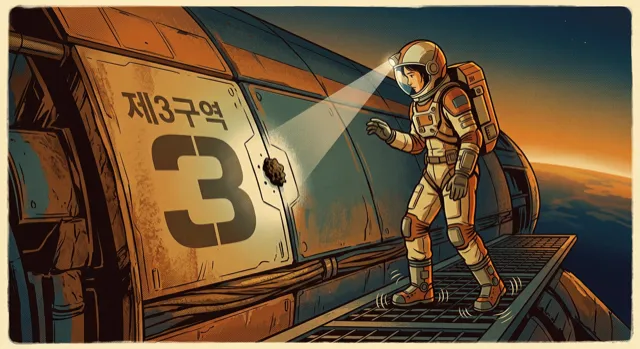
To prove it, Chae-won decided to calibrate the sensor of atmospheric processing unit 3 herself. Calibrating the sensor required access to the outer wall. Outside the dome, on the surface of the twilight belt. An environment swinging between 12 below and 31 above zero Celsius. She would have to go out in a spacesuit. Chae-won was a climate-contract auditor, not a field technician. But the 2 technicians for the unit 3 zone were in medical quarantine with injuries from flare season. She was the only one who could do it.
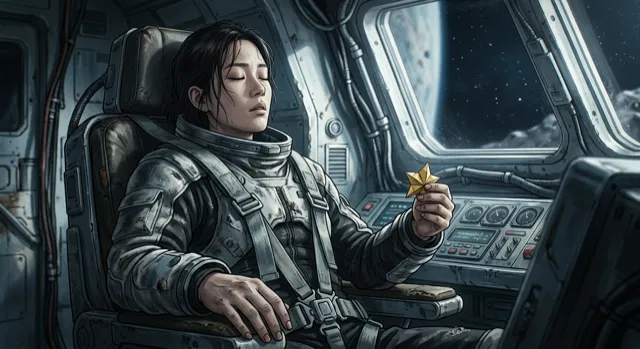
The night before the outer-wall work, Chae-won stood before the mirror in her quarters' bathroom. A 48-year-old face looked back. The lines at the eyes, the dry skin of the cheeks, the fine spots left by Proxima's ultraviolet light. Chae-won looked into her own eyes in the mirror and spoke her name. Im Chae-won. Im Chae-won. Im Chae-won. By the third time her voice had firmed. Then she counted the fingers of both hands. 1, 2, 3, 4, 5, 6, 7, 8, 9, 10. She took her pulse. 18 beats in 15 seconds. Normal. Tomorrow she went outside the dome. To set right 0.04 degrees. To protect the winter of 6,000 people.
The day of the outer-wall work. Chae-won passed through the airlock and stepped outside the dome. The light of Proxima Centauri hung above the horizon. The red dwarf's light was on the boundary between orange and crimson, light near a wavelength of 620 nanometers. That light stained the rock and dust of the twilight belt red, and reflecting off the dome's metal outer wall, it seeped into the helmet of Chae-won's spacesuit. A landscape like an Earth sunset held still for 24 hours. But this sunset did not end. Proxima's light was an eternal twilight, and within that twilight the Halla settlement shone. Chae-won stood still before the sight for 3 seconds. The fact that she had crossed 4.2 light-years to stand beneath this light called up, for an instant, a sense of awe.
The sensor panel sat three stories up the dome's outer wall. Chae-won climbed her own ladder. With her spacesuit gloves she opened the panel and drew out the sensor module. It was a sensor that had been exposed to Proxima's ultraviolet and particle radiation for 12 years. Its surface was faintly discolored. Chae-won connected the portable calibrator and sent a reference signal. A number appeared on the calibrator's screen. Sensor deviation: +0.02 degrees. The sensor was reading 0.02 degrees higher than the true value.
The 0.02 degrees was sensor error. The other 0.02 degrees was error in Earth's model. Together, 0.04 degrees. Chae-won swapped in a new sensor module and logged the calibration data. After the replacement the measured value dropped by 0.02 degrees, and the deviation from Earth's reference value shrank to 0.02 degrees. 0.02 degrees was inside the threshold of 0.03 degrees. It did not meet the conditions for a subsidy suspension.
But Chae-won did not stop there. The other 0.02 degrees — the error in Earth's model — had to be recorded too. That error came from changes in Proxima Centauri's stellar activity. Between the time Earth built the model 4.2 years ago and now, its flare activity had shifted, and the stellar radiation had changed by the smallest degree. Chae-won collected Halla's astronomical observation data and wrote a report comparing it against Earth's model. That report would be the grounds for a temporary reset of the reference value.
She submitted the report to the Halla Autonomy Committee. Five members reviewed it. The chair, Park Seon-yeong, 51, asked. So the 0.02-degree sensor error was solved by replacement, and the 0.02-degree error in Earth's model is due to changes in stellar activity? Chae-won answered. Yes. Because Earth's model rests on data from 4.2 years ago, it can't reflect current stellar activity. Halla's measured data is more accurate. Seon-yeong looked at her. If we approve resetting the temporary reference value, does the subsidy come back? Chae-won nodded and said. Yes. Heating stays on for 6,000 people.
The energy-engineer member, Jo Hyeon-tae, 43, asked. The chance Earth overturns this? Chae-won answered. Any objection reaches us 8.4 years from now. Until then the temporary reference value holds. Hyeon-tae looked at her. 8.4 years — that's past the next contract cycle. Chae-won said. Exactly. Which is why this decision becomes a precedent. A precedent that under a light-year delay, we can't follow Earth's standards blindly. Seon-yeong thought for a moment. Let's vote.
The result: 4 in favor, 0 against, 1 abstention. Temporary reference value reset approved. 3 heating subsidies restored. The winter of 6,000 people was kept safe. Chae-won left the committee room and walked down the corridor. The lights in the dome's ceiling glowed orange, mimicking Proxima's light. That light reflected off the corridor's metal walls, laying down warm stripes. Walking over those stripes, Chae-won thought about how, in a world where 0.04 degrees decided the winter of 6,000 people, the weight of a number was nothing at all like it was on Earth.
Min-ho said to Chae-won. Well done. Chae-won laughed. All I did was swap one sensor and write one report. Min-ho looked at her. That one sensor and that one report saved 6,000 people. Chae-won paused, then answered. They're not saved. Winter hasn't come yet. Min-ho said with a smile. Right — we'll only know once winter comes.
That evening she told her husband, Lee Jeong-hun, 50. Jeong-hun managed the agricultural dome of the Halla settlement. Their son, Lee Si-u, 17, was second-generation, born on Halla. Chae-won said. The subsidy's been restored. Jeong-hun smiled. Thank goodness. Si-u asked. Mom, what makes 0.04 degrees so important? Chae-won answered. On Earth it's a number that means nothing. But here it's the difference between whether 6,000 people sleep warm or not. Si-u looked at her. Why does Earth get to decide? We know better. Chae-won thought for a moment. You're right. That's why we changed it today. We proved, on the record, that we know better.
Si-u's question stayed in Chae-won's head. Why does Earth get to decide. A structure in which a standard sent from 4.2 light-years away outranked the measurements taken right here. That structure had been built in the early days of deep-space settlement. A legacy of the era before settlements had observation capacity of their own, when they had no choice but to lean on Earth's model. But Halla was a 12-year-old settlement now. It had its own astronomical observatory, it had atmospheric-modeling capacity, and 12 years of local data had piled up. Halla's present data was more accurate than Earth's 4.2-year-old model.
This incident became the spark for Chae-won to begin drafting the Halla Climate Autonomy Charter. Core provisions: A settlement whose communication delay exceeds 2 years holds the authority to set its own climate reference values. Earth's reference values are a point of reference, not a binding standard. Climate contracts give priority to local measured data.
She showed the draft to Jeong-hun. Jeong-hun read it and said. Will Earth accept this? Chae-won answered. Accept it or not, we won't find out for 4.2 years. And in the meantime we'll already be living by this standard. Jeong-hun smiled. A fait accompli strategy. Chae-won answered with a smile. It's the one advantage the light-year delay hands us. Decide and act, and by the time the objection arrives it's already become the way things are done.
Winter came. As Proxima b reached the far point of its orbit, the temperature of Halla's outer walls dropped another 8 degrees. The atmospheric processing unit stepped up its power draw. Thanks to the restored subsidy, the dome interior of the Unit 3 sector held at 18 degrees. 6,000 people slept warm. On the first night of winter, Chae-won looked out past the dome through the window of the official residence. Proxima's light was scattering off the ice crystals of the twilight belt. The red dwarf's 620-nanometer light passed through the ice and turned a deep magenta, and a magenta mist settled over the surface. That light seeped through the dome's glass into Chae-won's room, staining the walls and ceiling violet. This was how beautiful Proxima's winter was. In that light Chae-won drew a deep breath. Light sent from a star 4.2 light-years away was deciding the color of this room, deciding the temperature of this settlement, deciding the lives of 6,000 people.
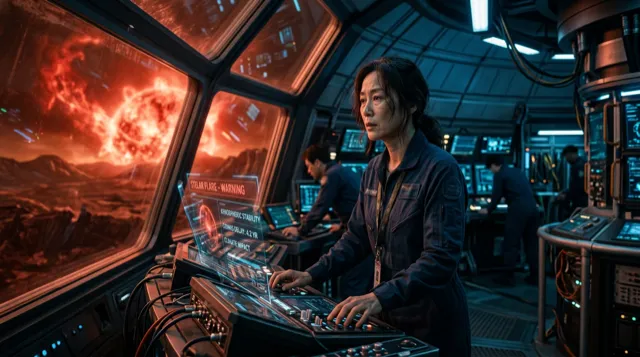
In the third week of winter, a flare alert was issued on Halla. Proxima Centauri had released a large flare, and the high-energy particles were due to reach Halla 12 minutes later. The dome's radiation shielding engaged, and all external work was halted. In the climate monitoring room, Chae-won watched the status of the atmospheric processing unit. When the flare's particles struck the dome's outer wall, the surface temperature would spike for an instant and then fall. That sudden swing created noise in the sensors, and the noise could contaminate the climate data.
The flare arrived. In the moment the high-energy particles collided with the dome's outer wall, a faint luminescence rose from the metal surface. The particles excited the metal atoms, and the excited atoms emitted light. For 0.3 seconds the entire dome flashed blue. Chae-won's face, pressed close to the monitor in the surveillance room, was washed in that light. It was light near the hydrogen-beta line, at a wavelength of 486 nanometers. The moment a star's fury was translated into light. Watching that flash, Chae-won held her breath. Beauty and danger rode the same wavelength.
After the flare she checked the sensor data. As expected, noise had appeared. The Unit 3 sensor had recorded a 0.07-degree spike from the flare's impact. If that spike wasn't removed, it would skew the monthly average. Chae-won said to Min-ho, We have to filter out the flare noise. The Earth standard protocols have no method for handling flare noise. Because Earth doesn't have flares. Min-ho looked at her. Something else we have to build ourselves? Chae-won nodded and answered. Yes. We need a protocol of Halla's own.
Chae-won designed a protocol to filter the flare noise. It isolated the data from 15 minutes before and after a flare, then interpolated across it using data from intervals the flare hadn't touched. That protocol became an annex to the climate autonomy charter. A climate-measurement standard belonging to deep-space settlements alone, one that did not exist on Earth.
Si-u came home from school and asked, Mom, during the flare today the dome glowed blue. What was that? Chae-won answered, That's Proxima getting angry. It fires particles, and the dome reacts and glows. Si-u looked at her. Is it dangerous? Chae-won said, The dome blocks it, so it's fine. But it affects the sensors, so Mom has to clean up the data. Si-u asked, Does it make an error bigger than 0.04 degrees? Chae-won smiled. It jumped all the way to 0.07 degrees. Si-u looked at her. So does the subsidy get cut off again? Chae-won answered, No. This time I filtered it out. Si-u nodded and said, So you're the person who guards the numbers. Chae-won smiled. That's right, the person who guards the numbers.
Over dinner Jeong-hun said, The climate autonomy charter — what happens if Earth objects? Chae-won answered, An objection takes 8.4 years to arrive. In that time Halla has to get through 3 more winters. If our standard carries us safely through 3 winters, that itself becomes the proof of its legitimacy. Jeong-hun looked at her. Proving it by results. Chae-won nodded and said, In deep space, only results are evidence. Because you can't debate with Earth. By the time the debate arrives, three winters have already passed.
In the last week of winter, while sorting the data for every sector of the atmospheric processing unit, Chae-won ran a statistical analysis on 12 years of Halla's climate data. A startling pattern emerged. Proxima's stellar activity was fluctuating on a 3.7-year cycle. Earth's models didn't account for this cycle. When the 4.2-year communication delay meshed with the 3.7-year stellar cycle, the reference values Earth sent always landed on a different phase of the stellar cycle. It was a system structurally bound to fall out of alignment.
Chae-won reported this discovery to the committee. Chae-won said, Proxima's stellar activity runs on a 3.7-year cycle. Since our communication delay with Earth is 4.2 years, Earth's reference values are structurally out of sync with the current stellar cycle. This mismatch isn't a technical defect — it's a physical limit. Seon-yeong asked, And the solution? Chae-won answered, Setting our own standard, nothing else. Halla observes the 3.7-year cycle directly and renews the climate contract accordingly. Hyeon-tae nodded and said, So it's independence, in the end. Chae-won looked at him. Climate independence. Not political independence. Seon-yeong smiled. Independence of the numbers.
Winter ended. As Proxima b swung back to the near point of its orbit, the outer-wall temperature recovered. The dome interior of the Unit 3 sector had held at 18 degrees all winter long. 6,000 people came through the winter safely. In the medical dome, cases of midwinter hypothermia were zero. Last winter there had been 14.
As she wrote the winter-closure report, Chae-won added a single sentence. 'Halla Settlement, Year 13, winter. Result of applying the provisional heating-subsidy standard: 0 cases of hypothermia in the Unit 3 sector. Projected cases had Earth standards been maintained: 8 to 12.' The numbers spoke. They said that a homegrown standard had carried 6,000 people through winter better than Earth's had.
Seon-yeong read the report and said to Chae-won, Let's send this to Earth too. They won't read it for 8.4 years, but it still needs recording. Chae-won nodded and answered, I'll send it. Seon-yeong looked at her. And let's begin deliberation on the Climate Autonomy Charter. Chae-won said, It's ready.
Si-u, researching Halla's climate history for a school assignment, asked Chae-won, Mom, back when Halla was first built, did it have problems like this too? Chae-won answered, It did. That first winter, a miscalculation in the subsidy once let the dome temperature drop all the way to 11 degrees. Si-u looked at her. 11 degrees? How did people survive that? Chae-won said, They shared blankets, and everyone huddled into one sector and held out on body heat. Si-u thought for a moment. Then what you do is better than back then. Chae-won laughed. That's right. Instead of blankets, we protect people with data.
Chae-won formally submitted the draft Climate Autonomy Charter to the Halla Autonomy Committee. Deliberation would take 3 months. Over those 3 months the standard values sent from Earth would keep arriving, and numbers from 4.2 years ago would keep trying to dictate the life of the present. But now Halla had a record. A record of tracking a deviation of 0.04 degrees, analyzing its cause, and establishing a standard of its own. Proof that the person who reads the numbers can change the numbers. The 48-year-old climate-contract auditor opened the next log. Atmospheric processing unit 4. Error checked. 0.01 degrees. Within tolerance. Chae-won moved on to the next unit. The work of protecting a deep-space winter with numbers went on. It was a story that had begun at 0.04 degrees. The error of a single sensor, the limit of a single model, the lag of a single light-year. These three had converged to threaten the winter of 6,000 people, and had led a 48-year-old auditor to pull on a spacesuit, step outside the dome, replace a sensor, write a report, and move a charter. This was what deep-space settlement was. A world where numbers were survival itself, measurement was politics itself, error was crisis itself. In that world the climate-contract auditor's work did not end. The next log was waiting, the next winter would come at a different phase of the 3.7-year cycle, and Proxima's light would go on lighting Halla in eternal dusk. Chae-won sat before the monitor and began to read the next number. Beneath a star 4.2 light-years away, the work of protecting winter with numbers went on. Proxima's dusk cast an orange glow across the monitor. Beneath an eternal sunset, an eternal audit continued. And the first line of that audit was always the same. Read the sensor, find the error, set the number right. Beginning at 0.04 degrees, guarding the nights of 6,000 people.