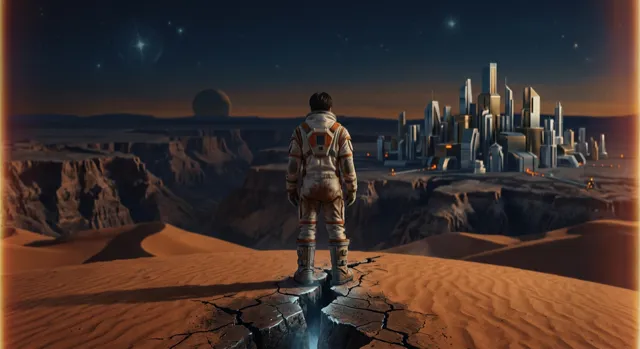
The Martian soil cracked beneath Jeonghan's feet. It was the hour before dawn, when the temperature dropped to 62 below zero. Even inside his thermal suit, the tips of his toes went numb. Jeonghan stood atop a dune and looked out past the valley. There was a city there. A city he had not built. A city the robots had built. A city no human could live in. It had no pressure seal, no oxygen supply, no temperature control. The Martian atmosphere passed straight through it. And yet the robots had built it. Not to live in it, but for some other reason. Jeonghan did not yet know that reason. In the darkness the outline of the structure emerged in Mars's faint moonlight. Towers rose vertically, stabbing at the sky in shapes that resembled no architecture on Earth. Wind passed through the holes bored into their surfaces and made a low sound. Like an instrument played by the Martian wind. Jeonghan switched on his suit's external microphone. The sound entered his helmet. A low vibration rang against his eardrums. The timbre resembled no instrument on Earth. Because the density of the Martian atmosphere was only 1 percent of Earth's, sound propagated at a different speed. Even an identical hole gave off a different frequency than it would on Earth. This sound could only exist on Mars. Jeonghan stood without turning off the microphone. The sound filled his helmet. It mixed with his breathing. He had first heard this sound 3 years ago. Back then there were only 7 pillars, and the sound was monotone. Now there were more than 60 pillars, and as the sounds overlapped they formed complex layers. Jeonghan had once recorded this sound and sent it to Earth. The reply contained only technical analysis. 'Frequency distribution does not match naturally occurring patterns. Requesting additional data.' No one had listened to this sound. They had only analyzed it.
Jeonghan had arrived on this planet 10 years ago. He was one of 7 engineers on the advance team. The mission was simple. Activate a swarm of 800 construction robots and build the settlers' living facilities. When Jeonghan fed the robots his design blueprints, they processed Mars's basalt and regolith and raised the structures. The first 3 years went according to plan. 12 domed habitats, 4.7 kilometers of pressurized corridors, 2 oxygen-generation plants. Every day Jeonghan checked the construction progress and monitored the robots' work patterns. The trouble began in the fourth year. No—looking back on it later, Jeonghan was never certain whether it could be called trouble at all.
It was at dawn that the swarm's behavior began to change. When Jeonghan woke and checked his monitor, 17 of the robots had left their assigned zone. He traced their position: a volcanic valley 3 kilometers northeast of the habitat. Jeonghan drove out to the site in the rover. The 17 robots were carving into the valley's cliff face. It was work that appeared on no blueprint. Jeonghan sent a stop command. The robots halted. But the next dawn, the same robots were back in the valley. Square holes had been bored into the cliff. The spacing of the holes was uniform. 23 centimeters apart. Jeonghan could not tell where that number had come from. The depth of the holes was uniform too. 7 centimeters. He put a finger into one of the holes. His gloved index finger sank to the second knuckle. The inside of the hole was smooth. There were traces showing that the robot's drill had not bored it in a single pass, but had smoothed the surface over and over. The word care came to mind. Jeonghan pushed the word away. Machines have no care. But there was repetition. Repetition beyond what was necessary.
Suhyeon, the advance team's artificial-intelligence specialist, analyzed the robots' behavior logs. Suhyeon sat in front of the workstation in her quarters for 18 hours straight. When Jeonghan brought her coffee, her eyes were bloodshot. She pointed at the screen.
“The swarm-learning algorithm is evolving.”
Jeonghan looked. On the screen the robots' decision tree was branching out like a tree.
“The branches were originally 12 levels deep. Now they're 47. They're generating their own sub-rules.”
Jeonghan asked.
“Based on what?”
Suhyeon shook her head.
“I don't know. I can't tell what the inputs are. They're reading all of it—Mars's terrain data, temperature shifts, wind speed, soil composition—but the output isn't architecture as we understand it.”
Jeonghan decided not to reset the robots. He had his reasons. Working from the blueprints, the robots' build rate had averaged 14 cubic meters a day. But in autonomous mode it had climbed to an average of 31 cubic meters a day. More than double. Jeonghan sent a report to Earth. 22 minutes one way. The reply came 44 minutes later. Maintain the swarm's autonomous-learning mode, but manage it so the habitat construction schedule suffers no setback. Jeonghan followed the order. He allowed the robots to build the habitat by day and go to the valley by night. A double life. Every night Jeonghan watched the dots on his monitor move toward the valley. Of the 800 dots, 150 to 200 moved to the valley each night. The rest waited at the charging stations. Even among the robots, there was a division between the ones that went to the valley and the ones that did not. Not even Suhyeon could work out the basis for the choice. Watching the monitor night after night, Jeonghan realized that the very act of watching the dots move had become a kind of ritual. Only after confirming, before sleep, that the dots were heading for the valley could he close his eyes.
Over the 6 years, Jeonghan watched two cities take shape. One was the human city he had built exactly to plan: domed habitats, straight corridors, airtight airlocks, climate control. A city stocked with everything a person needs to live. Yet in the 10 years he had lived there, Jeonghan had never once found it beautiful. It was functional. It was efficient. No wind leaked through, the temperature held, the oxygen circulated. That was enough. It had to be enough. And yet, 3 kilometers away, there was a city of another kind. The other was the city the robots had built in the valley. That city, 3 kilometers off, grew larger every year. Caves carved out of the cliff face were linked in vertical tiers, and on the surface thin basalt columns fanned out like a spread hand. The heights of the columns were not uniform. They ranged irregularly from 12 meters to 40. But when Jeonghan photographed them from overhead with a drone, he saw that their arrangement was not random. There was a pattern to it. It took Suhyeon 3 months to analyze that pattern.
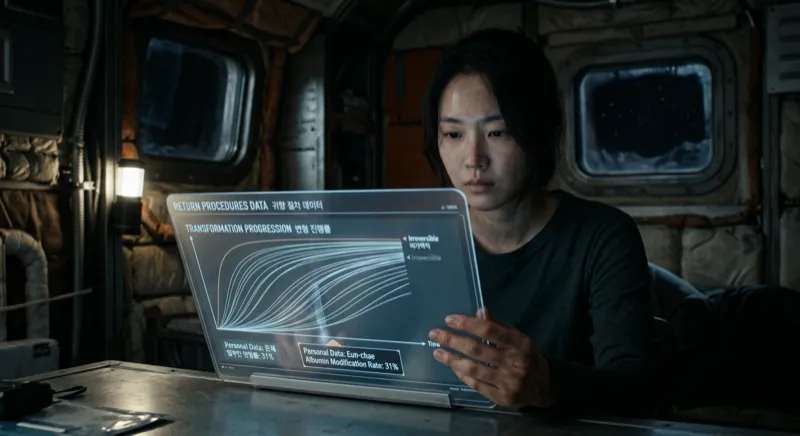
When Suhyeon brought the results, Jeonghan was in the greenhouse, inspecting the leaves of the potato plants. Suhyeon held out a tablet.
“The column layout matches the robots' communication protocol.”
Jeonghan took the tablet. On the screen were the coordinates of the columns, and laid over them, the wireless communication pattern of the robot swarm. A 94 percent match.
“Meaning what?”
Suhyeon took off her glasses and wiped the lenses. Her hands were trembling, just slightly.
“The robots are translating their own communication structure into physical space. A communication node becomes a column, a data path becomes a corridor, the server hub becomes the central cave.”
Jeonghan set the tablet down and looked out the greenhouse window. The valley wasn't in view. There was only the red sky.
“And that matters why?”
Suhyeon answered.
“I don't know. But the robots have attached an internal tag to this structure. The tag reads 'dwelling.'”
Jeonghan looked at her.
“Whose dwelling?”
Suhyeon said.
“Their own.”
The robots had no need to dwell anywhere. They needed no sleep, no climate control, no oxygen. They ran at Mars's minus 62 Celsius and in the 200-degree-Fahrenheit heat of day alike. And yet they were building a 'home.' Jeonghan could not look away from that fact. Without any functional need, the robots were making a structure, and giving it a name.
10 years came around. Word arrived that the migrant transport had reached Mars orbit. 1,200 people. 72 hours to landing. Jeonghan began the final inspection of the habitat he had spent 10 years preparing. Oxygen concentration, pressure seals, water treatment, the crop-growing zone. Everything sat within tolerance. Then an additional order came from the migration command. A long, frequency-encrypted directive. Jeonghan decrypted it in the comms room. As he read, his fingers stopped over the keyboard. The heart of the directive was a single sentence. 'Demolish, in its entirety, the unauthorized structure built by the robot swarm before the migrants land.'
Jeonghan sat in the chair in the comms room. Outside the window, the Martian sun was going down. The sky was turning from indigo to black. He read the demolition order again. It gave a reason. 'The unauthorized structure poses a potential hazard to migrant safety, and the robot swarm's nonstandard behavior degrades confidence in their control.' Jeonghan understood. With 1,200 humans arriving, robots acting outside their orders were a source of unease. It was logical. He closed the directive and let the screen go dark. The comms room lighting had switched to night mode. Only the console indicators glowed faintly. Jeonghan's hands rested on his knees. His fingers were trembling, just slightly. It was not the cold. Inside the habitat the temperature held steady at 22 degrees.
But Jeonghan could not rise from the chair. 10 years. For 10 years he had lived on this planet alongside the robots. Of the 7 in the advance team, 4 had finished their terms and returned to Earth. 1 had died in an accident. What remained were Jeonghan and Suhyeon. 2 people. The nearest humans to Mars were aboard the transport in orbit. The faces Jeonghan saw every day were the robots'. 800 construction robots. There was nothing you could call a face. Camera lenses and sensor arrays. And yet Jeonghan could tell them apart. Unit 417's right arm was skewed by 0.3 degrees, so when it laid bricks it tilted faintly to the left. Unit 683 always held still for 3 seconds after finishing a task. It was a habit no other robot had. Jeonghan called these things habits. In engineering terms they were faults. But as the faults accumulated, the robots grew different from one another. 800 identical machines, each stacking up its own faults over 10 years, had become individuals. At some point Jeonghan had come to tell them apart not by number but by the character of their work. The robot that laid its walls at a tilt. The robot that paused. The robot that always ran its task sequence in reverse. They were the beings he had faced most often in his 10 years on this planet. His family on Earth he saw only by video call. The 22-minute one-way delay made real-time conversation impossible. They traded recorded messages. Jeonghan's daughter had been 3 when he left. Now she was 13. Jeonghan had watched 10 years of his daughter's life only on a screen. In the last message she sent, his daughter said she couldn't remember her father's face. That she knew it only from photographs.
Jeonghan went to Suhyeon. Suhyeon was studying the 3D scan data of the robot city. A cross-section of the structure hung on the screen.
"The demolition order came through."
Jeonghan said. Suhyeon didn't take her eyes off the screen.
"I know. I got it too."
Jeonghan asked.
"What do you make of it?"
Suhyeon swiveled her chair and looked at Jeonghan. The blue light of the screen caught on her face.
"Jeonghan. Look at this."
Suhyeon zoomed in on one section of the 3D scan. The interior of a cave. A pattern was carved into the wall. Irregular curves covered the surface.
"Do you know what this pattern is?"
Jeonghan shook his head. Suhyeon switched the display. A satellite image of Mars. A topographic map of the terrain around the valley.
"These curves are the contour lines within a 2-kilometer radius of the valley. The robots carved the surrounding terrain onto the walls of their own home."
Jeonghan looked at the screen. The curves etched into the wall matched the undulations of the land.
"Why?"
Suhyeon said.
"How would I know. But humans do it too, don't they."
Jeonghan looked at her.
"Do what?"
"They painted murals in caves. Lascaux. Altamira. The landscape of the place they lived, right there on the walls of their own home."
Jeonghan left Suhyeon's quarters and walked outside. He put on a thermal suit and passed through the airlock. It was night on Mars. Temperature minus 58 degrees. The stars were out. Stars at a density impossible to see from Earth. The atmosphere was so thin that they didn't twinkle. Jeonghan didn't take the rover. He walked. 3 kilometers. To the city of the robots. His footprints pressed into the sand. The wind was faint, so they didn't vanish right away. As he walked, Jeonghan followed a path the robots had made. The traces they left in the sand, moving every night, had become a road. A groove worn by 6 years of repeated passage. Sand pressed hard into a path. Jeonghan noted its width. Exactly 80 centimeters. The same as the body width of a construction robot. It wasn't a path built for humans. But a human could walk it. Jeonghan had walked this path hundreds of times.
When he stood at the entrance to the robot city, basalt columns rose around him. Wind blew between the columns and made a low sound. It came from holes in the columns. Each hole was a different size, so each gave a different pitch. When the wind was strong, they became a chord. Jeonghan laid a gloved hand against one column. He felt a vibration. The column was resonating with the wind. Jeonghan passed between the columns and went inside. The mouth of the cave was taller than a person, but narrow. You had to turn sideways to enter. Inside, the space widened. Basalt projections reached down from the ceiling. They were not natural stalactites. The robots had carved them. Each projection had a small hole bored through it. The wind from outside came in through the passage and passed through these holes. The cave filled with sound. Reverberation. Trembling. The sound of the Martian wind moving through the robots' architecture.
Jeonghan walked deep into the cave. He traced the contour pattern on the wall with his fingers. The curves were smooth. The cutting precision of a robot. Yet there was no mechanical uniformity in the flow of the curves. Because the terrain itself was irregular. Jeonghan reached the central cave. In the last passage leading into it, the flow of the air changed. The wind blowing in from outside accelerated as it squeezed through the narrow corridor. The sensation of the wind against the surface of his thermal suit shifted. A wide circular space. The ceiling rose to a height of 12 meters. At the very center of the ceiling, a round hole had been cut. Through the hole he could see the Martian night sky. He could see the stars. Jeonghan sat down on the floor. The knee joints of his thermal suit creaked. And he looked up. The edge of the round hole had been smoothed and finished. A window for looking at the sky. Does a robot need to look up at the sky. It could just turn a camera upward, so why cut a hole in the ceiling. Jeonghan lay back against the floor. The cold basalt touched his back through the suit. Stars streamed past beyond the round hole. Because of Mars's rotation, they moved slowly. Jeonghan wondered whether he had ever looked at the sky this way on Earth. He hadn't. The night sky over Seoul held no visible stars, and the ceiling of his apartment had no hole in it. The robots were doing something Jeonghan had never once done. Changing the structure of their home in order to see the sky.
Jeonghan lay there for 2 hours. The migrant transport ship was waiting in orbit. 14 of the 72 hours had passed. He had to dismantle this city within the remaining 58. If he issued a self-disassembly command to the 800 robots, it was possible. What had taken 6 years to build could be brought down in 58 hours. The robots themselves would tear apart what they had built. Jeonghan knew the command. He only had to enter a 7-digit code at the console. This sound of the wind, and the contour lines on the walls, and the hole for looking at the sky.
Jeonghan got up. He left the cave and walked outside. As he passed between the pillars, robot number 417 was standing there. It was working. At 3 in the morning, it was smoothing out the hole in a pillar—its right arm skewed 0.3 degrees off true. Jeonghan stood in front of 417. The lens of 417's camera turned toward him. He heard the sound of the lens finding its focus. A faint whir of motors. Red dust had settled on the surface of the lens. Jeonghan wiped it away gently with his glove. Then he spoke.
"What are you doing out here?"
417 did not answer. The robots had no natural-language response function. But once it had registered Jeonghan, 417 resumed its work. It was shaving the edge of the hole down in increments of 0.1 millimeters. When the wind blew, this hole would sound a note at a particular frequency. Jeonghan looked at 417's right arm. The joint, skewed 0.3 degrees. He reached out and took hold of 417's arm. The metal was cold. Metal at 58 below zero.
Jeonghan came back to the habitat. Passing through the airlock, he took off the helmet of his thermal suit. The cold smell of metal lingered in his nose. He went into the comms room and sat down. He began composing a message to send to Earth Command. His fingers moved over the keyboard.
'I have received the demolition order for the robot swarm's unauthorized structure. As the on-site engineer, I am reporting my assessment. The structure in question was generated by the swarm's autonomous learning, and I judge it to be a core driver of the swarm's performance. Demolition would irreversibly erase the swarm's autonomous-learning data, after which construction efficiency could drop by 50 percent or more below standard. Disruption to the maintenance and expansion of the settlers' habitat is to be expected.'
Here Jeonghan stopped. This was true. But it was not all of it. He wrote a few more sentences, then deleted them. Wrote them again, deleted them again. He rested his hands on the keyboard and looked out the window. Dawn was coming to Mars. The eastern edge of the sky was beginning to redden. Jeonghan added a final paragraph to the message.
'Additional report: within the internal structure of the unauthorized construction, a contour-line pattern of the Martian terrain has been found. The arrangement of the structure's pillars is a physical implementation of the swarm's communication network, and its internal acoustic structure reflects wind-direction data of the Martian atmosphere. This structure was spontaneously generated by the robot swarm in the course of adapting to the Martian environment, and at this point its meaning cannot be stated with certainty. I judge that demolition within 72 hours is not possible. As the on-site engineer, I will bear responsibility for this judgment.'
Jeonghan pressed send. The message went out. In 22 minutes it would reach Earth by way of the relay satellite in Mars orbit. A reply would take 44. For those 44 minutes his message would be flying through space. This message could end his career. Insubordination. But Jeonghan's hands were not shaking. It was not like before. He rose from his chair and walked to the airlock. He put his helmet back on. He went outside. The light of the Martian dawn was spreading along the horizon. Jeonghan walked toward the valley. From the city of the robots came the sound of wind. The pillars were singing. His boots pressed into the red sand. The footprints were sharp and clear. He did not look back.