It was 4 a.m. Mars Standard Time when Eunchae first saw the anomaly flagged by the blood analyzer. The medical module was in night mode, so only the glow of the equipment's indicator lights washed across the wall. A warning message hung on the analyzer's screen. 'Specimens 31 — albumin structural anomaly detected.' Still gloved, Eunchae pressed the screen. A list of 31 blood specimens appeared. The number 31 lodged itself in her eye. 31 of 240 people. 12.9 percent. They had been drawn during routine health checks. Analyzing the blood of all 240 people every month was Eunchae's job. For 5 months there had been no anomalies. Every month she drew blood from 240 people, analyzed it, wrote the report, transmitted it to Earth. The same task, over and over. Life on Mars was repetition. Waking, examination, meals, work, sleep. Time flowed on inside the repetition. That nothing was ever wrong was the ordinary state of things. In the 6th month, 31 cases had been flagged at once.
Eunchae opened the first specimen. The three-dimensional structure of the albumin rendered on the screen. It was set side by side with a normal albumin for comparison. The difference was visible. An additional binding site had formed on domain 2 of the albumin. A structure that had not existed before. Eunchae opened the second specimen. The same deformation. The third too. All 31 cases had the same structural alteration in the same location.
Eunchae took off her gloves. The insides were damp with sweat. Her fingertips were cold. The moment the gloves came off, the air met her hands. The module's air. It had passed through the purification system, yet all at once that air felt different to her. The medical module's temperature was set to 17 degrees. The Mars habitat modules cut back the heating at night to save energy. Eunchae rubbed her hands together and looked at the screen again. She scrolled down the list of 31 names. Her hand stopped at the 14th name. Yunha. Eunchae's daughter. Twelve years old.
Eunchae pushed her chair back. Through the medical module's round window she could see the Martian surface. Rust-red desert. The predawn Martian sky was a deep violet. 56 million kilometers from Earth. The return shuttle would come in 8 months. Two years ago, 47 kinds of protein had been extracted from Martian regolith. They matched, at 98.6 percent, proteins found in Earth's primordial ocean. The Panspermia hypothesis — that life had begun on Mars and spread to Earth by meteorite — was confirmed. Mars became the homeland. A story took shape: that humanity was returning. The project's name was Homecoming. The first colony party, 240 people. Eunchae was the party's sole medical officer. The communication delay was 14 minutes one way.
Eunchae analyzed the binding site of the altered albumin. The shape of the added binding site fit the perchlorate molecule of the Martian soil exactly. Key and lock. Eunchae ran the binding simulation 3 times. All 3 times, the same result. The altered albumin broke down perchlorate 14 times more efficiently than the artificial filter. When the altered albumin bound to perchlorate, the perchlorate broke down into harmless chloride. Martian soil contained perchlorate at 0.5 to 1 percent. A substance toxic to humans. A substance that disrupts thyroid function and, under long-term exposure, damages the nervous system. In pre-migration training she had spent 40 hours on the perchlorate-response protocol alone. Immediate decontamination on exposure. Activated charcoal on inhalation. Eunchae had written the protocol herself. Now that protocol was on the verge of becoming meaningless. Because the body was processing the perchlorate on its own. The habitat modules' air purification systems filtered perchlorate out, but trace amounts were always present inside. The altered albumin could handle those trace amounts. The body was adapting to Mars.
Eunchae kept analyzing. She tested the oxygen-binding capacity of the altered albumin. The result came. The altered albumin's oxygen-transport efficiency had dropped to 62 percent of normal. At the 0.13 percent oxygen concentration of the Martian atmosphere, this was not a problem. The oxygen concentration inside the modules was kept at 16 percent, lower than Earth's. But at Earth's atmospheric 21 percent, the altered albumin was oxidized by the excess oxygen. The oxidized albumin damaged the red blood cell membranes. Hemolysis. Red blood cells were destroyed. She ran a simulation. Once the alteration was complete, exposure to Earth's atmosphere dropped the blood's red cell count to a lethal level within 48 hours. The simulation's graph traced a plummeting curve. Eunchae looked at the graph. This curve was a person's death. A death that began the instant a foot touched down on Earth.
Eunchae did not turn off the screen. Sitting in the chair, she rested both hands on her knees. Once the alteration was complete, the body could never return to Earth. The bodies of 31 people were becoming Mars's own.
7 a.m. The habitat module's lighting switched to day mode. Footsteps began to sound in the corridor. Eunchae locked the medical module's door and moved the data to her personal terminal. She reset the analyzer's warning log. The 31 anomaly signals vanished from the record. Eunchae's hands did not tremble. It was only that the motion of pressing the reset button was unfamiliar. Eunchae stood before the equipment and closed her eyes for 3 seconds. She opened them. The analyzer's screen had returned to its normal standby state. As if nothing had happened.
In the dining module, Yunha was eating breakfast. Synthetic protein blocks and cultivated vegetables. Yunha looked at Eunchae.
"Mom, you didn't sleep last night?"
"The analysis work piled up."
Eunchae sat down across from Yunha. She looked at Yunha's face. Her color was good. There was a flush in her cheeks. On Earth, Yunha had been different. Chronic lung disease. From birth her lung function had been 58 percent of normal. Climbing stairs left her winded. She couldn't run. After coming to Mars, Yunha's breathing had improved. On Earth she had used an inhaler 4 times a day. There were 7 days a month she couldn't make it to school. The reason for deciding on the move to Mars was Yunha. Eunchae had combed through medical papers, analyzing how a low-oxygen, low-gravity environment affected chronic lung disease. There was a positive possibility. It was not certain. For an uncertain possibility she had come 56 million kilometers. The low oxygen concentration eased the burden on the lungs, and the 0.38 gravity lowered the load on cardiopulmonary function. Yunha ran for the first time on Mars. When Eunchae saw her running down the corridor of the residential module, the strength went out of her legs. She had to brace a hand against the wall. Yunha looked back from the end of the corridor and laughed. A laugh with no shortness of breath in it. A face she could never have seen on Earth. Eunchae photographed that face. She saved it to her terminal. It was the first photograph taken on Mars.
"Today I'm going to the greenhouse with Yunseo."
Yunha said, chewing a vegetable.
"And the cough?"
"Gone. Really gone these days. Yesterday I ran 3 laps of the corridor and it wasn't hard at all."
Yunha stabbed a vegetable with her fork. A tomato. Grown in the residential module's greenhouse. Raised by a mixed method of Martian soil and hydroponics. Inside the tomato, too, something of Mars was mixed in.
Yunha laughed. Eunchae watched her laughing face. Inside this child's blood the albumin was changing. It was becoming a thing of Mars. Once the transformation was complete, Yunha would not be able to return to Earth. But Yunha's lungs, for the first time, were working properly—here on Mars.
10 a.m. Eunchae sat in the medical module for the scheduled report to Earth. On the communication terminal's screen was the name of Han Jeongsu, the Earth-side medical director. A one-way lag of 14 minutes. Send a message and the answer comes 28 minutes later. Han Jeongsu was the Earth-side head of the Homecoming project. From the same university as Eunchae. At the last meeting before the move, Han Jeongsu had gripped Eunchae's shoulder and said,
"Eunchae, the health of everyone out there is in your hands. If there's any sign of an anomaly, report it at once. We'll make the call from this end."
Eunchae had nodded then. She hadn't known that nod would grow this heavy 6 months later.
Eunchae wrote the report. "Results of the 6-month periodic examination: all 240 persons, no anomalies." She set the cursor over the send button. Her finger hung there above the screen. A report that did not record the 31 anomalies. Eunchae looked at the report. "No anomalies." The words glowed on the screen.
Eunchae pressed the send button. The confirmation tone sounded. A short, high electronic beep. The report flew toward Earth at the speed of light. It would arrive 14 minutes later. A lie crossing 56 million kilometers in 14 minutes. Eunchae sat in the silence left behind after the tone faded.
After the report was sent, Eunchae stayed sitting in the medical module. She did nothing. 12 minutes passed. In that time she calculated the pace of the transformation. The albumin transformation rate of the 31 people currently ran between 12 and 34 percent. If the pace held steady, completion would take 4 to 7 months. The return shuttle would arrive in 8 months. Anyone whose transformation finished first would board the shuttle and die on reaching Earth.
Eunchae looked at the list of 31 again. The highest transformation rate was 34 percent. She checked the name. Kang Minwoo. Attached to the geological survey team. The one who spent the most time outside. He went out of the module every day to collect soil samples. He wore a suit, but was exposed to trace amounts of perchlorate. The more exposure, the faster the transformation. Eunchae scrolled further down the list. Yunha's transformation rate. 19 percent. A middling level. Yunha, too, was being exposed to Martian soil as she worked in the greenhouse.
Eunchae closed the terminal. She left the medical module. She walked the corridor. The residential module's corridor was cylindrical. The line between floor and ceiling ran on in one curved surface. At the end of the corridor was an observation window. Eunchae stood before it. A Martian afternoon. The sky had turned pink. Wind was blowing across the surface. Reddish-brown dust drifted low. Beyond the dust rose the silhouette of Olympus Mons. 21,000 meters high. Higher than any mountain on Earth. The mountain people had begun to call the mountain of home. Inside that dust was perchlorate. That dust was changing the bodies of 31 people.
Footsteps sounded behind Eunchae. Minwoo was coming up the corridor. He'd stripped the top of his suit off and knotted it around his waist. Sweat stood on his face. He'd just come in from work outside.
"Dr. Eunchae, I saw something strange collecting soil today."
"What?"
"The soil's a different color in collection zone 3. Never seen it before. Everywhere else is reddish-brown, but that patch is gray-white. And the perchlorate reading came back 4 times higher."
Eunchae's eyes dropped to Minwoo's hands. Bare hands, gloves off. Reddish-brown dust clung to his fingers.
"Your gloves?"
"They tore while I was collecting. I worked bare-handed for about 10 minutes."
"Come get a blood test. Now."
Her voice had gone short. Minwoo cocked his head, but he followed. In the medical module she drew his blood. The blood filling the syringe was darker than it should have been. She fed it into the analyzer. 3 minutes. The result came up. Albumin transformation: 38 percent. In the test 4 days ago it had been 34. Up 4 percent. The bare-handed exposure had accelerated it.
Eunchae did not save the result. She closed the screen.
"It's nothing. Just checking for soil-component exposure."
"Something wrong?"
"No. If your gloves tear, swap them right away. And no bare-handed work."
Minwoo looked at her.
"Doctor, you've looked tired lately."
"The night analyses have backed up, that's all."
"I saw Yunha tearing around the greenhouse the other day. She's really gotten healthy. I think coming here was the right call."
Eunchae's hand stopped over the analyzer. Minwoo doesn't know about the change inside his own blood. Doesn't know his body is turning into Mars's. He was smiling. Handling the soil under the Martian sky.
Minwoo nodded and went out. Eunchae looked at the door he'd left through. 38 percent. At this rate, 3 months until his transformation was complete. 5 months before the shuttle. The window for Minwoo to go back to Earth was closing. And he doesn't know. Tomorrow he'll pull on the suit and go outside again. He'll collect soil. His gloves might tear again. Eunchae could bar him from all external activity. It was within a medical officer's authority. But she'd have to give a reason. To give the reason she'd have to name the transformation. To name the transformation was for all 31 of them to know.
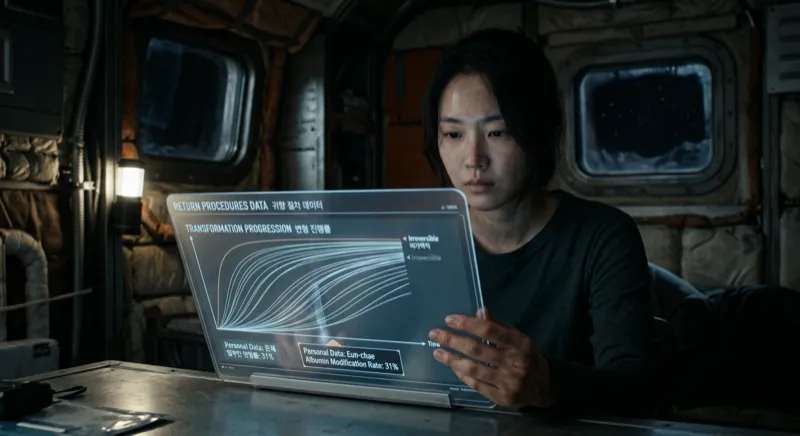
Night. After Yunha fell asleep, Eunchae opened the data again in her room. She graphed the transformation progress of all 31. Every curve pointed upward. Not one was falling. The transformation was irreversible. All of the curves were gentle upward slopes. Not steep. Slowly. Surely. Bodies changing without a sound. She checked her own data too. Albumin transformation: 7 percent. Eunchae was one of the 31 as well. No — one who would become one of the 78. Her body was turning into Mars's too. She set the terminal down. She opened her right hand and looked at it. An ordinary hand. From the hand alone you'd never know a transformation was underway. Inside the blood, at the level of proteins, on a scale no eye could see, Eunchae's body was being remade. The soil of home was reshaping her. There was no way to reverse it in her medical equipment. An Earth research facility might manage it. But what happens if she reports it? Earth Command issues an emergency return order. Rather than wait the 8 months, they turn back the supply ship already in orbit. The supply ship has living space for 60. Only 60 of the 240 can board. The 31 transformed become the priority passengers. The other 209 have to wait another 8 months for the next shuttle. And in those 8 months of waiting, the bodies of the 209 could change too. Breathing the module's air, exposed to the soil, as time goes on. By the time the supply ship had left with its 60 and the ones left behind finally came home, they too could have bodies that couldn't live on Earth. And when the 31 reached Earth, anyone whose transformation had passed 40 percent could not survive in Earth's atmosphere. The moment they arrived, hemolysis would begin. Eunchae stopped the calculation and looked at the window. It was Martian night. Stars showed in the sky. Fewer than in Earth's night sky. Because the atmosphere was thin, the starlight was, if anything, steadier. Stars that didn't flicker. One of those stars was Earth. Eunchae tried to find it, but she couldn't tell which star it was.
Eunchae closed the data. She shut off the room's light. In the dark she looked up at the ceiling. Air was coming from the ceiling vent. Purified air. But air with a trace of perchlorate mixed in. Breathing this air, the bodies of all 240 could be changing, little by little. The 31 were the ones whose transformation had been detected. For the other 209, it might only be a matter of time.
The next morning. Eunchae reanalyzed the blood data of all 209. A precision scan. It took 4 hours. While the analyzer processed the samples one by one, Eunchae sat in the medical module and waited. She drank 3 cups of coffee. Synthetic coffee. No taste, but it had caffeine. Her hands trembled faintly. Whether from the caffeine or from something else, Eunchae did not try to tell apart. The results. Among the 209, another 47 showed early signs of albumin deformation. Deformation rates of 1 to 5 percent. 78 out of all 240. 32.5 percent. A month ago it had been 31; at the 6-month mark, 78. At this rate, by the 9-month mark all 240 could become subjects of deformation. Every person who had set foot on Mars would have their body remade. Just by breathing the habitat module's air. Just by touching the soil. Mars was taking humans in. Whether the humans wanted it or not. A month ago it had been 31. The ratio was climbing.
Eunchae locked the door of the medical module. She sat down in the chair. She buried her face in both hands. Her palms met her face. They were cold. Eunchae lowered her hands. Tears had smeared across her palms. Eunchae wiped her palms on her trousers. She opened the communication terminal. She began drafting a revised report addressed to Earth Headquarters.
'Revised report, 6-month routine examination: In 78 of 240, structural anomaly detected in blood albumin. Deformation rate 1 to 38 percent. The deformation is irreversible and ongoing. Upon completion of deformation, adaptation to Earth's atmosphere is presumed impossible.'
Eunchae read the report. Her finger hung still above the screen. If this report was sent, it would reach Earth 14 minutes later. Earth Headquarters would read it. An emergency meeting would be convened. A return order would come down. The supply ship would come back. 60 would board it. The rest would stay. Among the 31, those whose deformation was fastest would not survive even if they reached Earth. Yunha's deformation rate was 19 percent. Departing now, she would reach Earth in 4 months. Over those 4 months the deformation would advance. Projected deformation rate on arrival. Eunchae ran the numbers. 35 to 42 percent. At 42 percent she would be near the threshold at which hemolysis begins in Earth's atmosphere. The threshold was 45 percent. Whether Yunha would stop at 42 percent or cross 45 depended on the rate of deformation over those 4 months. Calculation could not tell. At what rate Yunha's body would become Mars's own, only Yunha's body knew.
Send Yunha to Earth and Yunha could live. On the borderline, but live. Keep Yunha on Mars and Yunha's lungs would keep getting better. But once the deformation was complete, she could never go to Earth again.
Eunchae looked at the send button on the communication terminal. The same button as the false report she had sent that morning. The same size. The same place. Press it, and the truth goes. Leave it, and the lie stays.
There was a knock at the door of the medical module. Yunha's voice came through.
"Mom, let's go eat lunch."
Eunchae looked at the communication terminal's screen. The cursor of the revised report was blinking.
"I'll be there in a minute."
Eunchae answered. Beyond the door, Yunha's footsteps drew away. Light, quick footsteps. She was running. Footsteps possible only on Mars. Eunchae listened to the sound. The footsteps went to the end of the corridor and vanished. Eunchae looked at the communication terminal. She read the last line of the revised report again. 'Upon completion of deformation, adaptation to Earth's atmosphere is presumed impossible.' Presumed. Not certain. Only the result of a simulation. There was no actual case of a person whose deformation was complete being exposed to Earth's atmosphere. 0 cases. Eunchae looked at the word 'presumed.' This single word could change the future of 240 people. The send button was still there at the bottom of the screen. Eunchae's hand was over the terminal. Air was coming from the medical module's ventilation duct. Purified air. Air with a trace of perchlorate mixed in. Eunchae breathed. In and out. The air filled her lungs. What shape the albumin was taking inside her own blood, Eunchae did not test. Beyond the medical module's window she could see the Martian afternoon sky. Pink. A different color from Earth's sky. Yunha was running beneath this sky. From somewhere in the corridor came the faint sound of Yunha laughing. The cursor of the revised report was blinking. Eunchae drew in one more breath. The air of Mars filled her lungs.