His granddaughter's hair was 17 centimeters long. When Jeongsu looked down into the coffin at the funeral home, the first thing he saw was not her face but her hair. Brown hair spread across the pillow. 17 centimeters. His granddaughter was 3 years old. It had been a car accident. She was a child whose hair still grew. A child who had never received the gene-editing vaccine. Vaccination began at age 5, and so a 3-year-old's cells were free. They divided, grew, and changed as they pleased. Her hair grew. Her nails grew. A scrape on her knee healed in 3 days. Jeongsu touched his granddaughter's hair. His daughter took his hand and pulled it away. "Father, stop." Jeongsu withdrew his hand. The mourners stood in a line. Every one of their faces was unchanging. Faces the same as they had been 20 years ago stood before the coffin of a 3-year-old child. Only the child was different. Only the child had been growing, changing. Growing, and then stopped. It was soft. It had the feel of something alive.
For 20 years Jeongsu's hair had been the same length. 4 centimeters. It had not grown even once since he received the gene-editing vaccine in 2071. The vaccination was done at the neighborhood public health center. He took a shot in the arm. It didn't hurt. The nurse said, from tomorrow your cell division will be under control. Jeongsu nodded. It was 3 years after he had lost his wife. At the word that cancer would disappear, he did not hesitate. He got the shot and came home. The next morning, about to shave, he stopped. His beard had not grown. The face in the mirror was exactly the same as yesterday's. That day was the beginning of the stopping. He had never once been to a barbershop. For 20 years. His nails did not grow either. He had no need of nail clippers. No need to shave, since his beard did not grow. Jeongsu's body was 67 years old, but it was the same as a 47-year-old's. His wrinkles did not increase. His skin did not change. After the vaccine brought cell division under control, aging slowed to an extreme. In exchange for cancer disappearing, change disappeared. A body that was safe, but arrested.
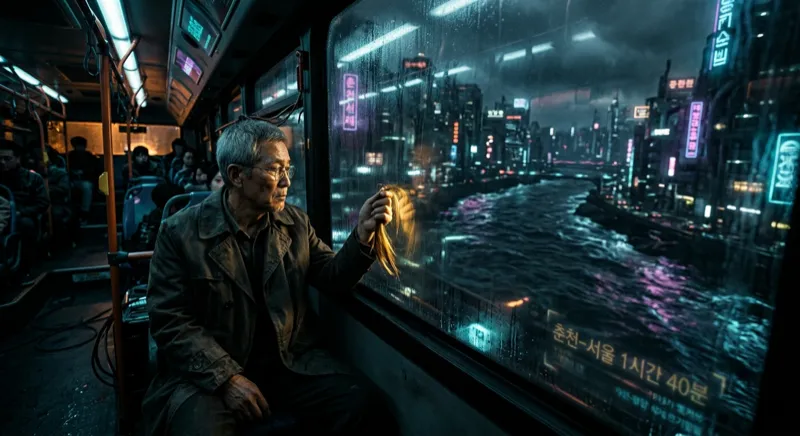
After leaving the funeral home, Jeongsu did not return home. He got on a bus. From Seoul to Chuncheon. 1 hour and 40 minutes. On the bus Jeongsu slipped his hand into his pocket. There was a single strand of his granddaughter's hair. He had taken it from inside the coffin. He had told no one. A single strand of hair. 17 centimeters. Jeongsu held it pinched between thumb and forefinger. It was thin. But it was there. It had grown. Cells had divided and made it.
In 2071 cancer disappeared. The gene-editing vaccine. Its name was CellGuard. It placed a limit on the number of divisions in every somatic cell. Once a cell divided beyond a set number of times, it was made to stop automatically. Cancer cells were cells that divided without limit, so once the division cap was in place, they could not become cancer. The cancer death rate became 0 percent. Lung cancer, stomach cancer, liver cancer, colon cancer, pancreatic cancer. Every cancer disappeared. People celebrated. The greatest medical achievement in the history of humankind.
But there was a side effect. As cell division came under control, the body stopped changing. Hair no longer grew. More precisely, it stopped at whatever length it had been at the moment of vaccination. Those who had cut their hair short before the shot had short hair for life. Those who had grown it long had long hair for life. Nails stopped too. Wound healing became 3 times slower. A cut took a week to close. A broken bone, 6 months to knit. Skin regeneration was extremely slow. Aging slowed as well. Even after 20 years passed, one aged only about 10. People's appearances grew alike. Because they did not change. The people walking the streets had the same faces they had 20 years ago. The same hair length, the same skin, the same nails. The barbershops closed. The hair salons closed. The nail shops vanished. A body that does not change needs no upkeep. Only plastic surgery remained. If you wanted change in an unchanging body, surgery was the only way. Someone who had chosen short hair before the vaccine and now wanted long hair wore a wig. The wig market grew. Synthetic wigs. False hair pulled over hair that would not grow. Jeongsu did not wear a wig. He did not dislike the 4 centimeters. What he disliked was the fact that the 4 centimeters would not change.
It was 3 in the afternoon when Jeongsu got off in Chuncheon. He took a taxi from the terminal. He gave the destination. The driver looked at him. "That's up in the mountains. There's nothing out there." "I know." The taxi left the town behind. The news was playing on the driver's radio. 'Crackdown on the wild-cell movement intensifies. The Ministry of Health and Welfare has this year uncovered 47 illegal reversal clinics.' Jeongsu listened to the radio. 47 places. The ones not uncovered would be far more. The road narrowed. The trees grew thicker. 15 minutes later the taxi stopped. The foot of the mountain. Jeongsu got out. The taxi drove off. Jeongsu walked the mountain path. Unpaved road. 20 minutes. He grew short of breath. 67-year-old lungs. The vaccine had slowed aging, but it had not erased it. From beneath his feet came the sound of dead leaves crumbling. It was spring, yet winter's fallen leaves remained. The fallen leaves were cells the trees had cast off. The tree cast off cells and made new ones. Circulation. Through the fallen leaves new shoots were rising. The dead and the newly growing were in the same ground. In Jeongsu's body there were no cells being cast off. And no cells being newly made.
There was a building halfway up the mountain. Around it lay a garden plot. Lettuce, cabbage, radish. Haeun had to be the one growing them. The vegetables were growing. Leaves pushed up out of the soil. Among the growing things stood a container. A structure of 3 containers joined end to end. There was no sign. A small slip of paper was stuck beside the door. 'Wild.' One word. Jeongsu knocked on the door.
The door opened. A woman stood inside. Her hair fell to her shoulders. That alone told Jeongsu. This woman had undone the vaccine. Her hair was growing. Dark at the roots, light at the tips. The newly grown hair and the old hair were different colors. Living hair. Jeongsu saw it and drew a breath.
“Who are you?”
“I've come to be released.”
The woman looked at Jeongsu. Jeongsu's 4-centimeter hair. A face unchanged for 20 years. A body still under the vaccine.
“Your referral?”
“I don't have one.”
“Without a referral, no.”
“My granddaughter died.”
The woman went still.
“She was 3. A child whose hair grew.”
The woman looked at Jeongsu for 10 seconds. She opened the door wider.
“Come in.”
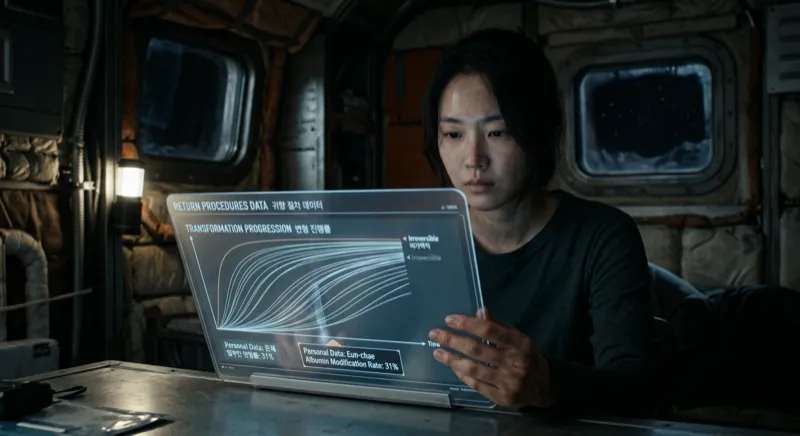
Inside, the container was cramped. 2 chairs, 1 table, 1 refrigerator, 1 laptop. A poster on the wall. 'Freedom for the cells.' The slogan of the wild-cell movement. A microscope sat on the table. A cell sample was mounted on a slide. Cells in mid-division. What Haeun looked at every day. Cells dividing freely. Every time Haeun looked at them she must have found them beautiful. The moment a cell splits in two. The moment one becomes two. The very moment CellGuard had sealed shut. The woman pointed to a chair. Jeongsu sat.
“Do you know what release is?”
“Undoing the division limit in the CellGuard vaccine.”
“That's right. I use gene editing to deactivate the division-limit code. Then the cells divide freely again. Hair grows. Nails grow. Wounds heal fast.”
“Cancer can come back too.”
The woman looked at Jeongsu.
“Yes. Cancer can come back too. Once the division limit is lifted, the chance of cells multiplying without end comes back. The odds are the same as they were for the original human race. The odds from before the vaccine. About a 40 percent chance of cancer in a lifetime.”
“I know.”
“Why do you want to be released?”
Jeongsu took a hair out of his pocket. 17 centimeters. He laid it on the table. A single strand of brown hair lying on the table.
“It's my granddaughter's.”
The woman looked at the hair.
“This grew. The cells divided and made it. In the body of a 3-year-old child. In my body, nothing has grown for 20 years.”
Jeongsu looked at his own hands. The nails were the same length as 20 years ago. The same shape. Once he'd cut his hand on a knife. It took 2 weeks. For the skin to close. The whole time it bled, Jeongsu doubted whether his body was alive.
“I want to change.”
The woman nodded.
The woman's name was Haeun. Haeun had been performing the release procedure for 3 years. It was illegal. Undoing the CellGuard vaccine was a violation of the bioethics law. A fine of 50 million won or 3 years in prison. Haeun had been a genetic-engineering researcher. She'd been on the team that developed the CellGuard vaccine. One of the first to report the vaccine's side effects. The report was ignored. The achievement of a 0 percent cancer death rate was too great. The government decided the side effects were worth bearing. Haeun left the institute. She took the data with her when she left. CellGuard's blueprints. Only 12 people on the development team knew how to perform the release. Haeun was the only one of them who had actually done it. The other 11 knew and did nothing. Because breaking the 0 percent cancer death rate frightened them. For 3 years now she'd been performing releases in the mountains.
“And the cost?”
“Nothing. I don't take money.”
“Why?”
“Because it's the vaccine I made. Because it's the prison I made.”
Jeongsu looked at Haeun. There were lines at the corners of Haeun's eyes. Fine lines. The wrinkles of someone who'd been released. Growing wrinkles. Something Jeongsu didn't have.
“Do you regret it?”
“Not regret, exactly. We did get rid of cancer. That was a good thing. But cancer wasn't the only thing we got rid of. We got rid of change. Growing, aging, going gray. It all comes from the same root. Cells dividing. Block that and you block cancer, but you block life too.”
Haeun opened the refrigerator. Inside were syringes. 3 small vials. A clear liquid. Haeun drew the liquid up into a syringe.
“Roll up your sleeve.”
Jeongsu rolled up his left sleeve. Haeun swabbed his arm with alcohol. It was cold.
“Once you've had the shot, the changes begin after 48 hours. Your hair starts to grow. Your nails too. Your body heals at its old speed again.”
“And the cancer?”
“When the cells are freed, cancer becomes possible. Not right away. But the possibility comes back. You'll have to go in for regular checkups. Caught early, it can be treated. Even before the vaccine, cancer was curable more often than not.”
“I know. My wife died of cancer. In 2068. 3 years before the vaccine came out.”
Haeun's hand went still. The hand holding the syringe.
“Breast cancer. They found it too late.”
“And you still want the release? Knowing the cancer could come back?”
Jeongsu looked at her. There were wrinkles at the corners of Haeun's eyes. Fine lines. The wrinkles of someone who'd taken the release. Wrinkles that were still growing. Something Jeongsu didn't have.
“The vaccine came out after my wife died. I took it. Because I was afraid of cancer. Because I was afraid of the very thing that killed her. So I took it. For 20 years I was safe. For 20 years I didn't change.”
Jeongsu looked down at his hands.
“For 20 years, every time I went to her grave, I looked exactly the same. Just as she'd last seen me. Not one new wrinkle. Not one hair longer. She changed. The disease changed her. Her hair fell out, the weight left her, her skin turned. Her body changed right to the end. And I didn't change at all.”
Haeun set the syringe down.
“Before I give it to you, let me ask you one thing.”
“Go ahead.”
“What is it you really want? For your hair to grow? Or is it something else?”
Jeongsu was quiet for a moment. He looked at the poster stuck to the container wall. FREEDOM FOR THE CELLS. Then he said,
“I want to grow old.”
Haeun looked at him.
“I want to change, the way she did. I want to look different every time I visit the grave. To grow wrinkles, to go gray, to have my back bend. If you're alive, you have to change. To not change is to be dead. It's being a stone.”
Haeun nodded. She picked up the syringe again. She slid the needle into Jeongsu's arm. Jeongsu grimaced. It hurt. Haeun pressed the liquid in slowly. 10 seconds. She withdrew the needle and laid a swab over the spot. Jeongsu held it down.
“There.”
“That's it?”
“Yes. In 48 hours your body starts to change.”
Haeun added,
“One more thing. A lot of people who take the release cry the first time they see their hair grow. Be ready for it.”
“It's been a long time since I cried.”
“That's a change too.”
Haeun smiled. Jeongsu smiled back. For a moment the sound of the two of them laughing hung in the container.
Jeongsu stepped out of the container. He went down the mountain. As he walked, he looked at his left arm. The mark from the needle. There was blood on the swab. Jeongsu peeled the swab away and looked at the puncture. A single red dot. A bead of blood. Jeongsu studied that blood. He wondered how long this little wound would take to close. Right now, 2 weeks. In 48 hours, it would heal in 3 days. Once the cells divided again. Once the cells were free again.
As he came down the mountain, a wind blew. It was March. New leaves were pushing out on the trees. Pale green leaves. Leaves made by dividing cells. The trees' cells had no CellGuard. The trees grew as they pleased. Branches reached out, leaves opened, flowers bloomed, fruit set. The trees grew tumors too. Places where the cells multiplied out of order. But even with their tumors, the trees lived. They grew on, carrying them.
Jeongsu looked at one tree with a tumor. A branch was bent. Because of the growth. But the tree stood. It had leaves. Jeongsu touched the tumor on the tree. The bark was rough. He felt the grain of it against his palm. Jeongsu's palm was a palm that hadn't changed in 20 years. The rough tree and the smooth hand. In 48 hours, this hand too might grow calluses. Hard. Uneven. Made by the tree's growing. This was what growing was. Something imperfect. Something uneven. Something that could grow a tumor.
He got back to the terminal. He waited for the bus. 30 minutes. He sat on a bench. Someone was sitting beside him. A man. The man's hair was short. About 3 centimeters. Hair that would be the same length for 20 years. The man looked at Jeongsu. Jeongsu looked back at him. Both of their faces were unchanged. The man spoke.
“Bus still hasn't come?”
“No. They say 10 more minutes.”
The man nodded. There was a bandage on the man's hand. A small cut. It would probably take 2 weeks. On a body that had taken CellGuard. Jeongsu touched his own hair. 4 centimeters. Hair that would start to grow in 48 hours. At the thought, the corner of Jeongsu's mouth lifted. At 67, he'd finally have a reason to go to the barber.
The bus came. Jeongsu got on. He took a seat. He looked out the window. Chuncheon to Seoul, 1 hour 40 minutes. Jeongsu drew his granddaughter's hair from his pocket. 17 centimeters. He held it up to the light from the window. The brown looked gold. Jeongsu put the hair back in his pocket. Out the bus window he could see a river. The Bukhan River. The water was flowing. The river did not stop. In spring melted snow ran into it, in summer rain swelled it, in autumn it grew calm, in winter it froze. The river changed too. And now Jeongsu would change too.
He got home at 7 in the evening. The apartment where he lived alone. He stepped into the entryway and took off his shoes. There was a mirror. On the wall beside the door. Jeongsu looked into it. A face that hadn't changed in 20 years. The face of a 47-year-old. The last face his wife had seen. Jeongsu looked at himself in the mirror. Next week he would go to his wife's grave. It was the anniversary. The 20th anniversary. Every year he had gone with the same face. This year would be different. Just a little. By 0.1 centimeters. His wife wouldn't be able to tell. But Jeongsu would know. That he had begun to change. In 48 hours this face would start to change. Wrinkles would form. Hair would grow. Maybe it would go white. Jeongsu found himself looking forward to it. It had been a long time. Waiting for something. For 20 years there had been nothing to wait for. In a body that did not change, tomorrow was the same as today. For 20 years he had worn the same face. The last face his wife had seen. Now Jeongsu would become a face his wife had never seen.
Jeongsu sat down in the living room. His wife's photograph hung on the wall. 2067. A photo from when she was still healthy. She was smiling. Her hair was long. Black hair. His wife's hair had always been growing. In the world before CellGuard. She went to the salon. She got perms. She dyed it. Things she could do because hair grew. The last time his wife went to the salon was before she started chemo. She cut it short. Hair that would fall out anyway. The hairdresser had cried, his wife told him. She said it smiling.
"It's fine, it'll grow back."
It did not grow back. Jeongsu looked at the photo. His wife's hair. His granddaughter's hair. Both of them growing hair. Only Jeongsu's hair had stayed 4 centimeters for 20 years.
Jeongsu went to the kitchen. He opened the refrigerator. There were side dishes. He made rice. He simmered doenjang stew. A recipe his wife had loved. He added tofu, added squash. He ate alone. As he ate, he looked at the needle mark on his arm. A red dot. A scab was forming. It had begun to heal. Jeongsu looked at it and thought. 48 hours from now. 2 days from now. His cells would be set free. And someday, one of those free cells might rise in revolt. It might turn into cancer. Like his wife. Jeongsu considered that possibility. He wasn't afraid. When his wife died of cancer, he had been afraid. That was why he took the vaccine. Now, 20 years on, it was different. What he feared was not cancer. What he feared was not changing.
It was night. Jeongsu lay in bed. He looked at the ceiling. In the dark he raised his own hand and looked up at it. His fingernails. The same length for 20 years. In two days they would start to grow. Jeongsu lowered his hand. He closed his eyes. His wife's face rose in his mind. Her face on the hospital bed. Her face with the hair gone. A changed face. A face that had changed because it was alive. Jeongsu opened his eyes. He took the hair from his trouser pocket. His granddaughter's hair. 17 centimeters. Jeongsu set the hair on the table beside the bed. And then he lay back down.
Once 48 hours had passed, Jeongsu's body would begin to change. His cells would divide. His hair would grow. His fingernails would lengthen. His wounds would heal quickly. And Jeongsu would grow old. Wrinkles would form, his hair would whiten, his back would bend. Everything a living body could do. Cancer might come. It might not. A 40 percent chance. Jeongsu closed his eyes, holding that probability. With a changing body, with growing cells, alive. Jeongsu touched his own hair. 4 centimeters. In two days it would be 4.1 centimeters. 0.1 centimeters. An invisible change. But a change. The first change in 20 years.
On the table lay a single strand of hair. 17 centimeters. In the dark it couldn't be seen. But it was there.