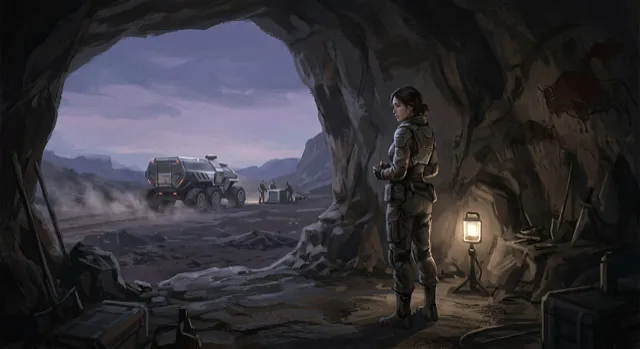
The cave mouth was narrow. Eunseo switched on her helmet lamp and turned her body sideways to slip through the crack in the rock. Her shoulder scraped the wall. The sound of her coveralls tearing echoed inside the helmet. Where the passage widened, Eunseo stopped. The lamp lit up the wall. Across the ochre stone ran a black line. It was the back of a bison. Following the curve of the rock, the line bent to raise the swell of muscle. A line drawn by a hand 40,000 years ago. Eunseo pulled off a glove and brought her fingertip to within 3 centimeters of the wall. It did not touch. It must not touch. On the surface of the pigment lay a layer that oxygen had never reached. This was the rule Eunseo had kept in this cave for the past 8 months. She had never once broken it.
The cave lay in the limestone country of Yeongwol, Gangwon-do. It was not Eunseo who found it. During road-widening work, an excavator had split the limestone wall and laid the entrance bare. The site foreman photographed it and sent the pictures to city hall, city hall contacted the Cultural Heritage Administration, and the Cultural Heritage Administration contacted Eunseo. Eunseo had trained in the conservation of prehistoric cave paintings. Including herself, there were 4 people in Korea who did this work full-time. The day Eunseo first stepped into the cave, the sight of the paintings on the walls made her knees give way. Bison, deer, handprints, geometric patterns. A scale to rival Lascaux in France or Altamira in Spain. It was the first time a painted cave like this had been found on the Korean Peninsula. Eunseo sank to the floor, took off her helmet, and looked up at the wall. She turned off the lamp and lit a candle lantern. Under the wavering flame the bison's muscles seemed to move. The people of 40,000 years ago must have looked at these paintings under the same wavering light. Eunseo sat there for 2 hours. She estimated the area of the paintings. At least 120 square meters. A discovery that would rewrite the history of prehistoric art on the Korean Peninsula. The next day Eunseo submitted an urgent report to the Cultural Heritage Administration. On the first line she wrote: First Paleolithic cave paintings on the Korean Peninsula confirmed. Once she had sent the report, Eunseo went back into the cave.
To record the condition of the paintings, Eunseo installed temperature and humidity sensors in the cave. The temperature inside held at 12 degrees year-round. Humidity, 94 percent. On the surface of the limestone walls, condensation formed and dried and formed again. When condensation touches pigment, it opens hairline cracks. Eunseo fitted anti-condensation pads to the walls. She took pigment samples and sent them out for compositional analysis. The results came back 3 weeks later. The biochemistry professor at the university who had done the analysis called her himself.
"Eunseo, there are cells in this sample."
Eunseo shifted her grip on the receiver.
"It should just be pigment. Iron oxide and charcoal-based—"
"I know the composition. But inside it, there are — well, cells. Not dead ones. Living."
Eunseo did not answer. Through the lab window she could see the mountains of Yeongwol. The white cliffs of the limestone slopes shone in the afternoon light.
"They seem to have held out 40,000 years in an anaerobic state. Inside a pigment layer sealed off from oxygen."
Eunseo asked, "What kind of cells are they, exactly?"
The professor seemed to catch his breath for a moment.
"That's… the problem. It's nothing that exists on this earth. Nothing comes up in any database."
After that, Eunseo restricted access to the cave. She reported to the Cultural Heritage Administration and installed a sealed door at the entrance. She replaced the air inside the cave with nitrogen. It was to shut out oxygen. Every day Eunseo went into the cave and checked the condition of the paintings. The hairline cracks in the pigment layer, the shifts in humidity, the condensation on the limestone surface. She organized her records into a file and sent a report to the Cultural Heritage Administration each week. The report always carried the same title: Yeongwol Cave Paintings — Weekly Conservation Status. Three months had passed since the biochemistry professor's team had taken the samples away. All that while, Eunseo had gone into the cave every day. The hours she spent with the paintings grew longer. In the handprint zone she discovered a new pattern. Two concentric circles overlapping. Its meaning was unknowable. Eunseo photographed the pattern and added it to her conservation report. At night, back at her lodging, she would put the photographs of the paintings up on her monitor and eat dinner. A second call came from the research team.
The one who called was not the professor but a postdoctoral researcher on the team.
"Um, Dr. Park Eunseo. Could we get some… additional samples? From a different area this time."
Eunseo asked, "Is something wrong?"
The researcher's voice went hoarse.
"This… it kills cancer cells."
Eunseo was taking the call inside the cave. The light of her helmet lamp was falling on the bison's eye. A single dot pressed in black pigment was the bison's eye. A dot 40,000 years old.
"What kind of cancer cells?"
"So far we've tested lung, liver, breast, and pancreatic cancer. It worked on all 12 cancer cell lines we cultured in the lab. It doesn't touch normal cells."
Eunseo looked at the wall. The bison's eye glinted in the lamplight.
"Taking more samples would damage the paintings permanently."
"I know. But if this is real, this is…"
The researcher could not finish the sentence.
Eunseo took an additional sample. From a section without the bison. The geometric patterns deep inside the cave. She pried loose a chip of pigment the size of a fingernail. The rock beneath showed through, chalk-white. One line of the pattern broke. Eunseo set down the scraper and looked at the severed line. The white flesh of the rock caught the beam of her headlamp and glowed between the black strokes. She photographed the spot and entered it into the record. Sampling location: Zone 4, geometric pattern no. 3. Amount taken: 0.3 grams. Extent of damage: 4 millimeters × 6 millimeters.
The team's results came back two months later. This time the professor came down to Yeongwol himself. They met in front of the sealed door at the cave entrance. A shadow hung over the professor's face. His beard was longer than before.
"It reproduced. The second sample… exactly the same. Applied to cancer cells, it wipes them out within 48 hours. Doesn't so much as touch the healthy ones."
Eunseo asked.
"So what is it, then?"
The professor shook his head.
"I don't know. We ran a full genome analysis, and it's not any organism that exists on Earth. Not prokaryotic, not eukaryotic… something entirely new. It's not in any textbook."
Eunseo leaned her back against the metal surface of the sealed door. The cold of the metal came through against her spine.
"So you're saying you don't know what this cell even is."
"That's right. But that it kills cancer cells—that much is certain."
The professor went on.
"There's a problem. This cell dies within 72 hours of exposure to oxygen. We tried to culture it and failed. Even under anaerobic conditions, it won't proliferate outside the pigment layer. Some specific component of the pigment seems to act as a growth medium, but we couldn't synthesize that component. The crystal structure of the iron oxide is an arrangement that only forms in a natural environment. It can't be replicated artificially."
Eunseo looked at the professor.
"So in the end, the only way to obtain this cell is…"
"Yes. We'd have to… tear out the cave paintings. As things stand, that's the only way."
Eunseo looked at the lock panel on the sealed door. The panel's green light was blinking.
"And once the paintings are removed, they'd have to be used within 72 hours."
"Yes."
The professor put his hands in his pockets. A gust of wind stirred his hair.
After the professor had gone, Eunseo went into the cave. In air displaced by nitrogen, she put on an oxygen mask and stood before the paintings. She switched off her lamp and stood in the pitch dark. Eyes closed or open, it was the same darkness. 40,000 years ago someone had stood in this darkness with a torch and drawn on the wall. Drew a bison, drew a deer, pressed a palm to the stone. Whether the cell had found its way into the pigment as the pigment was made, or the pigment had been made to hold the cell—Eunseo could not know. The question pressed down on her, heavy as the cave's darkness. She turned the lamp back on. The bison's eye gleamed. Eunseo left the cave. She pulled off the oxygen mask and drew in the outside air. As she closed the sealed door she looked back. The darkness narrowed to a sliver in the gap of the door, then vanished. Outside it was day. The sunlight hurt her eyes.
Two weeks later, the Cultural Heritage Administration called. They said discussions were underway with the Ministry of Health and Welfare. As she took the call, Eunseo looked at the conservation report on her desk. 284 pages. A file holding eight months of records.
"There's going to be an interagency joint meeting on the medical potential of the mural pigment. We'd like you to attend as well, Ms. Eunseo."
Eunseo asked.
"What are you going to do with the paintings?"
"That's a matter to be discussed at the meeting."
After the call ended, Eunseo looked at the last page of the conservation report. A photograph of the paintings, taken yesterday, was pasted there. The body of the bison. Beside it, a note in Eunseo's hand. Pigment layer thickness: 0.8 millimeters. Fine surface cracks: 23.
The meeting was held in Seoul. Eunseo drove three hours from Yeongwol. Fourteen people sat in the conference room. Cultural Heritage Administration officials, Ministry of Health and Welfare officials, a researcher from the National Cancer Center, the biochemistry professor's team, legal counsel. Eunseo presented the state of the paintings' conservation. Her voice rang thin in the room's wide expanse. The total area of the paintings was 127 square meters. The area covered with pigment was 43 square meters. The pigment layer was, on average, 0.8 millimeters thick. When Eunseo finished, the researcher from the National Cancer Center asked a question.
"2 million viable cells per gram of pigment. 5 million needed per patient. In other words, 2.5 grams of pigment is one human life. The paintings hold 34 kilograms of pigment in all, which comes to a total of 13,600 lives saved."
The room fell silent. Only the sound of the air conditioning. Eunseo looked at the last slide of her presentation. A photograph of the paintings was projected on the screen. The bison's eye looked at Eunseo from the wall.
The Ministry of Health and Welfare official spoke.
"Korea's current annual cancer deaths number about 82,000. 13,600 amounts to 16 percent of that."
The Cultural Heritage Administration official spoke.
"These are the first Paleolithic cave paintings on the Korean Peninsula. A candidate for World Heritage listing. An irreplaceable asset held in common by all humankind."
Eunseo looked from one to the other. Neither of them was looking at her. Each was looking at his own papers.
After the meeting, Eunseo ran into the professor in the corridor outside. The professor said.
"We're continuing the culture research. But realistically, I don't know whether we'll succeed. Reproducing the environment of the pigment layer isn't easy."
Eunseo asked.
"How long… would the culturing take?"
"There's no telling. It could take 1 year, or 10 years. Or whether it can succeed at all, in the first place… I don't know either." Eunseo's gaze turned to the window at the end of the corridor, to the dense press of Seoul's buildings. "Then… what about the patients in the meantime?" Instead of answering, the professor only bit her lip. Beyond the corridor window the sun was sinking. The professor said. "There's one more thing I have to tell you. The paper is going out soon. Once it's published, the press will report on it. Once that happens, the pressure to extract will grow far greater." Eunseo asked. "Can you stop the paper?" The professor shook her head. "It's already been submitted. This isn't something I can decide."
Eunseo returned to Yeongwol. She went into the cave. She stood before the mural. The geometric pattern in Zone 4. She could see the spot where the pigment had been taken. A white point, 4 millimeters by 6 millimeters. The place where the line of the pattern was severed. Eunseo looked at the pigment beside it. A black line stretched along the rock. This single line held cells inside it. Eunseo brought her finger to a point 3 centimeters from the pattern. It did not touch. That was Eunseo's rule. Eunseo lowered her finger and moved her gaze to another wall of the cave. There were handprints. 5 of them. Their sizes differed. An adult's hand and a child's hand were pressed side by side. They might have been a family from 40,000 years ago. Eunseo raised her own hand and held it beside the prints. Without touching. Eunseo's hand was smaller. The child's handprint was smaller even than Eunseo's hand. Eunseo lowered her hand. There were cells in this pigment too. Cells that had lived 40,000 years on a child's palm. Eunseo could not take her eyes off the handprint. Did the child who pressed this print know these cells existed? Did the child's parents know?
The following week, the National Cancer Center contacted Eunseo directly. "We'd like to arrange a schedule for extracting the pigment. As a first round, we're requesting 500 grams." Eunseo did the math. 500 grams meant 200 patients. 1.5 percent of the mural's total pigment. Eunseo spread out the map of the cave's mural. Where would she take 500 grams from? The bison's body. The deer's leg. The handprints. The connecting lines of the geometric pattern. No matter where she cut, the picture would be cut. Eunseo set her pen on the map. The pen did not move. The bison on the map looked at Eunseo. The bison's eye was smaller than the real one, but it was the same black point.
Eunseo went into the cave and photographed the entire wall surface again. With an ultra-high-resolution camera she recorded every zone of the mural. It took 3 days. 17,000 photographs. Eunseo saved the photos to an external hard drive and made 3 copies. One went to the Cultural Heritage Administration, one to the university, and one into the drawer of Eunseo's desk. While the photos were copying, Eunseo looked at the mural image on the monitor. The bison on the screen was the same as the real one. But no matter how she pressed the screen with her finger, there was no rough texture of rock. No thickness of pigment. No 40,000 years of time. Eunseo turned off the monitor and put the external drive in the drawer. The hand about to close the drawer hesitated in midair. This little metal box. Perhaps this would become all that remained of the cave.
Eunseo was notified of the extraction schedule. In 2 weeks. The National Cancer Center's technical team would come to Yeongwol. Eunseo would designate the extraction sites, and the team would separate the pigment. The separated pigment would be sealed in containers and transported in a nitrogen environment. 72 hours from the moment of oxygen contact. 8 hours of transport to the hospital. 12 hours to extract the cells and prepare them for administration. The actual window for administration was 52 hours. Eunseo wrote the numbers on paper. Her hand did not tremble as she wrote them. Over 8 months of handling the mural, Eunseo's hands had grown accustomed to fine work. She folded the paper and put it in her pocket. 52 hours. The time in which the mural would vanish and the time in which a patient would be brought back to life were bound to the same number.
The day before the extraction, Eunseo went into the cave. She put on an oxygen mask and sat before the mural. She shone the lamp on the bison's body. Tomorrow they would take 200 grams of pigment from this part. The boundary between the bison's foreleg and its body would disappear. Eunseo lowered the lamp and sat in the darkness. The cave's temperature was 12 degrees. Inside the mask, Eunseo's breathing echoed. Eunseo closed her eyes. The darkness of 40,000 years ago and the darkness of now were the same. Back then too, someone must have sat in this darkness. Whether that person put cells into this pigment, or whether the cells entered it naturally, Eunseo could not know. Whether this mural was a picture or a medicine, art or a prescription. She could not ask the people of 40,000 years ago.
Eunseo opened her eyes and turned on the lamp. She shone it on the edge of the mural, on a zone with no picture. Pigment was smeared there. Not part of any image—marks like splatters flung while mixing pigment. Eunseo took out a magnifying glass. She measured the size of the marks. If she gathered these marks, she could extract pigment without damaging the picture. The amount would be small. Eunseo went around the whole cave marking the pigment traces on the outskirts of the images. 47 spots. Estimated total: 80 grams. Enough for 32 patients. Far short of the 500 grams the National Cancer Center had requested.
Eunseo came out of the cave and called the National Cancer Center. "I'm changing the extraction site. We won't touch the mural itself—just scrape the pigment scattered around it. No damage to the images. But the amount… it'll only come to about 80 grams." A silence stretched out on the other end of the line. "80 grams is 32 people. We have 200 patients waiting right now." Eunseo didn't answer. Limestone dust clung to the hand holding the phone. "Ms. Park Eunseo. A picture can be preserved in a photograph, but people don't live in photographs." Eunseo didn't put the phone down. She didn't answer either. The other party hung up first. Even after the call ended, Eunseo went on holding the phone. The call duration showed on the screen. 2 minutes, 47 seconds. Eunseo set the phone down on the desk. The limestone dust on her fingers smudged the screen.
On the day of the extraction, the technical team arrived in Yeongwol. There were 3 of them. They wore white dust-proof suits. They took 50 sealed containers and a set of fine-separation tools out of a transport crate and laid them out on the floor. Eunseo met the technical team at the mouth of the cave. "I'll designate the extraction sites. We'll take only the residual pigment on the outer edges of the mural. Expected yield: 80 grams." The team leader looked at Eunseo. "What we were told was 500 grams. Extracting from the main body…" Eunseo shook her head. "Not the main body. Damage can't be restored." The team leader studied her for a moment, then picked up the sealed containers. "Let's proceed with 80 grams for now."
Eunseo led the technical team into the cave. She separated the residual pigment at the 47 outer sites one by one. With a fine scraper she scraped the pigment loose and sealed it into the containers. An average of 1.7 grams per site. Each time a container lid closed, a click echoed through the cave. Eunseo's hand held the scraper. Every time pigment came away from the wall, a fine powder drifted into the air. In the beam of her headlamp the powder glittered, then vanished into the dark. Eunseo followed the vanishing powder with her eyes each time. Inside every grain of that powder was a cell. The cells in the powder scattered through the air would die within 72 hours. Eunseo moved the scraper more carefully. When the work was done, the 47 sealed containers held 79.8 grams of pigment in all. The images of the mural were not damaged. Only the marks along the outer edges were gone. Eunseo stepped back and looked at the mural. The bison was still there. Its eye was still there.
The technical team placed the containers in a transport container and headed for their vehicle. Eunseo stood at the mouth of the cave and watched the vehicle leave. The 72 hours had begun. Cells would go to 32 patients. The remaining 168 would have to wait. Until the culturing succeeded. If it didn't, Eunseo would have to go back into the cave. And then there would be no outer marks. She would have to take it from the body of the bison. Eunseo closed the sealed door at the mouth of the cave. The green light on the locking panel came on. Nitrogen environment stable. Temperature 12 degrees. Humidity 94 percent. Eunseo stood with her back against the door. A wind blew. Yeongwol's limestone mountains glowed white in the evening sun. Her phone rang in her pocket. The name on the screen was 'National Cancer Center.' Eunseo gazed at the screen, then slipped it back into her pocket just as it was. The vibration pulsed against her thigh seven times and stopped. Eunseo took her hand out of her pocket and pressed her palm to the metal surface of the sealed door. It was cold. A palm print from 40,000 years ago was inside the cave. Eunseo's palm was on the door. She lifted her hand away. A handprint remained on the metal. It was a mark that would vanish once the evening dew fell. Eunseo put her hand in her pocket and looked at the mountains of Yeongwol. The white of the limestone mountains, catching the orange of the evening sky, was steeped in a warm glow.