The fluorescent tube blew at 3 p.m. on a Tuesday, in a ventilation shaft on the 7th underground level. Jeongha was up on the ladder, changing it out. A 40-watt straight tube. Manufactured 2,041. Fourteen years old. The moment Jeongha pulled it from the socket, the glass shattered. Fragments scattered across the floor. Fluorescent powder dispersed into the air. Jeongha turned away and held their breath. Fluorescent dust makes your skin itch if it touches you—common knowledge among the technicians of the Underground City. Jeongha peeled off the gloves and shook out both arms. Powder clung to the sleeves of the work coverall. A pale, whitish dust. The residue of phosphor and mercury vapor.
Then, from the far end of the ventilation shaft, footsteps. Someone was walking closer. Not an Underground City person. The gait was wrong. Underground City people stoop as they move through the low-ceilinged passages. Whoever this was walked with their back straight. And it was the sound of dress shoes. No one wore dress shoes underground.
The man came around the corner into view. Tall. Over 180 centimeters, by the look of him. More than 10 centimeters above the average height of the Underground City. The difference nutrition on the surface makes. His skin carried a light green tint—the color that appears when chloroplasts settle into the subcutaneous layer. A Photohuman. Someone who had come down from the surface. The man saw Jeongha and stopped. He saw the shattered fluorescent glass and narrowed his eyes. Then he saw the air, thick with drifting powder, and took a step back.
Something changed in the man's forearm. Beneath the skin, the light-green cells shivered—a fine tremor, a faint spasm. The man gripped his arm. His face twisted. The passage's emergency light was falling across the wreckage of the fluorescent tube. The emergency light's frequency and the light re-emitted by the fluorescent powder were mixing into a wavelength close to violet. Somewhere around 417 nanometers. Jeongha would only learn that later.
Sweat beaded on the man's forehead. Droplets ran down the light-green skin of his brow. He clenched his teeth. In places the skin of his forearm swelled up like blisters—chloroplasts distending under overload. The man dropped to his knees. The green of his forearm was turning brown. The color of cells going necrotic. Jeongha climbed down from the ladder and went to him. The man's face had gone pale. The green was draining out of him.
"Hey—are you all right?"
The man looked up at Jeongha. There were chloroplasts around his eyes too; the irises were green. That green was fading. The man spoke.
"The light. Outside. I have to get out."
Jeongha propped the man up and brought him out of the shaft. Out under the ordinary lighting of the 7th-level corridor. The spasms in his forearm stopped. The browned patches remained—3 coin-sized spots of necrosis. Breathing hard, the man looked at his forearm. Then he looked at Jeongha.
"What was that? In there… what the hell was in there?"
"A broken fluorescent tube. 40-watt. Just an old one."
The man shook his head.
"It wasn't the tube. The light. The color of the light was different. Close to violet."
Jeongha looked back into the shaft. The red of the emergency light and the afterglow of the fluorescent powder blended, and the inside of the shaft glowed faintly violet. Jeongha filed it away.
The man was an environmental inspector for the surface government. He had come down to check the Underground City's air-circulation system. He boarded the elevator to go back up to the surface. Before the doors closed, the man looked back at Jeongha—the necrosis on his forearm covered by his sleeve. There was wariness in his eyes. The doors shut. Jeongha stood before the closed doors. The whine of the elevator motor climbed and thinned. On the wall beside the elevator, the surface temperature was displayed. 28 degrees. Clear. UV index 8. On the 7th underground level the temperature was 17 degrees. An 11-degree gap. As with the amount of light, so with the heat.
Jeongha went back to the ventilation shaft. Collected the fragments of the broken tube. Sealed the fluorescent powder in a plastic bag. Measured the emergency light's frequency. 620 nanometers. The red band. Analyzing the powder's re-emission spectrum would take equipment.
Jeongha returned to the workshop on the 4th underground level—a room of about 3 pyeong. Tools hung on the wall. A spectrometer sat on a shelf, an old model scrapped 10 years ago that Jeongha had repaired and kept in use. Jeongha set a sample of the fluorescent powder on a glass slide and fixed the slide to the spectrometer's stage. Powered the machine on. It came to life with a hum, the 10-year-old machine's vibration traveling up through the table into Jeongha's hands. Jeongha shone a red light-emitting diode onto the sample, to reproduce the same wavelength as the emergency light—recreating the red emergency glow and casting it over the sample. A spectrum came up on the spectrometer's small screen. The fluorescent powder was absorbing red light at 620 nanometers and re-emitting violet light between 415 and 420 nanometers. The peak was at 417 nanometers.
Jeongha searched for 417 nanometers. The Underground City's database was limited. But there was an old biology textbook file. The absorption spectrum of chloroplasts. The wavelength chlorophyll a responds to most strongly was around 430 nanometers. 417 nanometers was slightly shorter than that—the high-energy border region toward ultraviolet. Energy right at the limit of what chloroplasts can process. Overload. Jeongha closed the textbook. The 417 nanometers on the spectrometer's screen. The brown spots that had bloomed on the man's forearm flickered before Jeongha's eyes. This light—this was what had made them.
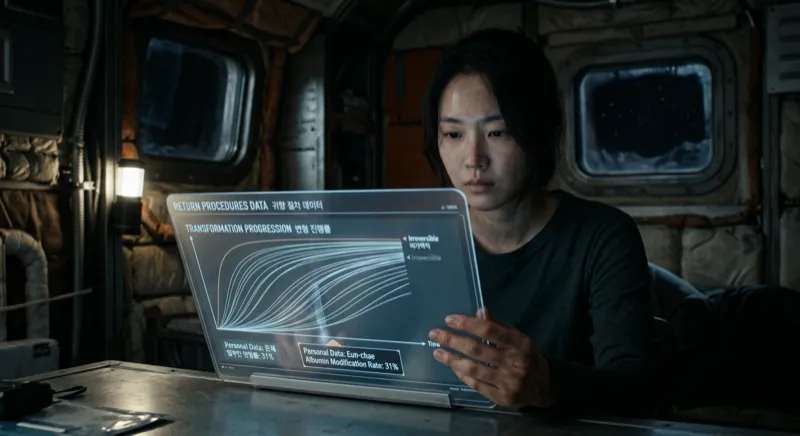
Jeongha captured the spectrometer's screen and saved it. The hand gripping the mouse trembled. He leaned back in the chair, but the trembling wouldn't stop. Photosynthetic cells. The technology the entire surface society depended on. This was a shard lodged in its heart. The weakness of humans with photosynthetic cells. The weakness of all surface society. Jeongha sat in his workshop chair and looked at the ceiling. The ceiling of the Underground City was concrete. A ceiling under which Jeongha, born and raised, had never once seen the sky. His mother, and his mother's mother, had all been born and had died beneath this ceiling. The only people who could go up to the surface were those who had received a photosynthesis gene transplant. The cost of the transplant was 12 times an annual salary. On an Underground City electrician's wages, a lifetime of saving would never be enough.
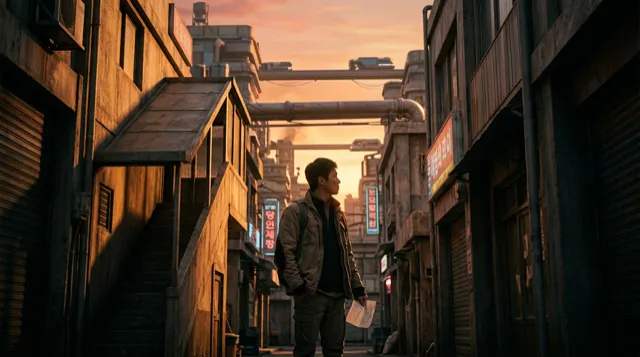
Jeongha didn't know much about the surface. The Underground City's information networks were limited. What was known amounted to about this much. On the surface, the Photohumans lived on light. 6 hours of direct sunlight a day was enough. No food was needed. No agriculture was needed. A society where the cost of producing food had dropped to 0. But that was the surface's story. The people of the Underground City still ate. Synthetic protein and hydroponic vegetables. It all cost money. The surface was abundant, the underground was poor. It was a world where light had become a class. There were no windows in the Underground City. From Basement Level 1 to Level 12. A population of 140,000. All of them born beneath fluorescent lights and dying beneath fluorescent lights. There were elevators that rose to the surface, but anyone who went up without a residence permit was forcibly sent back down as an illegal resident. Jeongha had seen the surface once. At 7 years old. When his mother went up to the surface for a hospital, he had gone with her. The elevator doors opened and light came pouring in. He couldn't open his eyes. 10 minutes later, when his eyes had adjusted, Jeongha saw the sky. Blue. An endless blue. Jeongha cried. He didn't know why he was crying. His mother took Jeongha's hand.
“Is it too bright for you?”
his mother asked. Jeongha shook his head. It wasn't that it was too bright. It was that the vastness frightened him.
3 days later, a woman came to Jeongha's workshop. Someone who had come down from the surface. Her skin was pale green. She wore a black coat. Inside the coat, a light-source pack was visible. A portable light source, to survive more than 48 hours underground. The woman closed the workshop door and sat in a chair. She looked at Jeongha.
“3 days ago, an inspector suffered cell damage in a ventilation shaft.”
The woman's voice was low and flat. Not that it lacked emotion—it was a voice that had decided to keep emotion out.
“Your name came up in the report. Said you were in the middle of replacing fluorescent lights.”
Jeongha didn't answer.
“I'm with the Surface Health Ministry. Let's cut to it. 417 nanometers. You already know what that does to photosynthetic cells, don't you?”
Jeongha looked at the woman's face. Beneath the pale green skin, he could see blood vessels. Not green vessels. Red. The chloroplasts were in the subcutaneous layer, but the blood was still red. Human blood.
Jeongha's heart quickened. How did this person even know about the spectrometer analysis? Jeongha tried to keep his composure.
“It was an accident.”
Jeongha said. His voice came out dry. He hadn't meant it to.
“I know it was an accident.”
The woman's gaze moved to the spectrometer on Jeongha's workbench.
“The question is what you did after the accident. You ran a spectral analysis with the spectrometer, didn't you?”
Jeongha's mouth went dry. The woman seemed to take his silence as confirmation; she drew an envelope from her coat pocket and slid it across the table.
“Inside is a surface residence permit and a photosynthesis transplant voucher. For 2. You and 1 family member.”
The woman looked into Jeongha's eyes.
“There's just one condition. Every record about 417 nanometers—including what's in your head—you hand it all over. And you never speak of this subject again.”
Jeongha looked at the woman's face again. Her age was hard to gauge. Photohumans aged slowly, their cells regenerating fast. She could have been in her 30s, or her 50s. The woman's eyes were cold. Not cold, exactly—practiced. Not the eyes of someone making this kind of deal for the first time.
“…I'm not the first to find this, am I?”
Jeongha asked.
The woman paused for a moment.
“You're not the first.”
That was the whole of her answer.
Jeongha looked at the envelope. A surface residence permit. The right to see the sky. A photosynthesis transplant voucher. The right to be free of food. Jeongha's mother was 62 this year. She was allergic to synthetic protein. Hydroponic vegetables alone weren't enough nutrition. Every month she had to buy supplements. The supplements cost a third of his wages.
“…Give me some time to think.”
The woman checked the light-source pack inside her coat. The pack's charge indicator glowed yellow. More than half spent. It meant her time underground was limited.
“By 8 tomorrow morning.”
The woman stood up.
“If you refuse, someone else will come. And they'll be carrying something other than an envelope.”
After the woman left, Jeongha did not open the envelope. He looked at it lying there on the table. A white envelope. And inside it, the sky.
Jeongha set the spectrometer beside the envelope and looked from one to the other. The sky inside the envelope. The 417 nanometers inside the spectrometer. Neither of them was his. He looked at his palms. Fluorescent powder still lingered in the creases of his hands. White powder ground into his fingerprints. This powder had been the beginning. If the fluorescent tube hadn't shattered up on the ladder, if the powder hadn't scattered into the air, if the inspector hadn't stepped into the corridor at that exact moment—Jeongha would have discovered nothing. He would have spent his whole life changing fluorescent tubes. The sky belonged to the surface, and the 417 nanometers had been made by chance. All Jeongha had was this 3-pyeong workshop, an aging mother, and the concrete ceiling he'd lived under for 22 years.
Jeongha left the workshop and went down to sublevel 9. His mother's room. She was sitting on the bed, taking her supplements. 3 capsules. A glass of water. Her hands were trembling. The hands of a 62-year-old. Hands that had lived 62 years in the Underground City.
"Mom. If… if you could go up to the surface, would you go?"
His mother looked at him.
"What's gotten into you all of a sudden?"
"Nothing. Just asking."
His mother swallowed her supplement and drank the water.
"And what would I do up there. My body isn't a body that lives on light."
With a trembling hand she set the empty cup down on the table. A drop of water that had clung to the rim rolled across the tabletop. It was as if 62 years of underground damp had pooled in her swollen, puffy knuckles.
"This is my home," his mother said. "Even if the ceiling feels like it's grazing my head, the people here are my neighbors."
Jeongha stepped out of his mother's room. As he closed the door he heard her drop the empty supplement bottle into the trash. The sound of capsules knocking against each other. 120,000 won a month. 1,440,000 won a year. The cost of his mother living out what was left of her life. Jeongha walked the corridor. The corridor on sublevel 9 was 1.8 meters wide. Pipes ran exposed along both walls. Fluorescent tubes hung at 2-meter intervals. 40 watts. The tubes Jeongha replaced every month. The light of these tubes was the whole of the Underground City.
Jeongha returned to the workshop. He sat down in front of the spectrometer. 417 nanometers. Hand this number over, and he could go up to the surface with his mother. He could see the sky. He could live on light. Don't hand it over, and—Jeongha remembered the woman's parting words. Someone else will come. Carrying something other than an envelope.
Jeongha switched on the spectrometer. The spectral peak at 417 nanometers rose on the screen. A sharp, narrow peak. This wavelength of light was the surface society's weakness. The one vulnerability of a society that depended on photosynthesis. Hand it over, and the surface would bury the information. Without a soul knowing. The people of the Underground City would go on living beneath their concrete ceilings, eating synthetic protein.
Jeongha saved the spectrometer's data onto a memory chip. He set the chip on his palm. It was small. The size of a fingernail. Inside it were the spectral data, the compositional analysis of the fluorescent substance, the records of the necrosis reactions he'd observed. Jeongha tucked the chip into the inner pocket of his work clothes. He picked up the envelope. Opened it. Inside were 2 cards. A surface residency permit. A voucher for photosynthesis implantation surgery. Jeongha looked at the cards. No name was written on them. Unassigned. Anyone could use them. A hologram was etched into the surface of each card. The shape of a sun. The shape of something Jeongha had never seen.
Jeongha slid the cards back into the envelope. He set the envelope on the table. He touched the chip in his inner pocket. The chip had grown warm with the heat of his body.
Jeongha drew the cards from the envelope again. The holographic sun caught the fluorescent light and bled into rainbow colors. His mother's trembling hands rose in his mind. The 62-year-old throat swallowing supplements. The fingers with their swollen joints. Jeongha put the cards back into the envelope and, for a moment, closed his eyes.
Jeongha rose from the chair. He went to the copier in the corner of the workshop. He put the chip into the copier. He made a copy. He returned the original to his inner pocket. He lifted a floor tile in the workshop and hid the copy beneath it. He set the tile back in place. The seam around it was the same as around every other tile. It didn't stand out. Jeongha set his toolbox on top of the tile. He felt the weight. Not the weight of the toolbox—the weight of what lay beneath it.
The next morning, 7:50. The woman came again. The same black coat as yesterday. The remaining-charge indicator on her light-source pack was red. Nearly spent. It meant her time underground was almost up. A faint sweat had beaded on her forehead. Her photosynthetic cells were beginning to feel the stress of too little light.
Jeongha handed back the envelope. He drew the chip from his inner pocket and passed it to the woman. She took it. She slipped it into the inner pocket of her coat.
The woman put the chip into a reader and checked the data. A spectral graph rose on the screen. The peak at 417 nanometers. The woman nodded.
"A wise choice."
For the first time her voice had loosened, ever so slightly. Jeongha couldn't tell whether it was relief welling up from something genuine, or simply the satisfaction of a job well finished.
"The residency permit will be issued within a week. The surgery will be scheduled as well."
The woman opened the door and went out. For a moment the fluorescent glare of the corridor spilled in, then vanished as the door swung shut. Jeongha was left alone in the workshop. The woman's perfume lingered. A smell that did not exist in the Underground City. Something like flowers. Jeongha sat there until it faded. Looked at the tiles on the floor. Beneath the tiles lay the copy. Jeongha stood on the tiles and felt the data underfoot. Couldn't feel it, really—but knew that it was there.
In the windowless workshop Jeongha looked up at the fluorescent tube on the ceiling. 40 watts. Mixed-frequency light. Born under this light, and under this light had lived. 22 years. Jeongha had become an electrician at 18. For 4 years, changing out fluorescent tubes. An average of 47 a month. Over 4 years, 2,256 of them. The broken, the flickering, the ones whose life had run out. Had witnessed the death of every kind of light. And for 4 years had not known that one of those dying lights was a weapon that could shake the society above ground. Soon Jeongha would leave this light and step out beneath the sun. The skin would turn pale green. Jeongha would live on light. And Jeongha would come to fear the light at 417 nanometers.
Jeongha switched off the fluorescent tube. The workshop went dark. Only the red of the emergency lamp remained. Jeongha stood in the darkness. The eyes were used to it. Over 22 years there had been countless blackouts. Changing a tube down on basement level 7, when the switch dropped, a total darkness would come. A darkness without a single point of light. To the people of the Underground City it was an inconvenience. To a Photohuman it was death. The darkness held no fear yet. Once Jeongha became a Photohuman, this darkness would turn to terror. 48 hours of it would turn to starvation.
Jeongha slid a hand into the pocket. The place where the chip had been was empty. It had been handed over. But beneath the floor was the copy. Jeongha had not told the woman that. Why the copy had been hidden, not even Jeongha could explain. Insurance against the surface? Or a debt owed to the 140,000 who would be left underground. Those people did not know this data existed. Only Jeongha knew. And soon Jeongha would go up to the surface. The skin would turn pale green. Jeongha would live on light. And Jeongha would come to fear the light at 417 nanometers. Now the direction of the threat was reversing.
Turned the fluorescent tube back on. 40 watts of light filled the workshop. Under that light Jeongha put the tools away. Today, too, the tubes in the ventilation shaft on basement level 7 had to be replaced. Tubes 14 years old. Jeongha opened a box of new ones. 40-watt straight tube. Date of manufacture, 2055. The glass of the new tube was smooth. Inside, the phosphor lay evenly coated. At what wavelength this phosphor re-emitted its light—Jeongha knew that now. There was no going back to not knowing. Jeongha took up the new tube and stepped out of the workshop. The corridor's fluorescent light threw Jeongha's shadow across the floor. The shadow walked a step ahead of Jeongha. Up on the surface the shadow's direction would change. The sun shines from above, after all. Jeongha walked, treading on the shadow. At the end of the corridor children were running and playing. 3 of them. Kicking a ball. It struck the wall and bounced. Their laughter rang off the concrete, echoing. Children born under fluorescent light. Their skin was not pale green. Neither was Jeongha's—not yet.
Underfoot, beneath the tiles, 417 nanometers lay sleeping. Jeongha shouldered the new tube and went down the stairs. On the stairwell wall someone had sprayed words.
"We have no need of light."
Old graffiti. The paint was flaking away. Jeongha passed it and kept going down. Basement level 7, the ventilation shaft. Where a tube had shattered yesterday. The socket sat empty. Jeongha set up the ladder and climbed. Fitted the new tube into the socket. Gave it a turn. The light came on. 40 watts of it filled the shaft. From the top of the ladder Jeongha looked at that light. It was the same light as yesterday. What had changed was Jeongha.