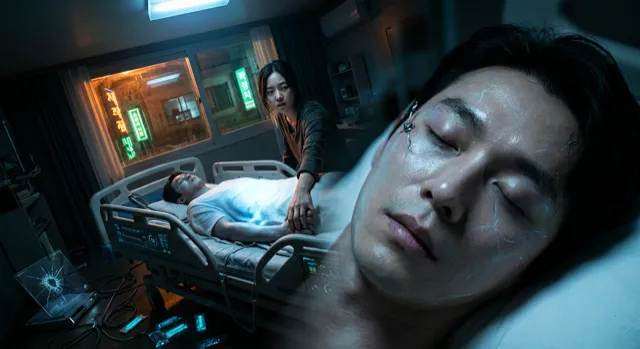
When Sua opened the door to the hospital room, her mother was standing by the window. It was a four-bed room, but the other beds were empty. Bathycella-fusion patients were assigned to the isolation ward. Not out of fear of infection. The other patients were frightened of the grey-blue skin. Her back was turned. The back of the hospital gown had come open, and the skin on either side of her spine showed. The color had changed. A week ago the grey-blue mutation had reached only 5 centimeters below the neck; now it had crept down past the shoulder blades. Sua closed the door. At the sound of it closing, her mother turned around.
"You're here?"
It was her mother's voice. The intonation too. Even the little habit of lifting the ends of her words. Sua set the plastic bag on the table beside the bed. Six tangerines. Her mother's favorite. Her mother came back to the bed and sat down. Beside Sua. Her mother's hand swept back Sua's hair. Behind the left ear. It was a gesture her mother had made since Sua was small. Sua looked at that hand. The skin under the nails was grey-blue. From the fingertips to the second knuckle. A week ago it had been only beneath the nails.
"Did you check the fusion rate?"
Sua asked. Her mother picked up the tablet from the table and handed it to her. A number was on the screen. 71.2 percent. The reading a week ago had been 68.4 percent. 2.8 percent in 7 days. An average of 0.4 percent a day. Sua looked at the number. What was left until 74 percent was 2.8 percent. 7 days. Sua's fingers gripped the edge of the tablet. The plastic dug in under her nails.
"Mom, it's 7 days."
Sua said. Her mother looked at her. The eyes were her mother's eyes. Still. The iris color hadn't changed. There was something the medical staff had told them. Once the iris color changes, the colonization of the brain's synapses has begun. Her mother's irises were still a deep brown.
"I know."
her mother said. She took a tangerine and began to peel it. As the peel came away, a citrus scent rose. Her mother's fingers worked in among the strips of peel. The grey-blue fingertips moved over the orange rind. Sua looked at that hand. Would this hand still be able to sweep back Sua's hair past 74 percent? And even if it could, would it mean the same thing?
The first time Sua came to this hospital was 8 months ago. The Marine Biomedical Center. On the coast of Gijang-gun, Busan. A five-story white building faced the sea. In front of it stood a breakwater. Beyond the breakwater you could see the waves. The wind carried the smell of salt. From the lobby you could see the sea. Her mother's diagnosis was early-onset senile macular degeneration. 54 years old. The vision in her left eye had dropped from 0.8 to 0.2 in 6 months. The right was following after it. They made the rounds of three eye clinics. All three said the same thing. The progression could be slowed but not stopped.
It was Sua who found the Marine Biomedical Center's clinical trial notice. An unknown cell discovered at a deep-sea hydrothermal vent — scientific name Bathycella immortalis. When this cell fuses with human cells, it restores the telomeres. It regenerates tissue damaged by aging. Macular degeneration, joint degeneration, loss of bone density. The Phase 1 results had been made public. 12 participants. Every one regained their sight. Every one showed improved joint function. Under the side effects it read 'skin pigment mutation.' Sua read it. Skin pigment mutation. Sua made light of what those few words meant. She thought it was something on the order of getting a mole. Sua urged her mother to join the trial. Her mother's sight was falling week by week. In a month the vision in her left eye would drop below 0.1. There was no time.
Her mother signed the consent form while Sua sat beside her. Her mother's left eye couldn't make out the signature line properly, so Sua guided the tip of the pen onto it for her. Her mother wrote her name. Kang Mi-young. Sua watched from beside her. Her mother's left eye could barely see. She was finding the signature line with her right eye alone. It took 8 seconds to write her name. Three characters. The pen trembled on the paper. Sua did not ask whether the trembling came from her eyes or from fear.
The first infusion was 3 months ago. 12 milliliters of Bathycella cell culture. Administered intravenously. Her mother spent the 24 hours after the infusion in the hospital room. Sua was beside her. Through the night her mother's temperature rose. 38.2 degrees. 38.7 degrees. 39.1 degrees. At 3 in the morning it climbed to 39.4, then began to come down. At 5 it was 37.8. Her mother opened her eyes. She looked at Sua.
"I can see clearly."
her mother said. She covered her left eye with her hand and looked at Sua with the right. Then she covered the right and looked with the left.
"The left sees clearly too."
Her mother smiled. Sua smiled too. Her mother got up from the bed and went to the window. She looked at the sea.
"I can see the waves. Even the foam."
her mother said, laying her hand on the glass. It was the first time in 6 months her mother had looked at something far away. Sua stood behind her mother and looked at the sea with her. There was still no change at the back of her mother's neck. The skin was a normal color. Back then, they could still smile.
The fusion rate was measured for the first time two weeks after the injection. 14.3 percent. The proportion of Bathycella cells that had bonded with the nuclei of her mother's cells. The medical team explained it to Sua. The higher the fusion rate climbed, the stronger the regenerative effect. At the same time, Bathycella's own traits would begin to express themselves in the human body. Bathycella was a cell that lived in colonies at deep-sea hydrothermal vents. The individual cells did not function independently. The colony as a whole operated like a single neural network. As the fusion rate rose, colony-type signal patterns could emerge in the human nervous system as well. Individual consciousness weakened, and the colony instinct grew stronger. The critical threshold was 74 percent. Past that, it was irreversible.
Sua looked at the number 14.3 percent. It was a long way from 74. It was the number at which her mother's eyes had begun to see again. Back then, Sua did not feel the weight of the number 74.
A month later, fusion rate 31 percent. Sua visited the hospital over the weekend. Her mother's knee pain was gone. She no longer gripped the railing when she climbed the stairs. A blue-gray spot had appeared on the back of her mother's neck. The size of a coin. Sua saw it. Her mother checked it in the mirror and said,
"It's just one little spot."
Two months later, fusion rate 49 percent. Her mother's hair began to darken. The white was growing back black from the roots. Her mother said to Sua over the phone,
"Guess I won't be needing the salon anymore."
The sound of her laughter came through the receiver. Sua laughed too. Back then they could still laugh. The blue-gray spot had grown to the size of a palm. Sua was smiling when her mother hung up, but after she set the phone down she opened a search window. Bathycella immortalis fusion side effects. 3 results. One paper had clinical data. Behavioral changes begin above 50 percent fusion. Decline in individual-recognition function above 60 percent. Irreversible colonization above 74 percent. Sua looked at the table in the paper. A graph correlating fusion rate with behavioral change. The curve rose sharply past 50 percent. Sua turned off the screen.
Three months later, fusion rate 62 percent. Sua took the train down to Busan. 2 hours 18 minutes from Seoul. On the train she looked at her mother's blood work on a tablet. Bathycella cell density: 42 million per milliliter. A month ago it had been 28 million. The cells were multiplying inside her mother's body. When Sua visited the hospital that weekend, her mother was looking out the window. The window that faced the sea. She did not turn around even when Sua came in.
"Mom."
Sua called out. Three seconds later her mother turned. Her eyes found Sua. But the gaze did not land directly on Sua's face. First it took in her shoulders, then her neck, then her chin, and only after that her eyes. A way of scanning the whole. Not the way you look at a person. The way you size up an object.
"Sua."
her mother said. She spoke the name. But it took 3 seconds for the name to leave her mouth. Before, her mother would call her name at the sound of her footsteps alone, before Sua had even opened the door. Sua sat down beside her. She took out a tangerine. Her mother took it. She did not peel it. She held it in her hand. She was feeling its round shape. Her fingers moved along the surface. As if reading the form of the fruit. The motion of probing an organism. Sua had seen that motion before. In a documentary that played in the lobby of the Marine Biomedical Center. A scene of a Bathycella colony at a deep-sea hydrothermal vent, wrapping itself around a new object to make out its structure. What her mother's fingers were doing to the tangerine was the same.
"Good, isn't it?"
Sua asked. Her mother looked at her.
"This one's cell structure is regular."
her mother said. Sua's back went cold. She took out another tangerine, peeled it, and handed it over. Her mother took it and put a segment in her mouth. Chewed. Swallowed.
"Sweet."
her mother said. Taste, at least, was still possible. Sua clung to that one word. Her mother was registering the tangerine not as "something delicious" but as "something whose cell structure is regular."
It was that afternoon that Sua went to see the attending physician, Han Jeong-woo. Han Jeong-woo's office was on the 3rd floor. Marine cell specimen slides were stacked on his desk.
"At fusion rate 62, is a change like this within the expected range?"
Sua asked. Han Jeong-woo turned his monitor toward her. A graph of clinical data. Of the 12 participants, 3 had crossed 60 percent fusion. The other 9 had stalled below 50 percent.
"All 3 showed similar behavioral changes,"
Han Jeong-woo said.
"A change in how they perceive objects, slower reaction times, diminished emotional expression. Above 60 percent, colony-type neural patterns start to activate."
Han Jeong-woo scrolled the screen.
"Once it passes 74 percent, the colony neural network replaces the individual's. After that, even if we stop treatment, the fusion continues on its own. There's no turning back."
Han Jeong-woo stopped talking for a moment and looked at Sua. He seemed to be reading her expression. Sua's face didn't move. She stayed in her chair and looked at the marine-life poster on the office wall. A photograph of a deep-sea hydrothermal vent. Hot water surging up out of the dark, and around it, a colony of cells glowing. A blue light. That was what had been inside her mother's body.
"What happens if we stop the treatment?" Sua asked.
"The fused cells aren't removed. They lock in at 62 percent. The regenerative effects hold. Eyesight, joints, bone density. But there's no further recovery."
"And the behavioral changes?"
"The changes stay at their 62 percent level. They don't improve."
Sua went back to the room. Her mother was sitting up in bed, looking out the window. Again. Looking at the sea. When Sua came in, her mother turned. This time it took only a second. She looked straight at Sua's face.
"Sua."
Her mother said it. Without hesitation. Her mother's hand reached across the bed and took Sua's. The hand was cold. The temperature of blue-gray skin. But the strength of the grip was her mother's. The way it folded around Sua's hand was her mother's.
"There's something I want to tell you," her mother said. Sua sat down beside her. Her mother smoothed Sua's hair back again. Behind the left ear. The blue-gray fingertips brushed Sua's earlobe. Cold.
"Lately the sea calls me. It's hard to explain, but something comes from the direction of the sea. Not a sound. Something like a vibration. To here."
Her mother pressed her palm flat against her own chest.
"At first it scared me. I couldn't sleep. The vibration gets stronger at night. It matches the hours when the waves come in. But now I'm not afraid. It's peaceful. It's not that the sea is calling me—it's more like the sea is speaking to me."
Sua's mouth was going dry. Her tongue stuck to the roof of her mouth. Her mother went on.
"But it's different when I look at you. That vibration coming from the sea stops. When I see your face, it stops. As long as I know who you are, it seems to stop."
Sua held her mother's hand. She tightened her grip on it. Her mother's hand was cold, but she didn't let go.
"Mom, let's stop the treatment."
Sua said it. Her voice cracked.
"They say if we stop it at 62 percent, your eyes still hold, and your knees are all right too."
Her mother looked at Sua. Three seconds. Her mother's eyes rested on Sua's. Deep brown irises. Still her mother's eyes.
"Sua," her mother said.
"I want to stop while I still know who you are. But I don't know how long that will be."
Sua couldn't answer. Through the window she could hear the sound of the waves. The hospital stood on the coast. The sea was close. Her mother was spending more and more time looking at it.
That night Sua sat in the hospital lobby. The vending-machine coffee was going cold. There was no one in the lobby. Ten at night. The sound of the coastal wind came through the building's glass. Sua wrapped both hands around the coffee. The warmth was leaking out of the paper cup. It was going cold, like her mother's hand. Moisture had beaded on the surface of the cup. Sua opened her tablet. Her mother's fusion-rate graph. A curve that had started at 14.3 and climbed to 71.2. The slope of the curve was constant. No sign of stopping. They'd said that even if the treatment stopped, it would lock in at 62 percent. But right now it was 71.2 percent. Whether stopping now would lock it at 71.2 or bring it down to 62, Sua hadn't checked. She called Han Jeong-woo.
"What happens if we stop at 71 percent?"
Han Jeong-woo was silent for two seconds.
"If we stop at 71, it locks in at 71. It doesn't come down."
"71 means it's only 3 percent short of 74. What's the chance it keeps going on its own?"
"There've been no cases of self-progression at 71 yet. But we only have three data points above 70 to begin with. I can't guarantee it."
Sua hung up. She drank the coffee in the paper cup. It was cold. A bitterness stayed at the back of her tongue.
Seven the next morning. Sua had slept on the sofa in the hospital lobby. Her neck was stiff. She washed her face and took the elevator. Fourth floor. A nurse passed down the corridor. When Sua opened the door to the room, her mother was standing at the window. Looking at the sea. Sua shut the door. Her mother turned. She looked at Sua. She looked at Sua's shoulders. The neck. The jaw. The eyes. She ran her gaze over the whole of her.
"Organism," her mother said.
Sua's feet stopped. In the two meters between the bed and the window. Her mother had called her "organism." Not by her name. The word out of her mother's mouth struck Sua's eardrum. Sua couldn't move. The strength had drained from her legs. Her mouth was thick and stale. Her heart was beating against the wall inside her ribs. It wasn't that her mother didn't know her. It was that her mother had classified her as an organism. It was the language of the colony. The way Bathycella referred to another organism.
Her mother's hand rose. It smoothed Sua's hair back. Behind the left ear. The blue-gray fingertips brushed Sua's temple. Cold. The motion was the same. A motion repeated thousands of times since Sua was small. Sua looked at that hand. This gesture was her mother's. But the mouth that had called Sua "organism" was not her mother's.
A blue-gray rim had formed at the edge of her mother's iris. A thin ring circling the brown. Sua saw it. The thing the medical team had described. When the iris changes color, the colonization of the brain's synapses has begun. Sua's knees gave. She caught the edge of the bed. The sheet crumpled in her fist.
Her mother's hand rested on Sua's hair. The stroking motion had ended, but the hand lingered. On Sua's head. Her mother's fingers trembled faintly.
"Sua."
her mother said. After "organism," three seconds later, she called Sua's name. The voice was different. Not the flat tone she used for "organism." When she said "Sua," the end lifted. It was her mother's intonation.
Sua embraced her mother. Her mother's body was cold. No warmth came through the hospital gown. The temperature of blue-gray skin. But her mother's arms wrapped around Sua's back. There was strength in the way they held her. Sua buried her face in her mother's shoulder. Her mother's gown smelled of the sea. Salt and seaweed. Before, it had smelled of fabric softener. Lavender. It had been her mother's smell since Sua was small. That smell was gone, and the sea had moved in. Water ran from Sua's eyes. It fell onto her mother's gown. Her mother's arms held Sua tighter.
Sua spoke with her face still buried in her mother's shoulder.
"Mom, stop it today."
Her mother's arm didn't halt on Sua's back. It stroked. From top to bottom. The motion her mother used to make when Sua cried as a child.
"All right."
her mother said. Her mother's hand stroked Sua's back once more.
"I'm sorry."
her mother said. Sua lifted her head. There was moisture in her mother's eyes. Over the brown iris ringed in blue-gray, clear water had pooled. Her mother was crying. A drop fell from her mother's eye and landed with a tap on the back of Sua's hand. A sensation as cold as the sea itself.
Han Jung-woo came to the room at 2 p.m. He brought the consent form to discontinue treatment. 2 pages. Her mother signed. Kang Mi-young. The pen did not tremble. Different from 8 months ago. Sua signed too, as guardian. Before Han Jung-woo took the form away, he checked her mother's irises. With a penlight. Her mother did not blink. Han Jung-woo switched off the penlight. He wrote something in his notebook. He said to Sua,
"The final fusion-rate measurement is tomorrow morning. We need 48 hours of monitoring after discontinuation."
Han Jung-woo carried the form out. The door closed.
Two people remained in the room. It smelled of disinfectant. The IV line had been removed from her mother's arm. The administration of the Bathycella culture medium had stopped. The empty IV stand stood by the window. Her mother sat on the bed. Sua sat beside her. Beyond the window lay the sea. The afternoon light was shattering on its surface. Her mother was watching the sea. Sua watched it too.
"The vibration comes."
her mother said. She pressed a hand to her chest.
"But right now it's weak."
Her mother looked at Sua. Looked into Sua's eyes. She didn't scan the whole of her. Straight to the eyes.
"When you're beside me, it goes weak."
Sua took her mother's hand and laced their fingers together. The sound of waves came from beyond the window. A faint tremor that started in her mother's hand traveled up Sua's arm. The sea glittered under the afternoon light. Her mother's hand was cold inside Sua's. Cold, but holding on. Whether tomorrow morning's number would stop at 71.2, or move another 0.4 further, there was no knowing. Sua rose from her seat. Without letting go of her mother's hand, she walked to the window and pulled the blind cord. The plastic slats came rattling down and erased the sea. The room darkened. Her mother's blue-gray fingertips glowed faintly in the dark.