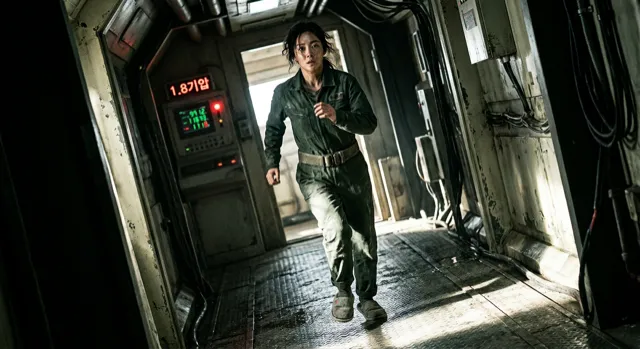
The alarm sounded at 3:07 in the morning. 42 meters underground. Seed vault, Sector 4. Yunha pulled herself out of the sleeping bag and looked at the console. Red letters glowed on the screen. 'Temperature anomaly. Sector 4 current: minus 2.1 degrees. Set point: minus 18 degrees. Deviation: 15.9 degrees.' Yunha tapped the screen twice. It wasn't an error. The compressor on cooling module 3 had stopped. She opened the module panel. Ice had formed in the compressor's drive assembly. The drain line had frozen, and the coolant backing up had frozen the drive solid. With a replacement part it could be repaired. But there was no replacement part. The parts stock had run dry after the last resupply, 3 years ago. Yunha shut the panel. The module would not run again. She stepped out into the corridor. The corridor thermometer read minus 7. Her breath came out as steam. Her ungloved fingers went numb in 2 minutes.
When she opened the door to Sector 4, fog came pouring out. As the temperature climbed from minus 18 to minus 2, the ice inside the vault had begun to melt. Water had pooled on the floor. Yunha's boots stepped into it. The splashing echoed through the vault. She switched on the flashlight. The beam swept across the shelves. 1,200 aluminum canisters stood in rows on the shelving. 420 varieties of rice, 310 of wheat, 180 of barley, and the rest millets and legumes. The last copy of South Korea's seed-preservation system. Yunha had managed this vault for 3 years. For 3 years she had checked the temperature twice a day, inspected the humidity once a week, and once a month opened a canister at random to examine the seeds by eye. 2,190 temperature checks. 156 humidity inspections. 36 visual examinations. Never once had anything been wrong. Until today. The originals aboveground had been lost in the first year, when the storm began, 3 years ago.
Yunha stood before the shelf. Condensation had beaded on the surface of the canisters. Droplets ran down the aluminum. She picked up the nearest canister and opened the lid. Inside there should have been vacuum-sealed seeds. The seeds were there. But the vacuum seal had swollen. Gas had formed inside. Yunha tore the packaging open. Rice seeds. But something like white thread was reaching out from the surface of the seeds. Roots. The seeds were germinating. At minus 2 degrees.
Yunha drew her hand back. She set the canister on the shelf. She opened the one beside it. The same. And the one beside that. She walked along the shelf, opening 12 canisters. All 12 had begun to germinate. It was impossible for rice seeds to germinate at minus 2 degrees. The minimum germination temperature for rice was 10 degrees Celsius. Yunha set the flashlight on top of the shelf and picked up the radio.
"Base. This is the vault. Sector 4 cooling module down. Internal temperature minus 2 degrees. Seed germination in progress."
Static came through the radio. 3 seconds. 5 seconds.
"…Vault, this is Base. Did you say germination? At minus 2 degrees?"
It was Jeongtae's voice. The surface control room. A man 42 meters above Yunha.
"That's right. 12 canisters confirmed. All of them germinating. The roots have grown more than a centimeter."
On the other end came the creak of a chair. Jeongtae had gotten to his feet, it seemed.
"…Bring a sample up. We need to analyze it."
Yunha sealed 3 of the germinated seeds into a container and rode the elevator up. As the elevator warmed, the color returned to her face. When she reached the surface floor she heard the wind. Wind battering the outer walls of the building. Wind that had not stopped in 3 years. The average temperature in Seoul was minus 23 degrees. Even at the height of summer it dropped below minus 15. After the storm began, farming had become impossible. Food meant only the stockpiles and the reserves in the seed vault. 30,000 people remained in the Seoul survival zone. In the storm's first year, most of the population had moved south. Busan, Jeju. But the storm had covered the whole of the Korean Peninsula. The south, too, was below minus 10. Nowhere could anything be grown. There was a single reason 30,000 people had stayed in Seoul. The seed vault. The last seeds lay beneath this building. The hope that, as long as the seeds existed, someday they could be planted again. That hope was what held 30,000 people in Seoul.
The analysis lab was on the second floor of the building. Jeongtae was waiting at the door. His face was swollen. Lack of sleep. He was the man who managed the surface food rations. His work was calculating the daily rations for 30,000 people and watching the dwindling reserves confirmed in numbers. There were dark shadows beneath Jeongtae's eyes.
Yunha handed the sealed container to Jeongtae. When she set it down, her hand was trembling. Not from the cold alone. Jeongtae opened the container and took out a seed. He gripped it with tweezers. The white root reaching out from the surface of the seed quivered beneath the tweezers.
"This grew at minus 2 degrees?"
Jeongtae asked.
"Yes."
Jeongtae set the seed on a microscope slide.
The analysis took 4 hours. Yunha sat in a chair in the corner of the lab and waited. Jeongtae was reading data at the console. 7 in the morning. Yunha's stomach growled. She hadn't gotten the morning ration. The distribution point aboveground opened at 6 a.m. Because Yunha had been underground, she'd missed it. The daily ration: 1,800 kilocalories. Miss it, and you waited until the next day. While Yunha waited in the lab, the wind outside the building did not let up. Beyond the wall she could hear the snow striking the outer wall. A sound like scattered sand.
"The results are in."
Jeongtae turned the screen. Yunha rose from the chair and went to it. On the screen sat two genetic maps side by side. On the left, the original rice. On the right, the germinated seed.
"Genetic match: 61 percent."
Jeongtae said. His voice was dry.
"That's 39 percent different from the original rice. This isn't rice anymore."
Yunha looked at the screen. 39 percent. The genetic match between a human and a banana was 60 percent. The germinated seed had mutated to a point closer to a banana than to rice.
"It changed like this inside the vault over 3 years?"
Yunha asked. Jeongtae shook his head.
"Not 3 years. No mutation can happen while the cooling holds. The mutation began after the cooling stopped—when did the module fail?"
"As of last night, an estimated 72 hours ago."
"39 percent mutation in 72 hours."
Yunha thought about what that number meant. In natural evolution, generating a 39 percent genetic difference had taken tens of millions of years. This seed had done it in 72 hours. In the process of waking from a frozen state of minus 18 degrees to minus 2 degrees, its genes had been explosively reorganized. Adaptation to an extreme environment. Mutation for the sake of survival. The seed had changed itself. Jeongtae shut his mouth. He looked at the screen again. His fingers had stopped over the keyboard.
Jeongtae ran an additional analysis. The traits of the mutated seed. The results surfaced on the screen. Yunha read them. Minimum germination temperature: minus 20 degrees. Minimum temperature for photosynthesis: minus 15 degrees. Growth cycle: 28 days from germination to fruiting. Fruit yield: 3.2 times the original rice. Yunha's eyes stopped. Her heart beat fast. Deep inside her chest. Photosynthesis at minus 15 degrees. Harvest in 28 days. Yield 3.2 times. It meant cultivation was possible in the surface environment of minus 23 degrees. For the first time in 3 years.
The moment Yunha started to speak, Jeongtae scrolled the screen. At the bottom were the toxicity results. 'Heavy-metal-binding protein (metallothionein variant) detected in fruit. Concentration: 0.08 percent of dry weight. Bioaccumulation in humans: high risk. Projected onset of irreversible liver damage: 10 years of continuous consumption.' Yunha read that line twice. 10 years. Eat this fruit for more than 10 years and the liver fails. Yunha sat down in the chair. The strength had drained from her legs. A miracle plant that grew at minus 15 degrees. And attached to that miracle was a 10-year curse.
"The original seed?"
Yunha asked.
"Is there an original that hasn't mutated?"
Jeongtae checked the data.
"All of Sector 4 was affected. When the cooling stopped, the temperature rose across every sector. All 1,200 containers. Nothing remains in its original state."
Jeongtae leaned back against his chair. He looked at the ceiling.
"And even if an original had survived, it wouldn't germinate at surface temperature. Rice needs at least 10 degrees to grow, and up top it's minus 15 even at the height of summer."
Yunha went to the lab window. Outside, snow was flying. Snow flying horizontally. The road in front of the building was invisible. White wind. 3 years ago, April cherry blossoms had been visible outside this window. Now there was nothing but snow. Yunha laid a hand against the window frame. The metal was cold. The moment her fingers touched the metal, she felt the heat drain out of them.
Jeongtae came over to Yunha. Holding a tablet. Numbers were up on the screen.
"Current surface food reserves remaining: 11 days. Based on 30,000 people."
11 days. Yunha looked at the number.
"Plant the mutated seed on the surface and you can harvest in 28 days. To stretch 11 days of reserves across 28 days, we'd have to cut rations to 39 percent of the current amount. 640 kilocalories per person per day."
"Is that enough for a person to survive on?"
"Survive, yes. If you don't move. For 28 days. An adult with a basal metabolic rate of 1,500 kilocalories taking in only 640 would run a deficit of 860 kilocalories every day. Over 28 days, a shortfall of 24,080 kilocalories. Converted to body weight, that was about 3 kilograms of fat and muscle burned away. You could live. Barely."
Yunha looked at the numbers on the tablet. 11 days. 28 days. 640 kilocalories. 10 years. The numbers overlapped in Yunha's head. Plant now and you can eat in 28 days. But in 10 years the liver fails. Don't plant, and in 11 days the food runs out.
"We have to plant it."
Yunha said.
"To worry about 10 years from now, we have to get past 11 days first."
Jeongtae looked at Yunha. The shadows under his eyes looked darker.
"I know that too. The problem is what we tell 30,000 people. 'Eat this and you'll live, but in 10 years your liver fails'?"
"We tell them the truth."
Jeongtae looked out the window. Nothing showed through the snow.
"My daughter is 8."
Jeongtae said. His voice was low.
"If she starts eating this, her liver gives out at 18. Before she's even grown."
Yunha looked at his profile. His jaw was clenched.
"Tell them the truth and there's a choice. But between starving to death in 11 days and your liver failing in 10 years — is there anything you could call a choice?"
Yunha couldn't answer. The wind slammed against the window. The building shuddered faintly. The tremor rose through the floor into the soles of Yunha's feet.
Yunha went back down to the basement. The deeper the elevator dropped, the more the temperature fell. Zone 4. She opened the door. The fog had thinned. The temperature had dropped further, to minus 4. With the cooling modules gone, the underground bedrock was slowly settling toward equilibrium. Yunha stood in front of the shelves. 1,200 containers. Every one of them mutated seed. She opened a container. The root of the germinated seed had grown longer. 3 centimeters. Six hours ago it had been 1 centimeter. 2 centimeters in six hours. The seed was growing. At minus 4.
Yunha walked between the shelves, a container in hand. 1,200. Was it enough to feed 30,000 people? She needed to run the numbers. Measured against the original rice, the seed bank of 1,200 varieties had been for preservation, not cultivation. 50 grams of seed per variety. 60 kilograms all told. Take the first harvest from 60 kilograms of seed, replant part of the yield, repeat, and — Yunha stopped calculating. There was something that had to come before the math.
Yunha picked up the radio.
"Headquarters. Requesting preparation to transfer the entire stock of mutated seed in Zone 4 to the surface greenhouse."
The radio went silent for 3 seconds.
"…Vault, this is Headquarters. Authority to approve a transfer lies with the operations committee, not you. You know that."
"I know. I'm requesting that the operations committee be convened."
Through the radio came Jeongtae's sigh. Short.
"All right. I'll convene it."
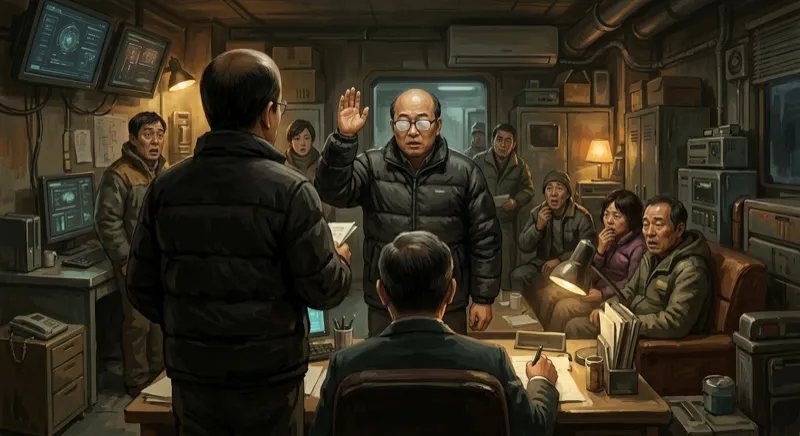
The operations committee met at 2 p.m. The conference room on the 3rd floor. 7 people. Yunha and Jeongtae included. Yunha reported the analysis. Genetic match rate, 61 percent. Germination temperature, minus 20. Harvest in 28 days. Heavy-metal-binding protein. 10 years. The members' faces were rigid. No one asked a question. The numbers left nothing to ask. The silence held for 15 seconds. The heating in the conference room wasn't working. Breath steamed from people's mouths. The steam of 7 people mingled at the center of the room.
One member spoke up.
"10 years — surely another way can be found in that time."
Jeongtae answered.
"It might. But there's no guarantee."
Another member asked.
"And if we don't plant it?"
"In 11 days the food runs out."
The room went quiet again.
The meeting ended at 4 p.m. Two hours. There was only one conclusion. Transfer the mutated seed to the surface greenhouse and begin cultivation. Cut the food ration to 640 kilocalories a day. Disclose the toxicity of the mutated seed to all 30,000 people. Whether to eat it would be each person's own decision.
The vote was 6 to 1. The one who opposed was Jeongtae. After the vote Jeongtae left the room without a word. Yunha watched him go. His shoulders were slumped. He had said his daughter was 8.
Yunha left the conference room. In the corridor she looked out the window. It was 4 in the afternoon and the sky was dark. Storm clouds had swallowed the sun. Three years running now. Yunha walked down the corridor to the elevator. A map of Seoul's survival zones was tacked to the corridor wall. Red dots on the map marked the distribution points. 12 of them. 30,000 people were queuing at 12 distribution points. She went down to the basement. Zone 4. The fog had almost cleared. The water on the floor was starting to freeze again. Her boots came down on the thin ice. It cracked. Yunha began shifting the 1,200 containers onto a transfer cart. Each container weighed 400 grams. 1,200 of them came to 480 kilograms. Impossible for Yunha alone. She called for hands over the radio. 30 minutes later 4 people came down. People in cold-weather gear. Their faces were flushed. Not from the cold. Yunha looked at their faces. One of them, lifting a container, asked.
"What is this?"
Yunha answered.
"Seed."
"What are we planting?"
"Rice. No — what used to be rice."
The man looked at Yunha. Eyes that didn't understand. Yunha didn't explain. Once the transfer was done, a notice would go out to all 30,000 people. They'd find out then. What it was they'd be eating. Yunha thought about what that notice would say. Who would write it. It would be Jeongtae. Jeongtae would lay out the numbers. 61 percent. 28 days. 10 years. Yunha didn't picture the faces of the 30,000 who would read those numbers. There was no room to picture it. The containers had to be moved. People come up from the surface. People who took the rations. People who would now eat what was inside these containers.
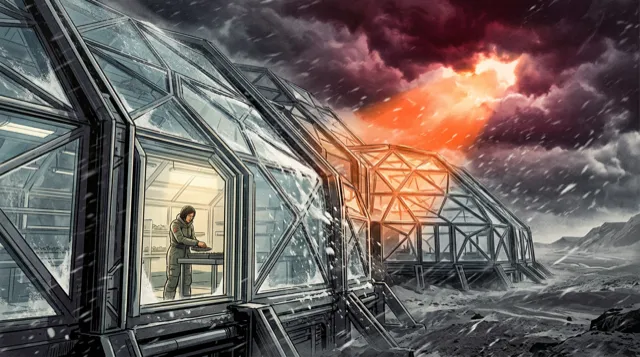
The transfer took 3 hours. The elevator ran between the basement and the roof 23 times. Yunha's arms went numb. Her back ached. It was punishing work for a body running on 640 kilocalories. She could feel the missed morning ration. Her stomach was empty. On an empty stomach she was hauling 1,200 containers. All 1,200 containers went up to the rooftop greenhouse. The greenhouse sat on the roof of the building. Triple glazing. Before the storm it had been a greenhouse for growing vegetables. Lettuce, tomatoes, herbs. Now it stood empty. Only the shelves remained. Rusted metal shelves. There was no heating. The interior temperature was minus 17 degrees. For the mutant seed, that was warm enough. Yunha opened the first container in the greenhouse. She moved the seeds to a tray filled with soil. With gloved hands. The moment the roots of the seed touched the soil, Yunha's fingers went still. This was not rice. Only 61 percent the same as the original rice. The other 39 percent was something Yunha did not understand. It was this 39 percent that made photosynthesis possible at minus 15 degrees, that let it bear fruit in only 28 days, that put heavy-metal-binding proteins into that fruit.
Yunha pressed the seed into the soil. Her finger sank in. The soil was cold. Soil at minus 17 degrees. The seed lay buried in it. She could smell the earth. Even cold earth had a smell. Minerals mingled with moisture. It was the first time in 3 years Yunha had smelled soil. There had been no soil in the underground vault. Only aluminum and concrete. Yunha picked up the next seed. Moved it. Pressed it in. Again. The first tray took 12 minutes to fill. 48 seeds to a tray. To sow all the seeds from the 1,200 containers, she would need more than 500 trays. There were 200 trays in the greenhouse. The rest she would have to make. Yunha set the first tray down on the greenhouse floor. The sound of it meeting the floor rang out. She picked up the second tray. Moving all 1,200 containers would take days. Yunha did not stop.
Outside the greenhouse the wind slapped against the glass. The triple panes shuddered. Snow struck the surface and slid down. Yunha looked past the glass as she pressed seeds into the tray. The sun was setting. Orange light bled through the storm clouds. It was the first sunset she'd seen in 3 years. No. The clouds had only thinned for a moment. The light lit the inside of the greenhouse for 30 seconds, then vanished. Gray again. Wind again. Seoul lay buried in white. Only the top of Lotte Tower showed through the clouds. The rest was hidden behind snow and wind. Inside those buildings were 30,000 people. 30,000 people waiting on rations. 30,000 people whose rations would run out in 11 days. Only the outlines of the buildings were visible. She couldn't see the roads. She couldn't see the trees. Three years ago the cherry blossoms had bloomed in Seoul in April. What would grow in this greenhouse now was not cherry blossoms. Nor was it rice. It was a thing without a name.
Yunha set down the tray. She peeled off her gloves. She touched the soil with her bare hands. It was cold. Her fingers went numb. There was a seed in the soil. Its roots would be reaching down into the earth. In soil at 17 below zero. Yunha laid her hand on the soil. 28 days. Something would grow up out of this soil. It would feed 30,000 people. For 10 years. What happened after 10 years would be decided by the people of 10 years from now. Yunha lifted her hand away. A handprint stayed behind in the soil. The shape of five fingers. She pulled her gloves back on and picked up the next seed. The wind rattled the greenhouse glass. The glass trembled and gave off a low sound. Yunha pressed the seed into the soil. In 28 days a stalk would rise from this soil. An ear would form on it. That ear would feed 30,000 people. For 10 years. What would happen in the 11th year, no one knew. Yunha picked up the next seed. Set it in the soil. Pressed it down. Her fingers were cold. She did not stop.