The first time Junha felt the mass in his side was in the shower. Below the left ribs. Something round met his fingertips. Not hard. Soft. It slid under the skin when he pressed. Junha pushed at it with his fingers. No pain. The absence of pain was normal. CellBoost tumors were engineered to bypass the pain nerves. Cancer that doesn't hurt. That was the whole point of CellBoost. Because a player who hurts can't play. A tumor that grows without pain, remakes the body without pain, raises your ability without pain. But in exchange, no warning signals either. Even when the tumor began pressing on an organ, it didn't hurt. And because it didn't hurt, there was no reason to stop.
Water from the showerhead ran down Junha's shoulders. Hot water. Junha laid his palm over the mass. He felt heat. The tumor's own heat. When cell division accelerates, the metabolic heat rises. Something the team doctor, Han Jeong-min, had explained during the third procedure.
"If the tumor gets hot, come in right away."
Han Jeong-min's voice echoed in Junha's head. Junha took his hand away. He finished the shower. He stood in front of the mirror. He looked at his left side. The skin bulged slightly. Two weeks ago it hadn't been visible. Now it was. Something was pushing up from under the skin.
Junha got dressed. Not the uniform — street clothes. It wasn't a game day. Game day was three days out. The last game of the season. If his batting average for this game pushed past .320, his contract would be renewed. If it didn't, he'd be released. Junha's current season average was .318. One hit in three at-bats in the final game would be enough. If CellBoost was working.
Junha went to the hospital. The team's dedicated medical suite. Two floors underground. When he stepped off the elevator, the smell of disinfectant hung in the corridor. He opened the door to the medical room. Han Jeong-min was seated in front of a monitor. Seeing Junha, he swiveled his chair around.
"The tumor's gotten bigger,"
Junha said. Han Jeong-min stood up.
"Lie down."
Junha lay down on the exam table. He pulled his shirt up. Han Jeong-min picked up the ultrasound device. He spread gel over Junha's side. It was cold. Han Jeong-min pressed the probe to the skin and moved it. An image appeared on the monitor. A boundary of gray and black. Inside it, a round shape. The tumor. A gray mass sat in the center of the screen. Its edges were irregular. On the ultrasound two weeks ago, the boundary had been smooth. Now it was ragged. The tumor was reaching out into the surrounding tissue. Like tendrils. Han Jeong-min's hand stopped. The probe held still over the tumor. Han Jeong-min looked at the numbers on the monitor.
"4.2 centimeters,"
Han Jeong-min said. His voice dropped.
"The threshold is 3 centimeters. That's 1.2 over. It has to come out immediately."
Junha looked at the ceiling. The fluorescent lights in the medical room's ceiling glowed white.
"Just give me 3 days."
"In 3 days it'll be past 5 centimeters. At 5 centimeters it presses on the spleen."
Han Jeong-min set the probe down. He pointed at the monitor. Beside the tumor, the spleen was visible. The distance between the tumor and the spleen was marked on the screen. 8 millimeters.
"There's only 8 millimeters left. If the tumor pushes on the spleen, there's a risk of splenic rupture. If you take a hit during a game—"
Han Jeong-min cut himself off. He looked at Junha.
"17 percent chance of dying mid-game."
Junha sat up on the table. He pulled his shirt back down. Still smeared with gel. The gel spread into a stain on the shirt.
"If I have it removed, when can I get the procedure again?"
"Six months. It takes at least six months for the tissue to stabilize after removal."
"Six months means the season's over."
"Yes."
Junha looked at Han Jeong-min. Han Jeong-min looked at Junha.
"If you take it out, my average drops. You know that."
Han Jeong-min shut his mouth. He knew. The increased muscle-fiber density the CellBoost tumor produced, the accelerated reflexes, the widened field of vision. Cut the tumor out and all of it vanishes within 48 hours. Junha's natural average was .240. Without CellBoost, he couldn't clear .300.
Junha left the medical room. The corridor. The elevator. The first-floor lobby. He walked out of the club building. The March air was cold. Junha walked toward the parking lot. He got in the car. He didn't start the engine. He sat gripping the wheel, staring ahead. The parking-lot wall. A crack ran through the concrete. Junha looked at the crack. The crack in the wall. The tumor in his body. Both had been made by a force pushing out from within.
Junha's phone rang. 'Coach' lit up on the screen.
"Junha, I've got to lock in Thursday's lineup. How's your condition?"
"I'm fine."
"You've got to clear .320. You know that, right?"
"Yes."
"Take care of yourself."
The call ended. Junha set the phone down. He laid his hand on his side. The mass was there. Warm. He could feel the heat even through his shirt.
The first time Junha got CellBoost was two years ago. Right after he came up from the minors to the first team. His average was .220. A teammate told him, "You don't do CellBoost, you won't last here." Nineteen of the twenty-five players on the roster had had the CellBoost procedure. League-wide, it was 78 percent. The players who didn't get it fell behind in the numbers. It didn't trip the doping tests. A CellBoost tumor originated from the athlete's own cells, so it wasn't an external drug. Legal, by the rules. That was the conclusion the Sports Ethics Committee reached after three years of deliberation. "Physical enhancement using an athlete's own cells falls under the individual's right to self-determination." There were dissenting voices. The players who had refused CellBoost issued a joint statement. "Is a sport that permits you to grow cancer inside your own body still a sport?" The statement was buried. When the numbers go up the crowds grow, when the crowds grow the broadcast rights go up, when the broadcast rights go up the clubs make money. CellBoost was a cancer that paid. Junha had the procedure. After the first round his average rose to .270. After the second, .290. After the third, .310. Every procedure grew the tumor. The more the tumor grew, the more his ability rose. The more his ability rose, the more he came to depend on the tumor.
Through the third procedure the tumor had stabilized at 2.8 centimeters. Below the threshold. Within the safe range. Junha had let himself relax. But four weeks ago the tumor had started to grow again. He hadn't added a procedure. The tumor was growing on its own. Han Jeong-min told him, "In 11 percent of patients past the third procedure we see autonomous growth. The tumor slips out of the recipient's control." 11 percent. Junha had landed inside it. For the tumor to slip out of control meant the tumor had a purpose of its own. Growth. Division. Expansion. Inside Junha's body, Junha's cells were growing with no regard for Junha's will. The sense that your own body was not your own. The moments when he couldn't tell whether the thing beating in his side was his heart or the tumor were multiplying.
Junha got out of the car. He didn't go home. He went to the indoor batting range. Night hitting practice. There was no one at the range. The lights were only half on. The netting of the batting cage sagged in the dark. Junha's footsteps rang off the concrete floor. He stepped into the cage. He took up a bat. Left-handed. The weight of the bat settled into his hands. 890 grams. A weight that had felt heavy before CellBoost. Now it was light. The muscle fiber the tumor had built was lifting the bat.
The pitching machine threw a ball. 148 kilometers an hour. Junha's eyes tracked it. The ball looked slow. CellBoost's field-of-vision effect. The microtumors around his optic nerve had sped up the way he processed visual information. Junha swung. The bat met the ball. The crack rang through the cage. Metallic. A clean sound. The ball buried itself in the net.
Second ball. Third ball. Fourth. Junha kept hitting. The ball looked slow. The bat was light. His body moved fast. Perfect. This body was perfect. The body the tumor had made.
On the twelfth swing his side pulled tight. A short pain. It wasn't supposed to hurt, but it hurt. Junha set the bat down. He touched his side. The mass moved. It was different from before. Before, it moved only when he pressed it. Now it was moving on its own. Under the skin the tumor was beating like a pulse. Regularly. Junha took his hand away. He lifted his shirt. There was no mirror. It was a batting range. Junha bowed his head and looked at his side. The surface of the skin rose and fell, faintly. The tumor's throb. It was as if he'd grown a second heart.
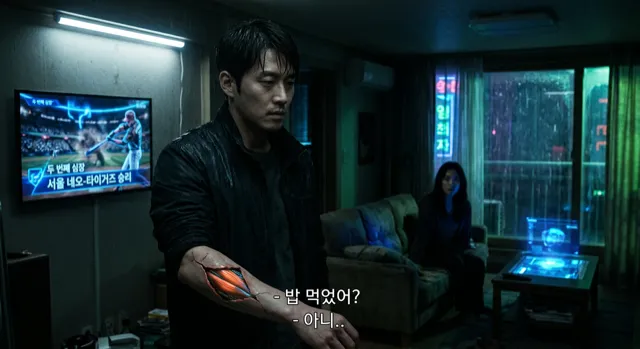
Junha walked out of the batting range. Rain had started to fall outside. A fine drizzle. His hair got wet. He got into the car. Turned the key. Drove home. Parked in the apartment lot. Rode the elevator up. Seventh floor. He opened the front door. His wife, Soyeon, was sitting in the living room. The television was on. Sports news. Junha's team was on the screen.
"Have you eaten?"
Soyeon asked.
"No."
"Want me to warm something up?"
"I'm fine."
Junha sat down on the sofa. Soyeon looked at him. There was a smear of ultrasound gel left on his shirt.
"Did you go to the hospital?"
Junha didn't answer. He watched the television. The news was running a story about another team's player and CellBoost. A player had collapsed mid-game. His CellBoost tumor had pressed on his liver. They'd carried him off the field. News caption: 'CellBoost incident, 4th this season.' Of those 4, 2 had died. One from a ruptured spleen during play. One from internal bleeding from liver compression. The other 2 retired after emergency resections. All 4 had taken the field with tumors past 4 centimeters. Junha's tumor was 4.2 centimeters.
"Junha."
Soyeon's voice changed. Dropped lower.
"How much has it grown?"
Junha looked at her. Her eyes were fixed on his side. The outline of the mass showed through his shirt.
"4.2."
Soyeon's mouth opened, then closed.
"The limit's 3."
"I know."
"Get it cut out."
"If I do, I'm released."
Soyeon looked at him. 3 seconds. Moisture spread across her eyes. She'd been against his 1st procedure. Against the 2nd, too. On the 3rd she said nothing. She knew that saying it wouldn't be heard.
"So what if you're released. It's better than dying."
Junha got up from the sofa. Went into the kitchen. Opened the refrigerator. Took out water and drank. The cold water ran down his throat. The tumor at his side was beating. Every time he swallowed, he felt the tumor's pulse. Stomach and tumor lay side by side, 8 millimeters apart. Junha set the bottle down. Through the kitchen window he could see the lights of the city. The apartment complex. Streetlamps. Somewhere out there lived people who didn't play baseball. People with no tumors. Junha looked at the window. His own face was reflected in the glass. Below the face, a body with no uniform. Under the shirt the tumor was beating. He stared at his face, then lowered his eyes. He looked at his side. The pulse showed through the shirt.
Thursday. Game day. He opened his eyes at 6 in the morning. Soyeon wasn't beside him. He went out to the living room and found her sitting at the kitchen table. She looked like she hadn't slept all night. The skin under her eyes was dark. A single sheet of paper lay on the table. Han Jeong-min's medical report. Soyeon had called the medical office and gotten it. At the bottom of the report it read: 'Probability of death by ruptured spleen if player takes the field: 17 percent.'
Soyeon didn't speak. She looked at Junha. Her hand rested on the table. Her fingers gripped the corner of the report. She was pressing hard enough that her fingernails went white. Junha sat at the table. He read the report. 17 percent. 17 times out of 100. 1 in 5.9. He set the report back on the table. Soyeon's hand came down over it. Her hand was shaking.
"Can't you just not play?"
"It's a contract."
"A contract matters more than your life?"
Junha looked at her. He didn't answer. His not answering was the answer.
40 minutes by car to the stadium. As he drove, Junha was aware of his side. The tumor's pulse went on. A pulse faster than his heart. Over 90 beats a minute. The tumor was growing. His body temperature was 0.4 degrees above normal. The metabolic heat of the tumor. His hands sweated on the wheel. A pre-game program was playing on the radio. The commentator said Junha's name.
"If Junha goes 1 for 3 today, he pushes over .320. It could be the season's finest moment."
Junha turned off the radio.
The locker room. He put on the uniform. The tumor touched the inside of it. As the fabric pressed against it, the shape of the tumor showed even from outside the uniform. Junha looked in the mirror. The left side of his torso bulged slightly. He pulled on another layer of undershirt. The mass was hidden. The other players in the locker room were getting ready. Mingyu, the leadoff hitter, was stretching. Mingyu had a CellBoost tumor in his left arm. In the biceps. When he bent his arm, the tumor swelled up like a muscle. Mingyu's tumor was 2.4 centimeters. Within the safe range. Mingyu looked at Junha.
"Side doing okay?"
"It's fine."
Mingyu nodded and turned away. It was a world where you didn't believe the word fine so much as you understood that not asking was the courtesy. Players didn't ask about each other's tumors. What each man was growing inside his own body was his own affair.
Han Jeong-min came into the locker room. He stood in front of Junha.
"I'll say it one last time. Cut it out and you live. Take the field and it's 17 percent."
Junha was pulling on his glove. Left hand. Right hand. The glove's leather fit his hand. Before CellBoost the glove had been loose. Now it fit exactly. The tumor had grown even the muscle fibers of his fingers.
"I'm playing."
Han Jeong-min shut his mouth. He turned and walked out.
Top of the 1st. Junha sat in the dugout. The opposing pitcher was warming up. A pitcher who threw a 152-kilometer-an-hour fastball and a 140-kilometer slider. For a Junha without CellBoost, a pitcher too hard to hit. For a Junha with CellBoost, a pitcher he could hit.
Bottom of the 1st— no, the 2nd. Junha's turn at bat came. Junha came out of the dugout. He took up the bat. He walked to the plate. The stadium lights were bright. Sound came from the stands. Junha stood in the box. He spread his feet. He lifted the bat. The pitcher threw. Fastball. 151 kilometers an hour. Junha's eyes tracked the ball. It looked slow. He could see the seams. Swing. The bat met the ball. The crack rang through the stadium. The ball flew into left-center. A hit.
Junha reached first base. His side was throbbing. The tumor's pulse rang out, layered over his heartbeat. Two hearts. One heart keeping Junha alive. One heart that could kill him. Junha stood on first and caught his breath. His heart was beating 140 times a minute. The tumor was beating 95 times a minute. Every time the two beats overlapped, his side throbbed. Like a tremor. Inside the uniform the tumor was hot. Sweat was soaking the uniform. The first-base coach looked at Junha. Junha nodded. That he was all right.
Bottom of the 5th. Second at-bat. One out, nobody on. The pitcher had changed. A lefty. A pitcher with a good slider. Junha stood in the box. He lifted the bat. His side pulled tight. The tumor was moving. Toward the spleen. Junha felt it. The sensation of the tumor sliding beneath his skin. Something warm and soft was passing under his ribs.
First pitch. Ball. Second pitch. Strike. A slider. The third pitch came. Fastball. 147 kilometers an hour. Junha swung. As the bat came around, his torso turned. In the instant of the turn came the sensation of something rupturing in his side. The feeling of something hot spreading out. The bat met the ball. The grounder rolled toward the third baseman. Ground ball. Out. Junha didn't run to first. He stood in the box. Still gripping the bat. He held his side with his left hand. It was hot. The inside of the uniform was wet. Whether it was sweat or blood, he couldn't tell.
The umpire looked at Junha. The first-base coach came running. Junha was standing. He could still stand. For now. The tumor was pressing on the spleen. It hadn't burst. He was on the outside of the 17 percent. For now.
Bottom of the 7th. Third at-bat. Two outs, runner on second. A hit and his average would be .321. The contract would renew. Junha stood up from the dugout. His side hurt. There was pain. The CellBoost tumor had been designed to bypass pain. This wasn't a muscle ache. It was the sensation of something sharp stabbing the flesh from within. Junha took up the bat. He walked to the plate. His stride was tilted a little. To the left. Toward the tumor. From the dugout Han Jeong-min was watching Junha. In Han Jeong-min's hand was a syringe. Anesthetic for emergency resection. There to be administered the instant Junha collapsed. Junha didn't look at Han Jeong-min.
He stood in the box. The pitcher threw. Fastball. 149 kilometers an hour. Junha's eyes tracked the ball. It looked slow. It still looked slow. The tumor was still working. His vision was clear as glass, but the boundaries of his body were blurring like fog. Junha swung. His torso turned. Heat surged up out of his side. The bat met the ball. The crack of the hit. The ball flew into right-center. It climbed high. The outfielder ran back. The ball carried over the outfielder's glove. A double.
Junha rounded first. He ran. His side was hot. Something hot was spreading through his body. He reached second. He didn't slide. He arrived on his feet. He stood on the bag. He breathed. The crowd was cheering. They were calling Junha's name. On the scoreboard
"Double"
lit up. His breath came short. He touched his side. The mass had grown. Every swing drove a shock into the tumor. As if the shock of the swing had woken it, the mass swelled and pushed against the ribs.
Junha's batting average went up on the scoreboard. .321. The threshold for contract renewal, met. Junha looked at the scoreboard. The numbers glowed bright. In Junha's side the tumor was beating. Faster than the numbers on the board.
Top of the 8th. Defense. Junha went out to the outfield. He stepped onto the grass. The grass was wet. Dew. Junha took his position in the field. The heat from his side reached the night air through the uniform. The heat coming off the tumor was raising steam out through the fabric. White steam. Steam rising from Junha's body. From out toward third, a teammate looked at Junha. He would have seen the steam coming off Junha's side. It would have been visible from the stands too. A night game. Under the lights, steam rising off a player's body. An eerie hush fell over the murmuring stands. There was no one who didn't know what that thing rising off the player meant. The stands went quiet. Junha didn't look at the stands. But Soyeon would be sitting somewhere out there. Soyeon would be watching the steam. The steam rising from Junha's body.
Junha reset his grip on the glove. Just then the last batter's ball shot up over his head. In the moment he stepped back to make the catch, the sensation of the tumor twisting inside reached him. With the dry sound of the ball socketing into the glove, the siren ending the game rang out. Junha, his back turned to his teammates, stared at a single point in the stands. The light was breaking apart in the heat-shimmer that rose above his shoulders.