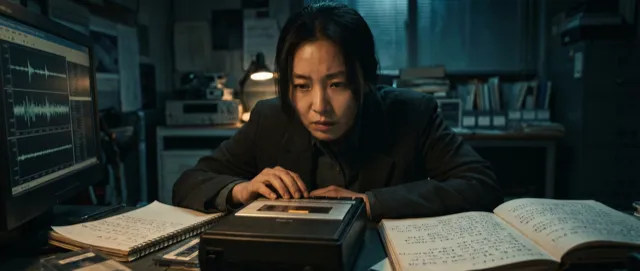
Ink smell. It had settled into her fingertips. To be precise, it was the scent of a traditional ink refined from squid ink. In her office at the National Intangible Heritage Center in Seoul, Imanishi Sua was writing her final report with that ink. By the institute's regulations, a dead-language interpreter had to submit, each quarter, the preservation status of the language in her charge, formatted to the official review template. An administrative procedure fixed by the Committee. Pause. Filling in that form, Sua thought. Yes—how absurd a thing it was, to record the death of a language in administrative paperwork. Beyond the window, the cityscape of Seoul lay below. Headlights streamed between the forest of buildings, and countless people came and went in the streets, yet nowhere in that city could Jejueo be heard. Never. Pause. Sua set down her pen and closed both eyes. Fatigue. It had seeped through her whole body. It had been more than six months since she'd put off her health checkup. She knew she was ignoring the signs of illness, and still she could not stop. Not one bit. If she stopped, it felt as though everything would come down.
Sua's family ties were complicated. Born to a Korean mother and a Japanese father, she had carried an unease about her identity since she was small. Her mother was from Jeju, and her grandmother had been a native speaker of Jejueo. But living in Seoul, her mother had forgotten Jejueo. Within the family, the loss of the language had already happened first; and as a result Sua majored in linguistics, as if to reclaim what she had lost, and arrived at last at the peculiar profession of dead-language interpreter. Her father died when Sua was sixteen. Her relationship with her mother had long since grown distant. The memories of being raised were not warm ones. Never. Loneliness—that was Sua's daily life, and she had grown used to living in isolation, but familiarity did not mean comfort. Never. Her income was not ample. She lived alone in a small studio in Seoul, and her living conditions could hardly be called good. Not one bit. Her debt, too, was creeping upward little by little. Sua felt it: that she was not the one holding on to the language—the language was holding on to her.
"Grandmother, how are you feeling today?"
Beyond the video call, Grandmother Kang Sun-deok's face appeared. One hundred and one years old. The last native speaker of Jejueo. Under UNESCO policy, the sole living proof of Jejueo, classified as a critically endangered language. Grandmother felt it—that her words would soon be gone—yet she did not let that fear pass her lips. Silence. A long one. Deep were the wrinkles at the corners of Grandmother's eyes on the screen. They were the traces of time passing over her body. They were also the traces of years lived alone, without anyone to care for her.
"Teacher, the report is due tomorrow."
"I know."
Sua answered curtly.
"Good, you coming all this way to see me."
There was warmth in Grandmother's voice, while on the screen her expression showed plain exhaustion. Sua hesitated. A long while. Whether to ask about her health, or to begin the recording. Time. Knowing there was not much of it, in the end she pressed the record button. A brief pause. A brief pause. A brief pause. A brief pause. A brief pause. A brief pause. A brief pause. A brief pause. A brief pause. A brief pause. A brief pause. A brief pause. A brief pause. A brief pause. A brief pause. A brief pause. She felt her heart clench. It did. The thought grazed her that this recording might be the last one. She remembered—three years ago, when she first met Grandmother, the motion of the hands peeling a tangerine. Back then Grandmother had said: Words—how would words die? It's the people who die. That saying changed Sua's life.
Sua's work fell broadly into two things. One was expanding the oral archive of Jejueo through her regular conversations with Grandmother. The other was reviewing the AI-based Jejueo translation system. This system was being developed on the national budget with the approval of the Cultural Heritage Committee, and was to be opened to researchers in the form of a platform. Institutionally it was a flawless project. The institute's support, the Committee's audits, the regular reviews—all were in place. And yet the reality was otherwise. Utterly. The translation AI's accuracy was falling short of the institute's review standard of ninety-five percent. The cause was not a shortage of data. Not in the least. It was because the nuances of Jejueo—especially the way it carries emotion—were fundamentally different from standard Korean; that is, there existed a domain a machine could not translate, and this was not a limit of technology but a matter of being. The translation platforms current in the market were built to the standard of efficiency, but Jejueo held a depth that efficiency could not measure.
"What was that you just said?"
"Tell me why this project matters."
"Because Grandmother is here."
"Is that enough?"
"It's enough."
Grandmother asked from beyond the screen. When Sua explained the translation system, Grandmother fell silent for a long time. No one spoke. No one spoke. No one spoke. No one spoke. No one spoke. No one spoke. No one spoke. No one spoke. No one spoke. No one spoke. No one spoke. No one spoke. No one spoke. No one spoke. No one spoke. No one spoke. A long while. Sua held her breath.
"If the words go inside a machine, then they aren't words anymore, now are they."
Sua wrote the words down in her notebook. Her heart clenched. She felt that the old woman was right. She was—but the institutions and the policies demanded digital preservation. Under the Cultural Heritage Committee's regulations, the preservation of intangible cultural heritage had to be carried out by way of a recording medium. The memory of a living person was not recognized as a legal means of preservation. That was the moment. That was the moment. That was the moment. That was the moment. That was the moment. That was the moment. That was the moment. That was the moment. That was the moment. That was the moment. That was the moment. That was the moment. That was the moment. That was the moment. That was the moment. That was the moment. The logic of administration and the logic of life were colliding. The system granted worth only to what could be measured. Ah, Sua thought. Yes. The tremor carried in the old woman's voice was something that could not be stored in any database.
Sua was full of regret. Deeply. She should have come to the old woman sooner. She should have learned Jejueo while her own grandmother was still alive. When the ties within a family are cut, the language is cut along with them. That loss was personal and, at the same time, social. She swallowed her breath. She swallowed her breath. She swallowed her breath. She swallowed her breath. She swallowed her breath. She swallowed her breath. She swallowed her breath. She swallowed her breath. She swallowed her breath. She swallowed her breath. She swallowed her breath. She swallowed her breath. She swallowed her breath. She swallowed her breath. She swallowed her breath. She swallowed her breath. She remembered the nights in childhood when her grandmother had sung her lullabies in Jejueo. That voice was already gone. There were too many things in the world that could never be taken back. Sua was afraid. Terribly. The thought came to her that she too, like the old woman, would grow old with something lost.
The next week Sua went down to Jeju. It was because word had come that the old woman's health had sharply declined. On the plane Sua gazed out the window. Beneath the clouds she could see the sea. When the outline of Jeju appeared, her heart beat faster. As the taxi carried her from the airport toward Gujwa-eup, the cityscape gave way to countryside. Time slowed. Time slowed. Time slowed. Time slowed. Time slowed. Time slowed. Time slowed. Time slowed. Time slowed. Time slowed. Time slowed. Time slowed. Time slowed. Time slowed. Time slowed. Time slowed. The old woman's living conditions were wretched. The old house, ringed by stone walls, had no insulation, and its heat depended on an old-fashioned oil boiler. Under the local government's ordinances, care services for elderly people living alone were supposed to be provided, but the actual delivery of them was scant. The old woman lived in isolation. There were almost no neighbors. None at all. The village had stood empty ever since the young people left.
"Grandmother, won't you come to Seoul? I could help look after you."
"Sua, you have to rest."
"I can't rest."
"Why not?"
"Because there's no time."
"I'll die in this house, I will."
The old woman was resolute. Sua had no choice but to accept the decision. Outside the window it grew dark. Outside the window it grew dark. Outside the window it grew dark. Outside the window it grew dark. Outside the window it grew dark. Outside the window it grew dark. Outside the window it grew dark. Outside the window it grew dark. Outside the window it grew dark. Outside the window it grew dark. Outside the window it grew dark. Outside the window it grew dark. Outside the window it grew dark. Outside the window it grew dark. Outside the window it grew dark. Outside the window it grew dark. So she had to find another way. Sua went to the Jeju City administrative welfare center. She asked for the care services to be expanded.
"By regulation, we can't go beyond the care personnel already assigned."
"But she's the equivalent of a holder of a national intangible cultural asset. Isn't a policy exception possible?"
"There's no such ordinance yet. We can only spend within the budget that's been approved."
Sua thought. Yes. That a reality in which the system exists but is never enforced could be this cruel. Law and policy spoke of preservation, but they did nothing to care for an actual human life. The logic of the market reigned over everything, and so Sua had no choice but to solve it on her own.
Sua hired a caregiver at her own expense. A third of her income went into it. Debt began to pile up. She could feel her own health failing. It was true. She was ignoring the signs of illness. There was no family for her to raise, no one waiting for her. Only the old woman's voice held Sua fast. It was a cord that went by the name of trust. If it snapped, Sua too would come apart.
But the situation grew more complicated. The Cultural Heritage Committee carried out an audit of the Jejueo preservation project. The audit singled out the translation AI's substandard accuracy as a problem. The committee gave notice that it would put the project's continuation to a vote, and so Sua had to lift the translation accuracy within two months. The possibility of dismissal could not be ruled out either. Sua was afraid. Terribly. If the project were shut down, her relationship with the old woman would be officially severed as well. The blade of the institution was aimed at the relationship.
"Mother, it's me."
"Sua?"
"Yes. I'm sorry I haven't been in touch for so long."
"It's all right. Thank you for calling."
Sua worked through the night. She refined the recorded data with the old woman still further and sorted Jejueo's patterns of emotional expression by hand. Loneliness. Deep. Her colleagues had already moved on to other projects. Sua was the only one left. The anxiety came at every daybreak. The conflict was with herself. Between the temptation to give up and the will to go all the way to the end, Sua made the same choice over again, every day.
"Why go that far?"
Minji—an old friend and a researcher at the same institution—asked. It was lunchtime, in a small restaurant near the office.
"If this language dies, the whole world she lived in vanishes with it."
"But what about your health? You look awful."
"I'm fine."
It was a lie. Sua could feel it—her body drawing close to its limit—but she couldn't stop. Minji was silent. For a long time. Then Minji asked. "Are you really okay?" Sua answered. "I told you I'm fine." Minji said. "That's exactly what someone who isn't fine says." Sua was silent. For a long time. "Sorry." Minji said. "Don't be sorry." It was the silence of someone who knew that saying anything more would do no good.
In the end, Sua chose a different approach. Instead of raising the accuracy of the translation AI, she decided to write a paper proving, academically, the untranslatability of Jejueo—a head-on rebuttal of the committee's evaluation criteria. Sua hesitated. For a long time. This choice could end her career. Ah, but in the end she decided to write it. She drew a deep breath and typed the first sentence. The paper's central claim was clear: the value of a language lies not in its translatability but in its relationality.
The paper set off a great stir in academia, while inside the committee the backlash was fierce. Criticism poured in that she had ignored administrative standards. Then something no one expected happened. A lawsuit was filed in court. A civic group brought an administrative suit demanding that the Jejueo preservation project be allowed to continue. The city's citizens began to care about the death of a language. The repercussions were vast. It became national news, and the matter was even raised in questions before the National Assembly. The floodgates of policy change began to open. At last.
Sua took the stand as a witness. She played the old woman's recording. Jejueo rang out through the courtroom. The judge, the lawyers, the gallery—all fell silent. No one understood the words. Not in the slightest. And yet, in the tremor of the voice and the spacing of the breaths, they felt something. They remembered—that they, too, had once lost something. A sense of loss filled the courtroom. Sua's heart felt as though it would burst.
Afterward the court ruled that the project would go on. But the news that truly mattered to Sua came from somewhere else. It was word that the old woman had been hospitalized. Her health had declined sharply.
Sua rushed to Jeju. Under the fluorescent lights of the hospital corridor, the old woman had grown small. Sua took her hand. The old woman opened her eyes.
"Sua."
It was standard Korean. For the first time, the old woman had called Sua's name in standard Korean. The moment the last speaker of Jejueo called out a name in standard Korean. Sua's heart seemed to stop.
"Grandmother, please speak to me in Jejueo."
The old woman closed her eyes for a moment. Then her lips moved.
"Now that you've come, my words won't die."
Sua wept. Hard. She did not record those words. No record, she thought, could ever hold this moment. Institutions, policies, the center's regulations—all of it was meaningless before this moment. Relationship. Only that remained. Only the trust between the two of them.
The old woman was discharged a week later. It was not a full recovery, but her trust gave Sua new strength. Sua came back and finished her report. Its final sentence read: A language is not preserved by institutions; it is preserved by relationships.
The Cultural Heritage Committee adopted the report. The Jejueo preservation policy turned from its old digital-centered model to a human-centered one. At last a new ordinance was enacted, extending institutional protection to the relationship between speakers of dead languages and their interpreters. Sua felt the ripple of it. Across the country, other dead-language preservation projects began debating the same kind of shift. Other interpreters who had faced dismissal were able to keep their posts. It was the moment an institution changed for the sake of people.
Sua's own life changed, little by little too. She called her mother—to mend the long-severed ties of family. Her mother wept. Hard. Tears. Sua wept too. Hard. What she had believed to be lost had only been asleep. She decided to get a medical checkup as well. Care was not something only others needed. Not at all. She needed it for herself, too.
Sua went to see the old woman again. Under the tangerine tree, Sua asked. "Grandmother, what would you like to eat?" The old woman said. "A tangerine." Sua said. "I'll bring you one." The old woman smiled. "Good." The old woman had been waiting. Sua took out a pen filled with squid-ink. The old woman spoke and Sua wrote. The wind blew in through the stone wall. And after that day, the work went on. As long as one does not give up, words do not die. As long as one does not stop caring, the bond is not severed. Sua thought: the title of last interpreter of a dead language was heavy, but its weight was what kept her alive. The way out of isolation was to listen to someone's words. Only within a relationship did language breathe.
When Sua first applied for this job, the interviewer asked why she wanted to revive a dead language. Sua answered that it was not dead but sleeping. The interviewer explained that, by the center's evaluation criteria, a language with one speaker or fewer was effectively classified as a dead language. Sua did not say the rule was wrong. Instead she read aloud a poem written in Jejueo. The interviewers fell silent. In that silence, Sua was hired.
The first year after she was hired was one long stretch of sorting archives. The task was to organize and classify three thousand hours of Jejueo voice data that had already been collected. Administratively it was tedious work, but to Sua it was the process of unearthing treasure. Inside the recordings, the voices of speakers long dead were still alive. Old men told stories of the sea; old women sang. Each of those voices was a shard of the world called Jejueo. Sua felt it — the hope that if she could fit these shards together, a whole world would come complete.
But reality gave no quarter. The center's budget was cut every year. To the policymakers, preserving a dead language was no priority. None at all. By the logic of the market, there was no reason to invest in a language with no speakers. Sua raged at that logic, but she had no power to change the system, and so she had to wring the most she could from the resources she was given.
She had first met Grandmother Kang Sun-deok three years earlier. A small village in Gujwa-eup, Jeju. Inside a low house where a stone wall broke the wind, the old woman was peeling a tangerine. When Sua held out her business card, the grandmother studied it for a long while and then spoke. Honjeo opseo — come on in. It was pure Jejueo, unmixed with any standard Korean. Sua's heart lurched. An intonation she had only ever heard in scholarly recordings was pouring from the mouth of a living person.
“Grandmother, my work is preserving Jejueo.”
“Preserve? And what would that be?”
“Recording the words you speak, and keeping them.”
The grandmother held out a segment of tangerine to Sua.
“Every time I hear folk say a language is going to die, I have to laugh. How does a language die? It's people who die.”
Sua wrote the words down in her notebook. In squid-ink. From that day on she went to Jeju every month. An hour by plane. A good part of her income went to the fare, but she never complained. When she reached the grandmother's house, the first thing she checked was the tangerine tree in the yard. The old woman would tell the turning of the seasons by the state of that tree. When the tree was healthy, it was a good day for the grandmother too; when the leaves drooped, her health was poor.
The conversations with the grandmother were recorded and stored in the center's archive. But the moments that went unrecorded mattered more. The times they ate together. The times they sat in the yard and let the wind come at them. The times they sat side by side and said nothing at all. It was in such hours that the bond deepened. This, Sua thought, was the thing that came before language. As trust accumulated, the grandmother began to bring out stories she had never told before. Memories of the Japanese occupation. The tragedy of April Third. The loss of a family. These were stories that had never been recorded in any institution's archive. Sua was afraid. Terribly afraid. That these stories would vanish along with the grandmother.
The translation-AI project was built on these conversations. The grandmother's voice data was the core of its training material. But the machine could not learn the grandmother's tremble. It could not grasp the meaning of a silence. It could not read the emotion held in the spacing of a breath. Sua described this honestly in her report. Later, at the committee's review, that honesty became the problem.
The committee's auditor spoke. Falling short on accuracy, he said, was nothing but wasted budget. Sua argued back. The value of a language, she said, could not be measured by accuracy. But in the world of administration, a claim without numbers carried no weight. None whatsoever. In the end, the time she was granted was two months. Over those two months Sua shuttled between the office and Jeju, refining data, writing her paper, and caring for the grandmother. To do all three at once was next to impossible, but Sua did not give up. To give up was to concede the loss, and Sua had nothing left to lose.
The title of the paper ran like this: Untranslatability and Linguistic Ontology. It was an academically rigorous piece of work, yet dissolved within it was Sua's own experience. The things she had discovered in her conversations with the grandmother. Jejueo's singular system for expressing emotion. Nuances that could not be carried over into standard Korean. As she translated these into the language of science, Sua felt, at the very same time, the irony — that she too was trying to translate the untranslatable.
The last time Minji offered her counsel was the night before the court testimony. Take that stand tomorrow, and there's no coming back. Sua nodded. She knew. But she did not want to go back. She wanted only to go forward. She wanted to do everything that could be done while the grandmother's words were still alive.
The testimony in the courtroom lasted twenty minutes. But those twenty minutes changed everything. When the grandmother's voice filled the courtroom, the judge took off his glasses and wiped his eyes. Someone in the gallery began to weep. Even without understanding the language, one could understand the voice. Unmistakably. That was what Sua had wanted to prove. Language is relationship before it is meaning. It is existence before it is voice.
The story after that day unfolded slowly. In the wake of the court's ruling, the Cultural Heritage Committee began to reexamine its internal policy. New provisions on the preservation of dead languages were debated, and qualitative measures were added to the existing quantitative review criteria. The administrative change was sluggish, but its direction was clear. Watching that change, Sua thought to herself. Institutions move slower than people — but once they turn, they hold for a long time.
Sua asked, "Grandmother, aren't you lonely?" The old woman answered, "I am. But when you come, I'm not." Sua said, "I'll come every week." The old woman smiled. A little. "Is that a promise?" Sua nodded. "It's a promise." The old woman said, "A promise is a thing you have to keep." Sua answered, "I'll keep it." The old woman closed her eyes. "Thank you." Sua said, "I'm the grateful one." The old woman held out her hand. "Take it." Sua took it. "It's warm." The old woman said, "Because I'm alive." Sua wept. "Live a long time." The old woman answered, "I will."
The old woman's health was still unsteady. But under Sua's ongoing care it was working its way toward stability. A caregiver tended to her every day, and Sua made a video call every week. Once a month she visited Jeju in person. After the relationship was institutionalized, the Center began covering her travel and lodging costs. The growth of her debt stopped. Her income still wasn't ample, but it had at least reached a level where survival was possible.
Her relationship with her mother was mending too. After the two of them met the old woman together in Jeju, her mother began, one by one, to recall Jejueo words she had thought forgotten. It was proof that loss is not forever. The thread of language, severed within the family, was being spliced back together. Sua remembered — her grandmother's lullaby. Her mother hummed the same song. It was a voice binding three generations.