[Minutes excerpt — Raemian Central Park, 127th Residents' Representative Meeting]
Date: February 9, 2026, 7:00 PM
Location: Management Office, 3rd-floor conference room
Attendance: 5 of 7 building representatives present
Agenda Item 3: Report on the operation of the smart management system 'HouseKeeper 3.0'
Representative Kim Mi-jeong (Building 104): We received a report saying that management fees have dropped 14% since the system was introduced. But complaints are on the rise. Superintendent, could you explain exactly what kind of complaints?
Superintendent Park: Yes. Mostly complaints about the elevators. For the sake of energy efficiency, HouseKeeper automatically allocates the elevators during late-night hours, and there have been grievances that on some floors the wait times have gotten longer.
Representative Kim Mi-jeong: Not that. Last week a resident from Building 301 came to protest. The fine for violating the recycling rules.
Superintendent Park: Ah, that matter — that's a function where HouseKeeper analyzes the CCTV footage and automatically detects violations of the recycling regulations.
Representative Kim Mi-jeong: Hold on. You're saying it monitors residents' behavior through CCTV and automatically levies fines? Who approved that?
Superintendent Park: It was resolved at last year's 118th meeting. Under the agenda item on expanding the smart management functions.
Representative Kim Mi-jeong: There was no mention of automatic CCTV fines back then.
Superintendent Park: It was included under the item 'automatic detection of and action against violations.'
Representative Kim Mi-jeong: That was supposed to mean automatically imposing fines? What resident could read that and think of fines?
(End of minutes)
---
Kim Mi-jeong walked out of the conference room and waited for the elevator. Fifty-two years old. The building representative of Building 104, home to fifty households. She had lived in this apartment complex for fifteen years now. Her husband worked at a trading company, and her son was in the military. She had taken on the role of representative three years ago. She wasn't someone who loved systems and regulations; she had simply started out questioning the management-fee statement, wanting to look into it, and that was how she had ended up here. At first the electricity bill had seemed off. Every month it came out thirty thousand won higher than the neighbor's unit of the same size. As it turned out, there had been an error in the basis used to calculate the fees. After she uncovered that, a reputation as 'a meticulous person' had attached itself to her, and she had been nominated as building representative. Kim Mi-jeong knew it wasn't that she had earned their trust; they had just needed someone to handle the bothersome tasks in their place.
The elevator arrived. She needed to get off on the fourth floor, but it went straight down to the first. Kim Mi-jeong pressed the close button and pressed 4 again. No response. HouseKeeper's allocation. In the end she had to ride all the way down to the first floor and then go back up. And so a trip that should have taken thirty seconds took four minutes. She thought: they say they're cutting the management fees, but who's going to cut back the time I'm losing?
---
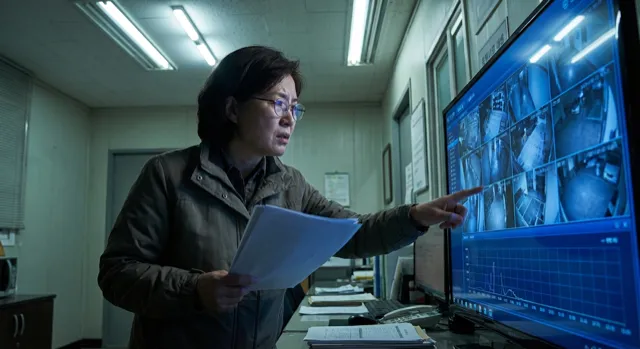
The next morning she went to the management office. Superintendent Park was a man in his early sixties, with twenty years' experience as a superintendent. But since HouseKeeper's introduction, his role had changed. The system had automated most of the management work. Superintendent Park sat in front of a monitor, staring at the system dashboard. On the screen, the complex's energy usage, parking-lot status, and complaint status were displayed in real time.
"Superintendent, let's talk about this elevator business."
"Ah, Representative Kim. Well, you see, HouseKeeper optimizes the elevator operation to reduce power consumption during late-night hours."
"And optimizing means sending a person all the way down to the first floor and then bringing them back up?"
"The algorithm calculates the overall traffic flow, so—"
"The algorithm. Superintendent, last night it took me four minutes. To get to the fourth floor."
"That must have been rather inconvenient for you."
"It's not inconvenient, it's wrong. Is an elevator that won't go to the floor a person wants normal?"
Superintendent Park put on an awkward expression. The coffee in his cup was going cold. He spoke carefully.
"Representative Kim, to be honest, I'm uncomfortable with it too. I used to make the rounds myself, meet the residents and hear them out, and when a problem came up I'd solve it right there on the spot. But now the system does everything. All I do is watch a monitor."
"Then what is your role, Superintendent?"
"Honestly, I'm not sure. Contact the NextLiving tech team when something goes wrong with the system? There's nothing I can do."
Kim Mi-jeong thought: this man is a victim too. Because the system decided everything, there was nothing left for the superintendent to do. And yet his salary was still being drawn from the management fees, unchanged. The system did the work, but the man's wages stayed the same. Was that efficiency?
"Superintendent, what happened with that fine?"
"Ah, the Mr. Lee Yeong-su matter, in Building 301. When HouseKeeper detects a recycling violation via CCTV, it automatically sends out a fine notice."
"Automatically? Without a person checking?"
"Because the system's accuracy is 97%. It's a function that the audit authorities approved as well."
"And the 3%? A 3% error means that, out of a thousand households, thirty are paying a fine they don't deserve."
Superintendent Park could not answer.
---
Kim Mi-jeong went to see Lee Yeong-su in Building 301. Lee Yeong-su was forty-three, a taxi driver. He lived alone. It had been three years since his divorce. He was living amid loneliness and debt. His ex-wife was raising their child. He had to send child support every month, and since a third of his income went to it, the fifty-thousand-won fine was no small sum to him. It was a small apartment, laid out like a studio. A fine notice was stuck to the front door. Fifty thousand won. Recycling violation — plastic mixed in with general waste.
"I sorted my recycling properly that day."
There was anger mixed into Lee Yeong-su's voice.
"Did you check the CCTV?"
"I asked the management office, but they said the system made the call and the footage can't be released. Privacy policy."
"Wait — the system looks at my CCTV footage and fines me, but I'm not allowed to look at that same footage?"
"Right. That's how it is."
Kim Mi-jeong understood. This wasn't an elevator problem. It was a structure in which the system watched residents, judged them, and punished them, while the residents couldn't verify any of it. A structure in which no one raised a question, on the grounds that it had been officially sanctioned.
"Mr. Lee, did you file an appeal?"
"I did. But the appeal gets submitted through the system too. The system reviews the very judgments it handed down."
"That — that makes no sense."
"Exactly. But nobody argues. It's 50,000 won. Everyone's too busy to fight over 50,000 won."
Kim Mi-jeong did the math. 50,000 won. 3% of a thousand households was thirty households. Thirty times 50,000 was 1.5 million won. Every month, that was 18 million. Over a year, 200 million. Error had been turned into revenue.
---
Kim Mi-jeong went to see another resident who'd been fined. Park Sun-ja of building 708, seventy-two. A grandmother living alone. Her health was poor; she needed care. She'd been flagged for putting a plastic bag in the wrong bin while sorting her recycling at four in the morning.
"My eyes are bad, I can't read the small print. Sometimes I don't know what the labels on the bins even say."
"Did you get the fine notice?"
"I got it, but I can't make heads or tails of it. HouseKeeper? What's that supposed to be?"
"It's the computer that manages the apartment complex."
"A computer's fining me? A thing that isn't even a person?"
"Grandma, let me help you file an appeal."
"What's an appeal?"
Kim Mi-jeong thought about it. The system accepted appeals through a smartphone app. Had the system's designers imagined a seventy-two-year-old grandmother opening an app to file an appeal? Probably not. The system was built for the 'average user,' and anyone outside the average was treated as though they didn't exist.
---
Kim Mi-jeong looked into the company behind HouseKeeper. 'NextLiving Inc.' Based in Gangnam, Seoul. Number one in market share for apartment management automation. It supplied its system to more than three hundred complexes nationwide. CEO Oh Jin-hwan, forty-eight. A veteran of the IT industry.
She obtained NextLiving's business report, disclosed in the committee's document archive. Sixty percent of revenue came from system maintenance fees. And 12% came from a line item called 'administrative delegation fees.' Administrative delegation. A fee for having the system carry out administrative duties on the complex's behalf — levying fines, managing parking, allocating energy. In other words, the complex handed its administration over to the system, and paid NextLiving for the privilege. The more fines the system issued, the higher the administrative-delegation numbers climbed, and so NextLiving's profits climbed with them. The more it surveilled, the more it caught, the more the company earned. A structure in which surveillance and profit rose in direct proportion. They called it 'smart management.'
Another line in the report caught her eye. 'Future expansion plans: automated detection of parking violations, noise-based mediation of inter-floor noise disputes, automatic warnings to energy-wasting households.' With institutional approval alone, this system would come to surveil every corner of a resident's life.
Kim Mi-jeong leaned back in her chair and stared at the ceiling. Her heart raced. This was not a problem of technology. It was a problem of institutions. A single company held a monopoly over the entire process — surveilling residents' behavior, detecting violations, levying fines, and reviewing the appeals. The watchman, the judge, and the enforcer were one and the same. And yet this system had been approved as policy by the residents' representative council, on the grounds that it lowered management fees. At a meeting Kim Mi-jeong herself had attended.
---
Kim Mi-jeong put an item on the agenda for the next residents' representative council meeting. 'An audit of HouseKeeper's operation, and measures to protect residents' rights.'
Five building representatives sat in the meeting room.
"Representative Kim, HouseKeeper clearly cuts our management fees. What's the problem?"
It was Jeong Taek-ho, the representative for building 201. Late fifties, a former construction-company executive.
"On fees alone, yes, it works. But there's a structural problem with the automatic fine system."
"Structural problem? What do you mean?"
"The same system detects the violation, levies the fine, and reviews the appeal. There's no independent review."
"Well, isn't that just for the sake of efficiency?"
"Efficiency? At a 3% error rate, thirty households could be paying fines they don't deserve."
"3% means 97% are correct."
"Representative Jeong, if the wrongful fine landed on your doorstep, would the 97% still matter to you?"
Jeong Taek-ho fell silent. A hush settled over the room.
Han Ji-yeong, the representative for building 502, spoke up. Early forties, a lawyer.
"Representative Kim has a point. It's a due-process issue. An administrative penalty has to have an independent avenue of appeal. Having the system levy and the system review violates a basic principle of administrative law."
"Representative Han, this is the complex's own bylaw, not an administrative penalty."
"Even a bylaw, if it affects property rights, has to guarantee a minimum of due process. You need to understand the difference between an ordinance and a bylaw."
The meeting ran on for more than two hours. Choi Won-seok, the representative for building 305, spoke. In his sixties, a retired civil servant.
"I find the system convenient. In the old days, residents used to fight each other over recycling. Now the system catches it — isn't that fairer?"
"Chairman Choi, for a system to be fair, it has to be transparent. Right now it isn't."
"If it's transparent, people just go looking for loopholes to slip through."
"What does that say about how you see the residents? Are they potential criminals?"
Choi Won-seok raised his hand and spoke.
"I think keeping maintenance costs down is what matters. Audit the vendor and our relationship with them could sour."
"Is a soured relationship more important than the residents' rights?"
In the end it went to a vote. Three in favor of the audit, two against. It barely passed.
---
The audit was carried out by Kim Mi-jeong and Han Ji-yeong together. They requested access to NextLiving's data. NextLiving refused to disclose the algorithm, citing "trade secrets." But it did hand over the records of fines levied and the outcomes of the appeals.
They laid out the numbers. Fines levied over the past year: 842. Appeals filed: 37. Appeals upheld: 2. Appeals upheld: 5.4%.
"The usual reversal rate for administrative appeals is 20 to 30 percent, so 5 percent means the system almost never overturns its own judgment."
Han Ji-yeong said.
"Just as I thought."
Kim Mi-jeong nodded.
"And look at this. I broke down the times of day the fines were issued — 38 percent were issued between two and five in the morning."
"In the dead of night? Are there really that many people sorting recycling at that hour?"
"No. Precisely because so few people sort recycling at that hour, the CCTV footage is crisp and the system finds them easy to detect. In the daytime there are crowds, so the system runs conservatively for fear of mistakes; at night it runs aggressively."
"You're saying the system picks off nothing but the easy targets?"
"And the upshot is that the people who sort their recycling at dawn — the night-shift workers, the elderly — are the ones paying the bulk of the fines."
Kim Mi-jeong wrote it down on the paper. 'The system chooses the easy targets.' Technology is neutral, people like to say. Algorithms carry no prejudice. But the data showed otherwise. The system concentrated on the ones it could catch well. Whether that was intended hardly mattered. If the result was unequal, then the system was unjust.
Kim Mi-jeong thought of Lee Yeong-su. A taxi driver. Night shifts. A man who came home at dawn and put out his recycling. The easiest person in the world for the system to catch.
Han Ji-yeong closed her laptop and said,
"There's one more thing. I analyzed the household types of those fined — single-person households make up 62 percent. And single-person households are only 28 percent of the whole complex."
"So it goes after people who live alone?"
"Because there are fewer of them to protest. A household with a family has someone to argue on their behalf, but a person living alone gives up more easily. I don't know whether the system learned that or it's coincidence, but that's how it plays out."
"We have to turn this into a report."
"Agreed. And we should send it to the oversight authority too."
---
After the report was submitted, NextLiving got in touch. The CEO, Oh Jin-hwan, called in person.
"Ms. Kim, I believe there's been a misunderstanding about our system, and I'd like to clear it up."
"It's not a misunderstanding. It's data."
"Reading data requires context. If we could meet, I could walk you through —"
"Meet? I'm more comfortable talking in data. Put it in writing."
Oh Jin-hwan's voice hardened.
"Ms. Kim, frankly, if this report goes public, it could hurt not only our company but this apartment complex as well."
"And what is that supposed to mean?"
"It means we may have to revisit the terms of the maintenance contract."
Kim Mi-jeong set down the phone. Her hands were trembling. She was afraid. She had never gone up against a large corporation. Serving as a building representative was volunteer work. No salary, and only limited legal authority. NextLiving, meanwhile, was a listed company with a market cap of 200 billion won. It would have lawyers, and lobbyists too, no doubt. But her anger ran deeper than her fear. She had no regrets. The system existed for the sake of people; people did not exist for the sake of the system.
---
A month later, the residents' representative council voted to suspend HouseKeeper's automatic fine function. Five in favor, two against. This time Jeong Taek-ho voted in favor too. His own mother had been hit with an unjust fine. Seventy-eight years old. While sorting recycling at dawn, she'd been caught, they said, putting a plastic film wrapper in the wrong bin.
NextLiving sent notice of a change to the contract terms. A 30 percent hike in the maintenance fee. It was retaliation. But legally it was a legitimate change permitted under the contract. Kim Mi-jeong started looking into other vendors — whether, in place of NextLiving with its lock on the market, there might be some small or midsize firm that would promise transparent operation. It wouldn't be easy. But doing what wasn't easy was the lot of a building representative.
Grandmother Park Sun-ja's fine was cancelled as well. Kim Mi-jeong went to the old woman's home herself to deliver the news.
"Grandma, the fine's been cancelled."
"Has it? Thank you. But I already paid it."
"You'll get a refund."
"Can you even get a refund? I paid it to a computer."
Kim Mi-jeong laughed. The old woman laughed too.
Lee Yeong-su's fine was refunded as well. 50,000 won. Lee Yeong-su called Kim Mi-jeong.
"Ms. Kim, thank you, truly. To be honest, I'd been about to give up."
"Why?"
"Because I felt ashamed, fighting over 50,000 won. Everyone around me kept saying just pay it. What's 50,000 won, they said."
"It isn't about the 50,000 won. The size of an injustice isn't measured in money."
"No. If I hadn't known either, I'd have just let it slide."
"Even so. It's only 50,000 won, but it's — it's unfair, isn't it."
"It is unfair. The 50,000 won is unfair, and so is a system that treats a person like a criminal."
After she hung up, Kim Mi-jeong stood on the veranda. The apartment complex lay spread out below her. A thousand households. Three thousand people. 240 CCTV cameras. 16 elevators. 800 parking spaces. A small city inside the city, run by numbers. But behind each number there was a person. The taxi driver sorting his recycling at dawn, the old woman in poor health who couldn't stand waiting long for the elevator, the person for whom a 50,000-won fine was a week's worth of lunches.
The maintenance-fee statement would arrive again next month. And Kim Mi-jeong would go through it again. She would read the numbers, check them against the rules, watch what the system was doing. That was a resident representative's job. Unassigned, unpaid, unappreciated — but work someone had to do.
She called her husband.
"I think I'll be a little late tonight."
"The apartment thing again?"
"Yeah."
"Mi-jeong, nobody would say a word if you just dropped it."
"I know."
"So why do it?"
"Because of 50,000 won."
"50,000 won?"
"For some people 50,000 won is a week of lunches. It's not right for that person to get the short end of it."
For a moment her husband said nothing.
"All right. I get it. You're a little reckless. But that's part of why I like you."
"It's not reckless. It's just fair."
"Okay. I'll make dinner."
"Thank you."
She hung up and stood on the veranda again. One by one, the streetlamps in the complex were coming on. HouseKeeper switched them on automatically, timed to sunset. It was convenient. Where credit was due, it was due. Technology itself wasn't the enemy. The problem was the relationships technology created. Who stands between the technology that watches and the person being watched? If that place was left empty, someone like Kim Mi-jeong had to stand in it.
Under the light of a streetlamp, someone was sorting recycling. Spreading open a plastic bag to check what was inside, separating the plastics from the paper. The movements were careful. They were the movements of a person who knew a CCTV camera was watching. Anxious and cautious at once — movements that were not free. A life in which even taking out the trash in front of your own home was surveilled. Kim Mi-jeong watched the figure for a long while. And in her head she drew up the list of things she would go and check at the management office tomorrow morning.