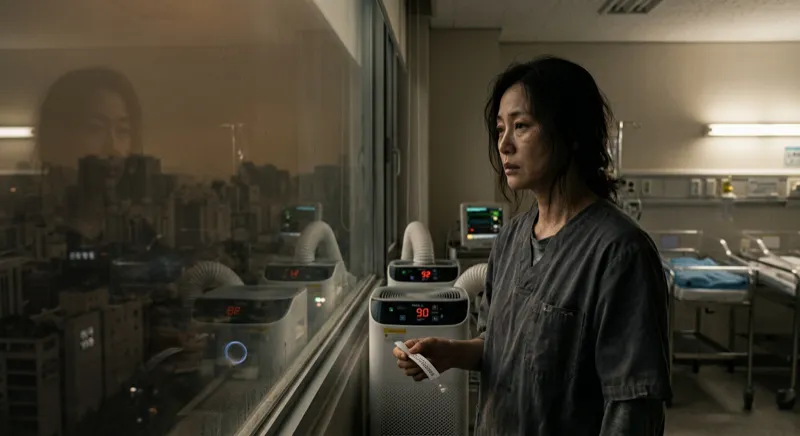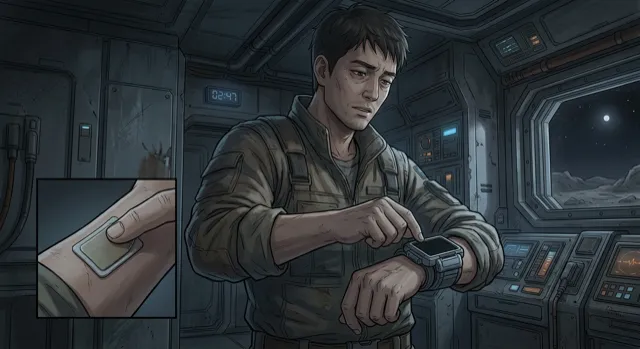
It was 2:47 in the morning when Doyun pressed the signal-blocking patch onto his left forearm. The adhesive side was cold against his skin. The green light of the heart-rate monitor blinked once and went dark. Signal lost. It took 0.8 seconds for Doyun's heart-rate data to vanish from the servers of the Central Energy Authority. He looked at the monitor screen on his wrist. It was dark. The first darkness he had seen in 3 years. For the 3 years the monitor had been switched on, that green light had always glowed on his forearm. When he slept. When he washed. In the bathroom. His forearm without the green light looked strange to him. There was a mark on the skin where the monitor band had sat. The skin, pressed under it for 3 years, had turned white.
Doyun opened the front door. The lights in the apartment corridor were in power-saving mode, so only the floor guide-lights were lit. He went down the stairs. The elevator was linked to the heart-rate monitor. Ride it with the monitor switched off and an alert went to the management office. It was 16 floors of stairs. Doyun descended one step at a time. He smothered his footsteps. The sound of his sneaker soles pressing the concrete echoed up the stairwell. 4 minutes and 38 seconds from the 16th floor to the 1st. His heart rate was 72 beats per minute. The legal ceiling was 60. Already 12 over. With the monitor off, it went unrecorded. As he came down the stairs, Doyun retied the laces of his old sneakers. The sneakers he had last worn 3 years ago. The soles were worn thin. The cushioning was gone. He could feel the edges of the steps against the soles of his feet. He had run a full course in these shoes. 42.195 kilometers. That distance now existed only as a number.
He crossed the ground-floor lobby and went out through the complex's rear gate. There was no heart-rate gate at the rear gate. Only at the front. Doyun had confirmed this 3 weeks earlier. Beyond the rear gate lay the riverside walking path. At 3 in the morning the path was empty. Only 1 of every 3 streetlamps was lit. An energy-saving measure. Before, all the streetlamps had been on. The riverside had been bright. Night runners ran. Bicycles passed. There were people walking their dogs. Now there was no one. Walking wasn't classified as an energy-consuming activity, but if your heart rate rose while you walked, a warning appeared. So people gave up walking too. Doyun followed the path. As he walked he felt his body loosening. The calf muscles moved. The thighs followed. Muscles unused for 3 years were waking. And as they woke, they ached.
The meeting place was under a bridge pier 300 meters down the path. When Doyun arrived, 4 people were already standing there. All of them had a patch on their left forearm. All of them wore workout clothes. But the clothes didn't fit. They hung loose. Clothes bought to fit a body of 3 years ago draped over the shrunken bodies of now. He couldn't see their faces. There was no streetlamp under the pier. In the dark, only breathing could be heard. Ragged breathing. Not the sound a person makes holding their breath. The sound of long-unused lungs taking in the outside air.
"Everyone here?"
A voice came out of the dark. Low and thick. Sangho, the crew leader. Doyun had never seen Sangho's face. He knew only the voice and the patch supply route.
"We're here."
Sangho stepped forward. He was tall. But his shoulders were narrow. His build was small for the voice. This one had shrunk too.
"Head count, five. Course is the south bank of the Han River, 8K round trip. Hold a pace in the 6s. Patch buff is 55 minutes, so your time limit is 50. You know what happens if you can't seal the deal in 5 minutes, right?"
His throat went bone-dry. He hadn't even run yet and his heart was knocking against his ribs. Whether this was anticipation, or fear.
"Go."
The 5 of them began to run. Doyun's foot struck the asphalt. The first step. The first step in 3 years. The impact traveled up through the sole of his foot. Past the knee to the thigh, from the thigh to the pelvis, from the pelvis up the spine to the skull. His whole body rang like a single resonating chamber. Something hot surged up his throat. Doyun clenched his teeth and swallowed it down. Then he lifted his foot again. The second step. The third. The fourth. A rhythm took shape. His arms swung. His chest opened. His lungs opened. Air came in. Cold, damp dawn air. The smell of the river was in it. The smell of moss and fish.
Doyun's heart rate climbed. 80. 90. 100. 100 beats per minute. 167 percent of the legal ceiling. By the Energy Authority's measure, Doyun was now consuming energy equal to one small air conditioner. The calories his body burned were being deducted from the national energy total. After the Total Energy Management Act took effect 3 years ago, the metabolic energy of the human body became subject to management too. Citizens with a basal metabolic rate of 1,800 kilocalories or more were assigned an activity-restriction grade. 14 million people nationwide. 34 percent of the adult population was subject to activity restriction. Athletes, construction workers, and delivery riders were classified first. Doyun had been a candidate for the national marathon team. In the first year of enforcement, all official marathon events were suspended. The sports association was dissolved. The national training center was shut down. As he packed his things at the athletes' village, Doyun put the sneakers into his bag. He had not worn those sneakers in 3 years. Until tonight. Doyun's basal metabolic rate was 2,340 kilocalories. Grade A. The highest tier of restriction.
Grade A had to keep a heart rate of 60 beats per minute or lower. If it went over 60, the monitor sent a warning. When 3 warnings accumulated, the energy ration was cut by 30 percent. The ration cut applied to electricity, gas, and water all at once. At 6 accumulated warnings, the energy supply to the residence was cut off. In 3 years Doyun had not received a single warning. He sat. When he walked, he walked slowly. Even climbing stairs, he rested one step at a time. Heart rate 60. He lived inside that number. His muscles wasted. His thigh circumference shrank by 5 centimeters. His lung capacity dropped by 1,200 milliliters. A body that had once finished a full marathon in 2 hours 38 minutes now went breathless on a third-floor staircase. Doyun endured it.
It was a month ago that he could endure it no longer. He woke in the small hours and, on his way to the bathroom, caught sight of the mirror. The body in the mirror was not Doyun's. The shoulders were narrow. The arms were thin. Above the collarbone the skin had sunk in. Doyun raised his arm in front of the mirror. The arm trembled. Muscle that could not bear the weight of its own arm. Doyun covered the mirror with his palm and turned away. He stepped onto the scale on the bathroom floor. 68 kilograms. Back when he ran marathons his weight had been 74 kilograms. 6 kilograms had vanished. It was muscle. Not fat, muscle. Heart rate 60. That number was burning through the muscle of his own body for fuel. That night he searched the deep net for a signal-blocking patch. 3 weeks later he was standing under the bridge pier.
5 of them ran along the riverbank. In the dark only footsteps could be heard. The sound of 5 pairs of feet striking asphalt. The rhythms differed slightly. The breathing of the man running beside Doyun was ragged. Each time he drew breath there was a wheezing sound. The sound of lungs gone narrow. A sound made by 3 years of activity restriction. A similar sound came from Doyun's lungs too. His breathing grew labored. But his legs did not stop. The memory was coming back. Muscle memory. The angle of the arm, the landing point of the foot, the timing of the breath. The body remembered. Things he had thought forgotten over 3 years remained inside the muscle fibers. Doyun ran with his eyes closed. 3 seconds. The wind grazed his ears. The soles of his feet stamped the asphalt and lifted off. In the instant of lifting off there was weightlessness. 0.3 seconds of weightlessness. Landing. Rising again. Weightless again. For that brief span his body hung in the air, Doyun was free. There was no law. There was no monitor. There was no number. 0.3 seconds' worth of freedom came back with every stride.
At the 2-kilometer mark Sangho picked up the pace. 5 minutes 30 seconds per kilometer. Doyun kept up. His heart rate climbed. 120. 130. His chest felt like it would burst. It felt good. The sensation of a chest about to burst. It had been 3 years. Doyun's breathing quickened. In and out. The rhythm caught. 1 breath every 2 steps. His marathon breathing had returned. In through the nose, out through the mouth. The air that came through his nostrils was cold. It passed the windpipe and went down into the lungs. The lungs swelled. The ribs spread apart. The muscles between the ribs pulled taut. It was not pain. It was the sensation of being alive. Water ran from Doyun's eyes. It was not the wind. He did not wipe it. He ran.
At the 3-kilometer mark a sound came from behind. The sound of something collapsing. The sound of something heavy striking the asphalt. The knees came down first, the shoulder followed. The head struck last. A dull sound spread across the riverbank. Doyun turned his head. 1 of the 5 lay collapsed on the ground. The one who had looked the oldest in the crew. Doyun did not know the name. In the crew they used no names. There were only numbers. Number 4. Number 4 lay collapsed.
Sangho stopped. 4 of the 5 gathered around Number 4. Number 4's face could not be seen. It was dark. Doyun switched on his phone's flashlight. Number 4's face came into view. The eyes were closed. The lips were blue. The chest was not moving.
Sangho knelt and pressed his fingers to Number 4's neck. 2 seconds. 3 seconds.
"…No pulse."
Sangho's voice came out torn. It was not the low, thick voice it had been.
Doyun's hand gripped the phone in his pocket. 119. Three digits. He only had to press them. The paramedics come. A defibrillator comes. Number 4 could live. But if the paramedics came, the locations of all 5 people at the scene would be logged. 5 people gathered on the riverbank at 3 in the morning with their heart-rate monitors switched off. Violation of Article 14 of the Energy Quota Management Act. Disabling a heart-rate monitor. A fine of 30 million won or 2 years in prison. Permanent cut to energy rations.
"Put the phone away. Call it in and we all die."
Sangho growled. Still on his knees. Beside Number 4's body. Number 3 stepped back. One step. Two steps. A movement toward slipping off into the dark. Sangho shouted.
"Don't move. Scatter and we stand out more."
Number 3 stopped. There was the sound of a toe scraping the asphalt.
Doyun took out the phone. The screen lit up. The light of the screen fell on Number 4's face. Blue lips. Closed eyes. A body whose chest did not move.
"Don't."
Another crew member spoke. It was Number 2. A woman's voice. It was trembling.
"You can't… if you call it in… my kid — if the energy's cut we won't even have heating. Please."
Doyun's thumb was on the screen. 1. 1. 9. Three presses and it was done. Doyun looked at Number 4's face. What had this person's basal metabolic rate been? Had they been Grade A? Had this person, too, come here after watching their own body shrink in the mirror? Had this person, too, once had a pair of sneakers from 3 years ago? Had this person, too, felt they could no longer tell the difference between being alive and being dead inside 60 beats a minute?
Sangho set his hands on Number 4's chest. He began compressions. 1, 2, 3, 4, 5. Chest compressions ran 100 to 120 a minute. Sangho's own heart rate would be climbing higher than that. Doyun could see the patch stuck to Sangho's forearm. Time remaining on the patch. Doyun checked. 23 minutes since it went on. 32 minutes left.
"Ambulance, 8 minutes on average."
Doyun's voice was calm to the point of strangeness.
"32 minutes of patch left. Peel it now, reboot, and we can doctor the record. Location set to home, heart rate under 60. That's plenty of time, isn't it?"
Sangho's hands did not stop. He looked at Doyun as he pressed.
"The reboot alone takes 3 minutes. Peel it now and this heart rate gets logged exactly as it is. That's a warning, one strike, right away."
"One warning is fine. The cuts don't start until three."
Sangho bit his lip. He kept up the compressions. 6, 7, 8, 9, 10. Number 4's chest pressed down and rose again. No response.
Doyun took hold of the patch on his left forearm. He peeled it off. There was pain as the adhesive lifted from the skin. The skin had gone thin. The monitor began to reboot. A loading bar came up on the screen. 3 minutes. Doyun looked at the phone screen. 1. 1. 9. His thumb moved.
"119, emergency. How can I help you?"
"The walkway on the south bank of the Han River, the 3-kilometer mark. 300 meters east of the bridge pier. One patient in cardiac arrest. Chest compressions underway."
"We're on our way. Don't stop the compressions."
Doyun hung up. He looked at the rest of the crew. Number 2 was crying. Without a sound. Water ran from her eyes and dropped off her chin. Number 3 was already peeling off a patch. Number 5 did not move in the dark.
"Everyone, patches off. Reboot your monitors. Get your heart rates back to normal before the medics arrive."
Doyun said it. It was strange, that he was the one giving this order. Until 3 weeks ago Doyun had been a man who only sat in his apartment.
Sangho nodded as he kept pressing. With one hand he peeled off his patch. His other hand did not stop over Number 4's chest.
For the 3 minutes the monitor took to reboot, Doyun stood there. His heart rate would not come down. 140 a minute. The energy his body was burning was draining out of the national total. Somewhere a streetlight would be going dark. Somewhere an elevator would be grinding to a stop. Doyun did not care.
The monitor screen lit up. Loading complete. The heart rate came up on the screen. 138. A warning message was generated at once.
"Heart rate exceeded. Warning 1. Ration cut pending on further overage."
Doyun looked at the screen. One warning. Allowances remaining, 2. The number hung on the screen. Red letters. Doyun looked at that number. 2. It was not the number of times he could run. It was the number of times he could live.
The ambulance siren sounded far off. The sound drew nearer. Red light began to sweep beneath the bridge pier. Two paramedics came running. Carrying gear. Defibrillator pads went onto Number 4's chest. A machine tone sounded.
"Shock advised. Stand clear."
Sangho lifted his hands away. The electric shock passed through Number 4's body. The body rose once and came back down. Onto the asphalt. The shock made no sound. The electricity went through the body soundlessly. But you could see Number 4's body flinch. The muscles clenched and let go. The paramedic looked at the monitor.
2 seconds. 3 seconds. The machine analyzed again.
"Pulse detected."
the paramedic said. Number 4's chest began to move. A small movement. But it was movement.
The paramedic looked at Doyun.
"You're the one who called?"
Doyun nodded. The paramedic's eyes went to Doyun's forearm. The monitor. The heart rate and the warning message hung on the screen. The paramedic saw it. Doyun saw it too. The paramedic's mouth opened a little, then closed without a word. His gaze went back and forth between Doyun's face and the monitor on his forearm. 3 a.m., the riverside, heart rate 138. No question was needed. He only gave a short nod and turned away. He lifted Number 4 onto the stretcher. Number 4's arm hung down over the side. There was a patch mark on the forearm. A red square left by the adhesive. The paramedic laid the arm back onto the stretcher.
The ambulance pulled away. The red light receded. The siren shrank. Four people were left under the bridge pier. Doyun, Sangho, Number 2, Number 3. Number 5 was not there. Vanished into the dark.
Beneath the bridge pier it went dark again. Once the ambulance's red light was gone the darkness came back. On the asphalt the spot where Number 4 had lain remained. Nothing was left there, and yet no one stepped on that spot.
Sangho sank down onto the asphalt. He rested his arms on his knees. He bowed his head. He let out a breath. Long. It was a trembling breath.
Number 2 came over to Doyun. The tracks of dried tears streaked her face. "Did you get a warning?" Doyun asked. Number 2 nodded. "One." Doyun nodded too. "Me too." Number 2 wiped her eyes with the back of her hand. "Next time… will you come out again?" she asked. Her voice trembled, thin. In the dark her wet eyes shone. Doyun couldn't answer. She answered for herself. "I don't know. I just… I couldn't stand the thought of him sleeping cold." Number 2 turned away. She walked off along the path. Her steps were slow. They were steps meant not to raise her heart rate. Doyun watched her go. For 3 years everyone had walked like that. Slowly. Carefully. Cheating their own hearts.
3:42 in the morning. Doyun stood on the path. The river was flowing. Across the water she could see the lights of an apartment complex. Power-saving lights. Streetlamps, only 1 in every 3 lit. Doyun's heart rate was coming down, slowly. 130. 120. 110. Still a long way from 60. Doyun's legs were shaking. Legs that had run 3 kilometers. Legs that had run for the first time in 3 years. The muscles were cramping.
Doyun had to go home. She had to climb 16 flights of stairs. She had to get the number on the monitor below 60. Tomorrow morning she had to sit still again. She had to walk slowly. She had to rest on the stairs. She had to go back to the life of a heart rate of 60.
Doyun looked at the river. The water flowed in the dark. The light of a streetlamp stretched in a long reflection across the surface. The light shivered on the ripples. Doyun's calves throbbed. It was pain. Pain for the first time in 3 years. She liked the pain. Doyun stood at the water's edge and breathed. Her heart rate was falling. 99. 90. 85. The number on the monitor dropped slowly. The number on the monitor blinked and dropped. 90. 85. Doyun fingered the two patches left in her pocket. Warnings permitted: 2. Her heart could beat twice more. Really beat. After that the rations were cut. The electricity went down. The gas went down. The water went down. Doyun knew that. Knowing it, she stood at the water's edge. The pain in her calves was slowly settling. Her heart rate had come down to 74. Still 14 to go to 60. Doyun didn't go home. She sat on a bench by the river. The metal of the bench was cold. A chill crept up the backs of her thighs. Three years ago her last training session had been on this riverbank. 5 in the morning. The coach standing there with a stopwatch. Doyun had run 10 kilometers. 3 minutes 48 seconds per kilometer. Doyun's heart rate had been 172 beats a minute. Back then 172 was normal. It was a healthy number. Now 172 was a crime. Doyun sat on the bench and looked at the river. The water flowed. In the dark there was only the sound of the water. Somewhere a bird cried out. A bird announcing the dawn. Soon the sun would rise. When the sun rose, people would come out. People wearing heart monitors, walking slowly, beginning their day within a heart rate of 60. The heart rate on the monitor came down to 68. 8 to go to 60. Doyun looked at the monitor. The number was dropping by 1. 67. 66. 65. The closer the number came to 60, the more her body was shutting down. Her heart slowed, her blood slowed, her thoughts slowed. 60 beats. Doyun had to fit herself inside that number. Doyun did not get up from the bench. The river flowed. Her legs shook. The shaking would not stop.