It was Monday morning when Jeongha found her daughter's specimen on the sorting table. Third-floor analysis lab, Division of Epidemiological Investigation, Korea Disease Control and Prevention Agency. Forty-seven yellow envelopes lay in a row on the sorting table. The weekly specimens that came up from each public health center every Monday morning. Jeongha scanned the barcode on the first envelope. The scanner gave a beep and uploaded the specimen data into the system. Jeongha had done this task every week for 7 years. Monday morning. Pick up an envelope, hold it to the scanner, listen for the beep. Name, date of birth, collection date and time, collection agency. Jeongha's hand stopped at the 17th envelope.
Name: Kang Su-a. Date of birth: March 7, 2042. Collection agency: Dobong-gu Public Health Center. Reason for collection: routine school checkup.
It was Jeongha's daughter. Eleven years old. Jeongha's mouth went dry. She wanted a drink of water. The water cooler in the lab was out toward the corridor. Jeongha did not get up. Inside the envelope were 2 blood collection tubes and a buccal epithelial cell collection kit. The seal on the envelope was intact. Jeongha lifted the envelope. Its weight was the same as the other envelopes. Light. The weight of 5 milliliters of blood and a single swab.
Jeongha set the envelope back down on the sorting table. She scanned the remaining 30 envelopes. The scanner beeped 47 times. When the scanning was done, Jeongha looked at the monitor. Forty-seven specimens were listed. On the 17th line was the name Kang Su-a.
There was only one reason the Division of Epidemiological Investigation analyzed these specimens. To detect the Second Immunity response. Three years earlier, the protein code of an ancient virus had been found in the noncoding region of the human genome. The inactive region that makes up 97 percent of the genome. A sequence that had lain dormant for tens of thousands of years. In 0.7 percent of the population repeatedly exposed to severe environmental stress — high concentrations of fine dust, low-dose radiation, heavy-metal exposure — this sequence became active. The activated sequence produced proteins unlike those of the existing immune system. Second Immunity. People in whom it was active were immune to most infectious diseases. They didn't catch colds. They didn't catch the flu. They weren't infected by the successor variants of COVID either.
The problem lay elsewhere. Trace amounts of an immune-disrupting protein were detected in the saliva and breath of Second Immunity carriers. Studies came out showing that this protein disrupted the immune systems of noncarriers. The degree of disruption was slight. Enough to make a noncarrier's white blood cell count fluctuate temporarily by 3 to 7 percent. A level a healthy person would feel no symptoms from at all. There was one study saying it could be dangerous to immunocompromised patients. Three rebuttal papers came out. The original author could not produce further data. Still, the law remained. Whether it was statistically significant but clinically meaningful was under debate. The debate had gone 3 years without a conclusion. But the law had been made first. Second Immunity carriers were subject to quarantine. They were housed in isolation facilities. There were 14 facilities nationwide. Total capacity: 23,000 people. In her 7 years as an epidemiological investigator, Jeongha had returned a positive verdict on 417 people. She had analyzed 417 people's blood. She had written 417 names into reports. She had signed 417 quarantine notices. The first time she signed, the hand holding the pen felt heavy. Somewhere around the 100th, the weight was gone. Because it was procedure.
Jeongha took her eyes off the monitor. Beyond the lab window she could see the Seoul morning. November. The trees had almost no leaves left. The sky was gray. It was a day of high fine-dust concentration. Jeongha looked at the window, then at the sorting table. The 17th envelope was wedged in among the other envelopes. Yellow. The same color. The same size. Jeongha picked that envelope up again.
Su-a's specimen turning up here was normal procedure. Starting this year, the Second Immunity test had been included in routine elementary school checkups. Everyone aged 7 and over was subject to it. The law had been revised this past January. Before, only adults had been tested. The expansion to children came because pediatric carriers were on the rise. The pediatric activation rate was 1.4 times that of adults. One analysis attributed it to children's immune systems being more sensitive to environmental stress. Specimens collected at a public health center came up to the Korea Disease Control and Prevention Agency. The Division of Epidemiological Investigation analyzed them. If positive, it notified the health authorities. The notified health authorities transported the person to an isolation facility. Jeongha was in charge of the first step of that process. The person who received the specimen, analyzed it, and uploaded the result.
Jeongha left the lab carrying the envelope. She walked down the corridor. At the end of the corridor was the cold storage room. Jeongha opened the storage room door and went in. Temperature 4 degrees. On the shelf, the space where this week's specimens would be arranged sat empty. Jeongha set Su-a's envelope on the shelf. Together with the other 46 envelopes. She let go. She left the storage room. The door closed.
Jeongha went back to her seat. She sat down in her chair. She looked at the monitor. The list of 47 specimens. Analysis would begin tomorrow. The analysis equipment's operating time was scheduled for tomorrow morning. From today until tomorrow morning. Jeongha had time.
At lunch Jeongha called Su-a. From the stairwell outside the office. The dial tone rang 3 times.
"Dad."
Su-a's voice. Bright.
"School's out?"
"Yeah. I'm home now."
"Is Mom there?"
"Not yet."
Jeongha gripped the stair railing. The metal was cold.
"Su-a, you got tested at school last week, right? The one where they took your blood and scraped inside your mouth."
"Yeah. It hurt."
"It hurt?"
"When they took the blood. But it was over fast."
The hand gripping the railing tightened.
"Su-a, the results aren't in yet. You know that?"
"Yeah. Teacher said she'd tell us later."
"Right. They'll tell you later."
He hung up. Su-a's voice stayed in his ear. It hurt. She'd said it hurt when they took the blood. The nurse at the health center would have slid the needle into Su-a's arm. Su-a would have shut her eyes. Su-a always shuts her eyes when she gets a shot. Jeongha sat down on the stairs. The concrete was cold. The November air pushed up through the stairwell.
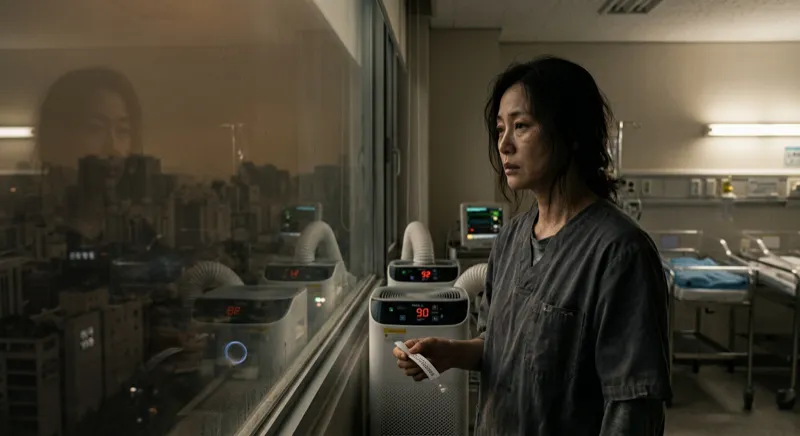
Jeongha thought of the year Su-a was born. 2042. The year Seoul's annual average concentration of fine dust crossed 80 micrograms for the first time. In the hospital where Su-a was born, 4 air purifiers had been running in the windows. In the newborn ward too. From the moment she was born, Su-a breathed polluted air. Jeongha breathed it too. So did Eun-mi, Jeongha's wife. Everyone living in Seoul did. There were 90 days a year when the sky over Seoul was blue. The other 275 were gray or a dull yellow. Su-a treated a blue sky as something special.
"Dad, the sky is really blue today!"
The words Su-a had said when she was 5 stayed in Jeongha's memory. Su-a had grown up in a city where a blue sky was special. 0.7 percent. The rate at which Second Immunity activates among a population repeatedly exposed to environmental stress. Jeongha had written that number into reports for 7 years. It was a number. The number behind 417 positive determinations. Now that number lay over Su-a.
Afternoon. Jeongha checked the reagent stock for the analysis equipment. To analyze 47 cases tomorrow, there had to be enough reagent. There was enough. As he checked off the reagent list, Jeongha thought of something else. Specimen 17. Kang Su-a. What happens if the analysis comes back positive. The result goes up into the system. It is automatically reported to the health authorities. Within 72 hours of reporting, a quarantine transfer order is issued. Su-a goes to a quarantine facility. To one of 14 across the country. Jeongha knew the conditions inside the facilities. He had inspected one. One room per person. Floor area 9.9 square meters. Toilet included. There is a window, but it does not open. Outside visits twice a month. Through a glass partition. Once Su-a went in there, she would not come out. Because Second Immunity activation is irreversible. Jeongha had inspected facility number 3. Pocheon, Gyeonggi Province. The building's exterior wall was gray. The corridor was long. Open a door and there was one bed, one desk, one chair. There was a clock on the wall. Through the window you could see a mountain. A window that did not open. One of the detainees asked Jeongha.
"Is it raining outside?"
It was raining. Raindrops were running down the window.
"Yes."
"I want to smell the rain."
Jeongha could not answer.
Jeongha set the reagent list down. The paper fell to the floor. Jeongha did not pick it up. He picked it up a long while later. The paper was crumpled. His hands were shaking. He clenched his fist. Unclenched it. Clenched it again.
Evening. Jeongha came home. Su-a was doing homework in the living room. Math. Division of fractions. Su-a looked at Jeongha.
"Dad, what's 3 over 4 divided by 1 over 2?"
"Flip it and multiply."
"So 3 over 4 times 2 over 1?"
"No, what do you get when you flip 1 over 2?"
"2 over 1. Oh, 2?"
"Right. 3 over 4 times 2. What's that?"
"6 over... no, 6 over 4. 3 over 2?"
"That's it."
Su-a smiled. The hand holding the pencil was small. Jeongha looked at Su-a's hand. Blood had been drawn from this hand. Last week. At the health center. That blood was in cold storage. Tomorrow it goes into the analyzer.
Eun-mi came out of the kitchen. Eun-mi asked nothing about Su-a's school screening. She knew what the test was, but whether she had decided not to speak until the results were in, or whether she simply didn't know, Jeongha couldn't tell. Eun-mi knew what Jeongha's job did. She was the wife of a man who had quarantined 417 people over 7 years. Not once had Eun-mi asked about that number. She was holding a plate in her hand.
"Come eat."
Eun-mi's voice was calm. The voice of every evening.
Jeongha sat down at the table. Su-a closed her homework and sat beside him. Eun-mi dished out the rice. Kimchi stew came to the table. Su-a spooned up the stew. Blowing on it. The hot broth touched Su-a's lips. Su-a opened her mouth and blew air into it. Even as it burned her, she took another spoonful. Jeongha looked at Su-a. Su-a's cheeks were flushed. A healthy color. A child who rarely catches cold. Last winter, when 14 kids in her class were out with the flu, Su-a went to school. Jeongha hadn't thought anything of it then. He'd thought she was a healthy child. He'd thought her immune system was strong. Even in preschool Su-a had almost never caught cold. The pediatrician had said she was a healthy child. Hearing that, Jeongha had been glad.
Now it was different. Not catching cold could carry another meaning.
Night. After Su-a had fallen asleep, Jeongha sat in the study. He opened the laptop. He logged into the Korea Disease Control and Prevention Agency system. Remote access. Under his own account. He opened the queue of pending analyses. 47 cases. Number 17, Kang Su-a. On the screen, the name glowed.
Jeongha knew the architecture of the system. He had worked with it for 7 years. When a specimen went into the analyzer, the result uploaded to the system automatically. A positive triggered automatic notification to the health authorities. Automatic. Jeongha could not intervene. Not after the result came out.
Before the result came out, it was possible. The specimen could be switched. He could take the blood collection tube out of Su-a's envelope and put in someone else's blood. The blood of someone negative. Keep the barcode as Su-a's, and change only the blood. The analyzer reads the barcode and analyzes the blood. A negative result would go up under Su-a's name. The oral epithelial cell kit would have to be swapped too. Because the cells in the kit and the genotype of the blood had to match.
Jeongha closed the laptop. He shut his eyes. The clock in the study made a sound. The sound of the second hand moving. 11:47. Tomorrow at 9 a.m. the analysis would begin. 9 hours and 13 minutes.
Jeongha opened his eyes. On the study bookshelf stood the epidemiological investigation manual. A manual he had personally helped write. On page 137 were the regulations for specimen management. The reporting procedures for specimen exchange, contamination, or damage. It was a clause Jeongha himself had written. In the event that a specimen is exchanged or damaged without authorization, the investigator in question shall be subject to removal from post and criminal prosecution. It was Jeongha's sentence. Jeongha's name was printed on the manual's cover as a co-author.
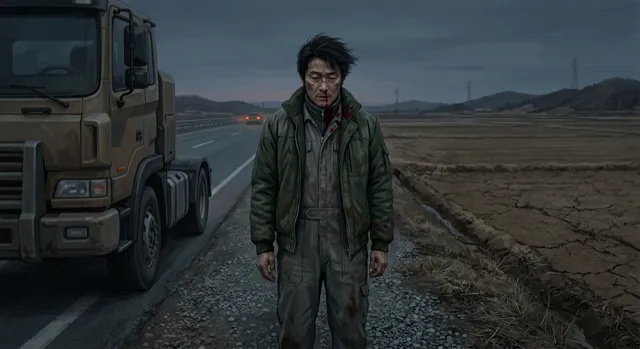
Tuesday, 5 a.m. Jeongha had not slept. After staring at the ceiling in the study, he stood at the door of Su-a's room. The door was slightly open. Su-a was asleep. The blanket pulled up to her chest. She was breathing. Her chest rose and fell. Jeongha stood at the door and watched Su-a breathe. 30 seconds. He closed the door and went to the front hall. He left the house. The subway was not yet running. He took a taxi. He arrived at the Korea Disease Control and Prevention Agency building at 5:38. A night guard sat on the first floor. Jeongha tapped his ID card. An entry record was left behind. 5:38.
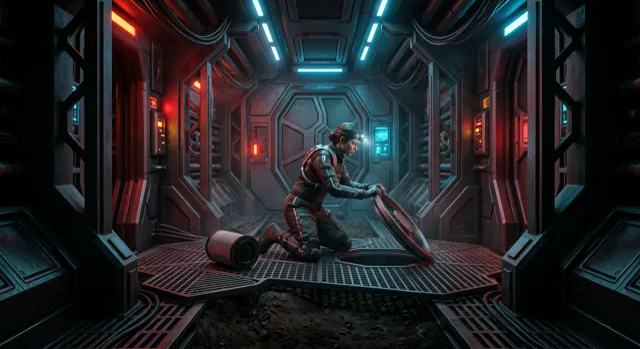
The analysis lab on the third floor. The lights were off. Jeongha turned them on. The fluorescent tubes flickered, then caught. He went to the cold storage room. He opened the door. Air at 4 degrees touched his face. On the shelf, 47 envelopes. He found the 17th envelope. Kang Su-a. Jeongha took it out. The envelope was cold against his hand. The chill of 4 degrees passed through the paper. Jeongha's fingers gripped the envelope. The label bearing Su-a's name lay beneath his thumb.
He carried the envelope back to the analysis lab. He set it on the workbench. He tore open the seal. Inside were 2 blood collection tubes and an oral cell kit. The blood was a dark red. Normal. Jeongha lifted a collection tube and looked at it. Su-a's name and number were printed on the barcode label.
Jeongha took another envelope from his bag. It held the blood he had drawn from himself the evening before. With a collection kit he'd had at home. Jeongha's blood. Jeongha had undergone the Second Immunity test 3 years ago. He was negative. Put his blood into Su-a's collection tube, and a negative result would come out. The oral cells too would have to be replaced with his own. The genotype would differ, but the current analysis protocol tested only for Second Immunity activation. It did not run a genotype comparison. Jeongha knew that protocol. Because it was the protocol he had built. When he drafted it 3 years ago, Jeongha had put efficiency first. With so many specimens, adding a genotype comparison would triple the analysis time. Testing only for Second Immunity activation was sufficient. That was what Jeongha had written in the report. It was approved. That efficiency was now opening a window for him.
Jeongha set Su-a's collection tube on the workbench. Beside it he set his own. The two tubes lay side by side. Under the fluorescent light, the colors of the blood looked alike. Father's blood and daughter's blood. By color they could not be told apart. Jeongha raised his hand between the two tubes. The right hand. The hand that had signed 417 certificates of positive diagnosis. Jeongha looked at that hand. The veins showed on the back of it. Inside those veins ran Jeongha's blood. Jeongha's albumin. Jeongha's immune system. Negative 3 years ago. Whether it was still negative now, he did not know. Because Jeongha too had been breathing the air of Seoul.
417 people. The people Jeongha had declared positive. 38 of them were children. Under the age of 10. The parents wept. In front of Jeongha. Jeongha delivered the results. By procedure. By the manual. It is positive. You will be transferred to a quarantine facility. Visits are permitted twice a month. The parents' faces remained in Jeongha's memory. The mother who wept clutching her little boy. The father who could not let go of his daughter's hand. A 7-year-old boy had grabbed Jeongha's trouser leg and would not let go. The boy's mother tried to pry him loose. The boy cried. The print of the child's hand was left on Jeongha's trousers. Jeongha threw those trousers away. He could not wash them. Jeongha said to them. It is procedure. It is by law.
Jeongha's hand hovered over Su-a's collection tube. 5 milliliters of Su-a's blood. The answer was inside it. Positive or negative. Jeongha did not yet know. Because he had not run the test. Su-a might be positive, or she might be negative. A probability of 0.7 percent.
Jeongha picked up the collection tube. Su-a's tube. The blood shifted inside it. Jeongha looked at the tube. 3 seconds. He set the tube down.
Jeongha picked up his own collection tube. It had no label. All Jeongha had to do was peel the label off Su-a's tube and stick it on his own. A job that took 1 minute. The barcode scanner only reads the label. It doesn't know whose blood is inside the tube.
Jeongha's hand came to rest on the label. He worked the corner of the label up with his fingernail. The label began to lift. 1 millimeter. Jeongha's hand stopped.
The clock in the analysis room read 6:12. There were 2 hours left before the other staff would arrive. Jeongha kept his finger on the label and looked up at the ceiling of the analysis room. The fluorescent light gave off a steady glow. Jeongha's shadow lay across the bench.
Jeongha lowered his hand. The label stayed on the collection tube, peeled back 1 millimeter. Jeongha picked up Su-a's collection tube. He picked up his own tube too. He stood there with one tube in each hand. Su-a in his left, himself in his right. The air in the analysis room was cold. It was the hour before the heating came on.
Jeongha set the two collection tubes down on the bench. Side by side. On Su-a's tube the label stood 1 millimeter clear. Jeongha looked at the gap. 1 millimeter. The gap Jeongha had made. Jeongha took his phone out of his pocket. He woke the screen. A photo of Su-a was his wallpaper. A photo from the sea last summer. Su-a laughing with her feet in the waves. Jeongha looked at the photo. The light of the screen fell across the bench. Over the two collection tubes.
Jeongha set the phone down. He picked up Su-a's collection tube. He pressed the lifted corner of the label back with his finger. The label held again. The 1-millimeter gap was gone. Jeongha slid Su-a's tube into the envelope. He put his own tube into his bag. He sealed the envelope. He went to the refrigerated storage room. He set the envelope back on the shelf. In the 17th slot. He closed the storage room door. The sound of the door shutting rang down the corridor. A metal sound. The heavy metallic note filled the corridor, then seeped into Jeongha's ears.
Jeongha went back to the analysis room. He sat down in his chair. He did not turn on the monitor. The clock in the analysis room read 6:23. 1 hour and 37 minutes until the workday began. Jeongha sat in his chair and looked out the window. Dawn was breaking over Seoul. The sky was turning from gray to pale orange. The sun beyond the fine dust. Light was coming in through the analysis room window. The morning light through the dusty glass stretched long and slanting, and lit the back of the hand resting on his knee. The analysis would begin in 2 hours and 37 minutes. Positive or negative, the result would come. The light crossed the floor and climbed onto the back of his hand. Only then did Jeongha see them. Three red spots, not there the night before, had bloomed on the back of his hand. From the far end of the corridor came the sound of the first arrival's shoes.