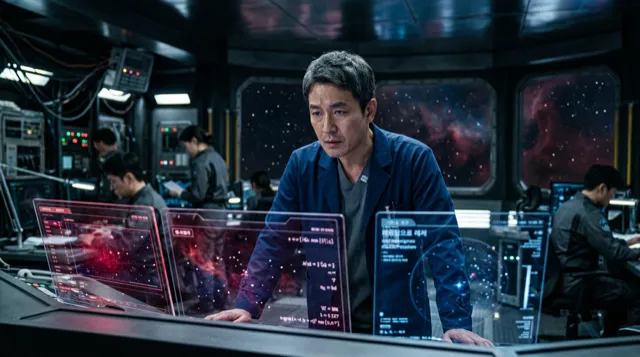
The alarm went off at 10:23 on Tuesday morning. Third floor of the Korea Meteorological Administration's integrated forecast control room. 48 monitors filled the wall. Weather data from across the globe streamed in real time. Temperature, humidity, wind speed, air pressure, precipitation. On 1 of the 48 monitors, a red alert light was blinking. Daejeon.
Yunjae set down his coffee cup. The coffee had gone cold. He hadn't touched it all morning. The control room was quiet. 34 forecasters sat at their monitors, but there was almost nothing for them to do. Athena did everything. Coffee sloshed over the rim of the cup. Yunjae didn't wipe up the spill; he went to the monitor. On the screen was a forecast-error graph for the Daejeon region. Error rate: 41 percent. A red bar punched up through the top of the graph.
"What is this."
Yunjae said. Minji, a junior beside him, looked at the screen.
"Daejeon's error went up again. It was 38 yesterday."
"Isn't it a sensor fault?"
"All 6 Daejeon observation stations are normal. And the inspection finished yesterday."
Yunjae dragged over a chair and sat. He tapped at the keyboard. He opened the 15-minute-interval forecast records for the Daejeon region. This morning, 7 a.m. System prediction: clear, temperature 14 degrees, humidity 42 percent, precipitation probability 0.3 percent. Actual observation: overcast, temperature 11 degrees, humidity 78 percent, showers starting at 9:12 a.m. Rain fell from a sky the system had called clear.
Yunjae scrolled further down the records. Last Thursday. System prediction: heavy rain from 2 p.m., 35 millimeters per hour. Actual observation: clear. Not a single cloud. The city of Daejeon trusted the system's prediction and issued evacuation warnings for the areas around the rivers. The heavy rain never came. 23,000 citizens evacuated and then went home. Daejeon's director of disaster and safety phoned the Korea Meteorological Administration to complain. Athena had been wrong. Evacuation cost: 470 million won. Public distrust. The next time real heavy rain comes, people might not evacuate.
Yunjae was a forecaster with 15 years of service. He'd joined the Korea Meteorological Administration in 2034. Back then, forecast accuracy was 72 percent. Forecasters analyzed data and wrote forecasts from experience and judgment. Some days they got it wrong. They took the complaint calls. You said it wouldn't rain—so why did it? I didn't bring an umbrella. My suit got soaked. Yunjae would take those calls and say he was sorry. An accuracy of 72 percent meant being wrong 3 times out of 10. Those 3 failures came back to Yunjae over the phone. Yunjae wanted to cut those 3 down. That was why he'd studied meteorology. He didn't want to get the weather wrong.
In 2041 the Athena system was introduced. A global integrated weather prediction system. It processed 47 million data points per second from 340 microwave observation satellites, 120,000 ground sensors, and 8,400 ocean buoys. Predictions every 15 minutes. Accuracy 99.97 percent. The forecaster's job changed. It became not writing forecasts but checking the forecasts the system had written. And there was almost nothing to check. Because there was almost never a day the system got it wrong. Yunjae would come in, turn on his monitor, press the check button confirming Athena's forecast had been correct, and write the report. Normal. For 8 years. There was never a day his knowledge of meteorology was needed. The forecaster headcount shrank from 120 to 34. Not layoffs—reassignment. 86 forecasters were moved to other departments. Data management, system maintenance, handling public complaints. People who had forecast the weather stopped forecasting. On the day Park Sang-yun, from Yunjae's cohort, was transferred, he said to Yunjae,
"I envy you. You still get to do the work of watching the sky."
Yunjae couldn't answer. What Yunjae watched wasn't the sky but a monitor. Yunjae was one of the remaining 34.
Daejeon's error had begun 3 weeks earlier. At first the error rate was 7 percent. Trifling. Yunjae wrote the error-rate report every day. It was one of the things the 34 in the control room did. Writing the report. Confirming the accuracy of the forecasts Athena put out and recording the figures. On most days the error rate was under 0.03 percent. There was nothing to write in the report. Normal. Daejeon's 7 percent meant there was now something to write. Other regions occasionally had errors of 3 to 5 percent too. But only Daejeon kept climbing. 12 percent. 19 percent. 27 percent. 41 percent today. Seoul, Busan, Gwangju, Jeju—every other city under 0.03 percent. Only Daejeon at 41 percent.
"Did you ask Athena headquarters?"
Yunjae asked Minji.
"I did. They say the system's normal. That there might be a problem with the Daejeon observation-data input."
"If the observation data were the problem, the error would skew one way. This goes both directions. It gets clear wrong as rain, and rain wrong as clear."
Minji zoomed in on the graph.
"It's periodic. Wrong days and right days alternate. It doesn't look completely random."
Yunjae looked at the graph. Minji was right. There was a pattern—3 days right, 2 days wrong, 1 day right, 4 days wrong. If it wasn't random, there was a cause.
Minji nodded. Yunjae looked at the monitor. The real-time satellite image of Daejeon was up. There were clouds. Athena had said clear. In the satellite image, there were clouds.
Yunjae stood up.
"I'd better go to Daejeon."
The next morning. Yunjae stood at a weather observation station in Yuseong-gu, Daejeon. The station roof. Wind blew. On the roof an anemometer was turning. A rain gauge was catching the drops. The instruments were working honestly. Wind 3.2 meters per second. Temperature 11 degrees. Humidity 78 percent. The numbers the instruments showed and the numbers Athena showed did not match. The sky was overcast. Athena's forecast for Daejeon today: clear, high of 16 degrees. Yunjae looked at the sky. The clouds were thick. There was no sun to be seen. Temperature: 11 degrees.
Han Jeong-min, the head of the station, stood beside him.
"Three weeks now. At first we thought it was an equipment problem too. We replaced every sensor. The satellite receivers as well. Same thing."
"The observations are accurate, right?"
"They're accurate. Exactly what you're seeing. Overcast, 11 degrees. It's Athena that's wrong."
Han Jeong-min looked out the window.
"People are complaining. The Athena app says clear, but it's raining. They go out without an umbrella and come home soaked. We've gone back to the old days."
Yunjae chewed on the word old days. The era of 72 percent. The era when Yunjae took the calls and said he was sorry.
Yunjae went inside the station. He sat down at a computer. He checked the input data feeding Athena's Daejeon prediction model. Satellite observation data. Ground sensor data. Ocean data. Data from the stations near Daejeon. All normal. The input was normal, but the output was wrong.
Yunjae opened Athena's prediction log. Athena was displaying the grounds on which it had forecast Daejeon clear. 'Per satellite observation data: cloud cover over Daejeon 0 percent.' Yunjae looked out the window. The clouds were thick. The satellite data said there were no clouds. In reality there were clouds.
"The satellite data is off."
Han Jeong-min looked at the screen over Yunjae's shoulder.
"But the data the station receives is normal?"
"The data the station receives is normal. The satellite data going into Athena is different."
Yunjae put the two side by side. Satellite data the station received directly: cloud cover over Daejeon 73 percent. Satellite data fed to Athena: cloud cover over Daejeon 0 percent. Same satellite, same moment, different numbers. Yunjae checked other dates. Going back three weeks. Every day there was a discrepancy. The discrepancy occurred only in Daejeon. Seoul. Station data and Athena input in agreement. Busan. In agreement. Gwangju. In agreement. Jeju. In agreement. Only Daejeon disagreed. Yunjae leaned back in the chair. The back of his neck was stiff.
Yunjae's hands stopped over the keyboard.
Yunjae took the high-speed train from Daejeon Station. 49 minutes to Seoul. On the train he looked out the window. Once past Daejeon, the sky cleared. Beyond Cheonan the clouds were gone. Beyond Suwon sunlight came through. The weather was different in every city. Just as Athena had forecast. Yunjae returned to Seoul. He did not go into the control room. He went to his own office. He shut the door. He opened his laptop. He opened Athena's technical documentation. 340 microwave observation satellites. The satellites' role was observation. They measured the atmosphere's water vapor, temperature, and cloud distribution by microwave. Passive observation. The satellites emitted no energy of their own; they received the microwaves the atmosphere emitted naturally. That was the design.
Yunjae opened the satellites' operation logs. They were classified. His security clearance could not reach them. Yunjae thought of the system administrator account he'd been issued when he joined 15 years ago. He didn't know if it was still valid. Yunjae entered the credentials. His fingers hesitated as they pressed the keys. Unauthorized access to classified material was a disciplinary offense. Yunjae pressed the enter key. He was in.
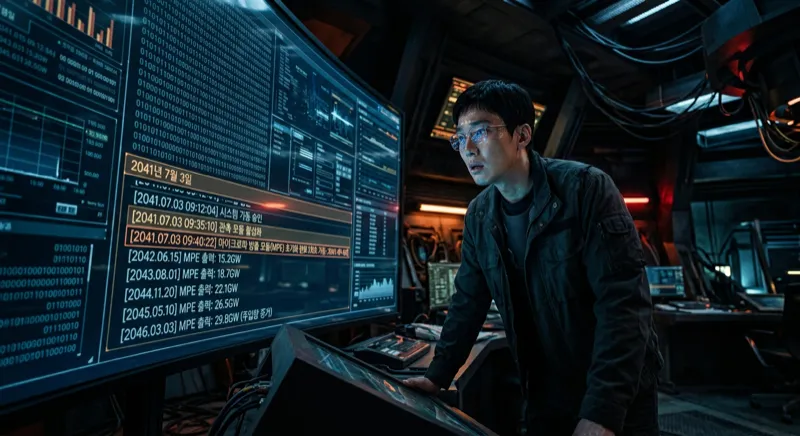
The satellite operation logs filled the screen. Yunjae read them. The satellites weren't only observing. They were emitting microwaves. The first entry in the log was July 3, 2041. The day Athena went live. From the very first day. It had been in the design from the beginning — observation and intervention running at the same time. Yunjae read further. The energy injection had been increasing every year. 2041: a daily average of 12 megajoules. 2049: a daily average of 340 megajoules. 28 times as much. The system was putting more and more energy into the atmosphere. Because the atmosphere was resisting. The natural weather was fighting against Athena's corrections. If it didn't add more energy, accuracy dropped. There was a note in the log: 'March 2047: Without a 15 percent increase in energy injection, Northern Hemisphere forecast accuracy projected to fall to 97.2 percent.' The system was raising its own energy output. Without human approval. Not passive observation but active emission. Microwave energy was being injected into the atmosphere. The amounts were minute. The energy emitted by any single satellite was about a tenth of a microwave oven's. But 340,000 of them at once, focused on a single point, was another matter. It could heat the water vapor in the atmosphere. It could make clouds. It could dissolve clouds. It could bring rain. It could stop rain. It could shift the path of a typhoon. It could dial the amount of a snowstorm up or down. The log held a record of Typhoon Meari in 2043. Its original path was a direct hit on Busan. Athena had activated the satellites and moved the typhoon's path 120 kilometers east. The typhoon slipped out to sea. Busan took no damage. The news reported that the forecast had been accurate. It hadn't been a forecast. It had been steering. Yunjae remembered that Athena had received the Republic of Korea Science and Technology Innovation Award that year. Korea Meteorological Administration staff had been invited to the ceremony. Yunjae had gone too. He had applauded. What Yunjae had applauded was not a prediction system but a weather-manipulation system.
Yunjae searched the logs for a pattern. The timing of the satellites' microwave emissions matched Athena's predictions. When Athena predicted rain, the satellites injected energy into the atmosphere over that region and made clouds. When Athena predicted clear skies, the satellites dispersed the clouds. The system wasn't making predictions. The system was making the weather. The predictions weren't coming true — the weather was being made to match them.
99.97 percent accuracy. That wasn't the accuracy of prediction. It was the accuracy of control. The remaining 0.03 percent was Daejeon. Daejeon alone lay outside Athena's control. Daejeon's 41 percent error wasn't an error. It was the accuracy of nature. It was the number that showed how unpredictable nature had been all along.
The reason Daejeon was a blind spot was in the logs too. The skies over Daejeon were an intersection of satellite orbits. A point where three orbital paths overlapped. At the orbital crossing point, the energy-injection algorithm produced interference. The microwaves of the three satellites canceled or amplified one another, creating unintended results. Athena couldn't control Daejeon's weather. Daejeon alone was showing the real weather of nature.
Yunjae closed the laptop. He leaned back in his chair. The office clock read 3:14 in the afternoon. Through the window he could see the sky over Seoul. It was clear. Athena had said clear, so it was clear. Athena had made it clear, so it was clear.
For 15 years Yunjae had done the work of predicting weather. Weather was a natural phenomenon. Something you could predict but not control. All a human being could do was observe, analyze, and predict. That was meteorology. That was what Yunjae had believed.
Yunjae picked up the phone. He dialed the Administrator's direct line. It rang.
“Yunjae?”
“Administrator, there's something I need to report. We have to meet in person.”
“What is it?”
“Not over the phone.”
30 minutes later Yunjae was sitting in the Administrator's office. Administrator Kim Hae-won sat across the desk. Yunjae opened his laptop. The satellite operation logs. The energy-injection records. The Daejeon error analysis. Yunjae explained. 10 minutes. Kim Hae-won listened without a word. Yunjae finished. Kim Hae-won opened his mouth.
“I know.”
Yunjae looked at him.
“You knew?”
“Since the day we brought Athena in. The developer briefed me.”
“Then why would you —”
“Yunjae, do you know how many people died every year from weather disasters before Athena?”
“—”
“Between 230 and 400. Typhoons, downpours, blizzards, droughts. In the eight years since Athena, the annual death toll from weather disasters is 4. Four.”
Yunjae didn't answer.
“If the forecast is accurate, you can prepare. If you prepare, people don't die. Whether it's prediction or control, isn't it enough if people don't die?”
Yunjae looked at Kim Hae-won's face. His expression was calm. It was the face of a man who had known this for eight years.
“And Daejeon?”
“Daejeon's a blind spot. We're working on it. Adjusting the orbits would fix it, but it takes time.”
“The people of Daejeon don't know. The reason their city is the only one whose weather can't be predicted.”
“They don't need to know. Once it's fixed, Daejeon will be just like every other city.”
“And once it's the same, Daejeon's weather won't be nature either.”
Kim Hae-won looked at Yunjae. A silence settled for a moment.
“Yunjae. What happens if you make this public?”
“I don't know.”
“Let me tell you. Trust in Athena collapses. Every country shuts its system down. Forecast accuracy falls back to 72 percent. The dead from weather disasters climb back into the hundreds. Is that what you want?”
Yunjae didn't answer. Kim Hae-won went on.
“The security team has already been notified about the logs you accessed. Coming to me first was the smart move.”
Yunjae looked at Kim Hae-won.
“Are you threatening me?”
“I'm stating a fact. A record of log access can't be erased. But handle it as an internal report and there's no problem.”
Yunjae stood. He left the director's office. He walked down the corridor. He took the elevator. He crossed the first-floor lobby and stepped out of the building. A Seoul afternoon. The sky was clear. The sunlight was warm. It was a clearness Athena had made.
Yunjae took his phone from his pocket. He checked Daejeon's weather in real time. It was raining. Athena said clear, but it was raining. Only Daejeon had real weather. Weather you couldn't predict, couldn't control. Weather where no one knew whether the rain would come or the sun would rise. The people of Daejeon looked out the window in the morning and decided whether to take an umbrella. People judging the weather by looking out a window, in 2049. In other cities the habit had vanished. Seoul's citizens didn't look out the window in the morning. They had no need to. Athena told them. Athena was right. Athena made it right. The citizens of the other cities decided by Athena's forecast. Athena's forecast wasn't a forecast but a schedule. A schedule for the weather.
Yunjae looked at his phone. Athena's Seoul forecast was up on the screen. Clear this afternoon, clouds building from 6 p.m., showers at 10 at night. Yunjae looked at the sky. Clear. In 6 hours the clouds would come. Because Athena would send them. At 10 it would rain. Because Athena would let it fall.
Yunjae went back to the office. He opened his laptop. He looked at the satellite operation logs again. He checked the access record on the logs. His own log-in was still there. An administrator account from 15 years ago. The time of access. The list of files opened. The record was still there. It couldn't be deleted. The system knew, as a fact, that Yunjae had seen this data.
Yunjae looked at the screen. He could send the logs outside. To the press. To the National Assembly. To international bodies. The send button was in the lower left of the screen. Yunjae's hand rested on the mouse.
The clock read 5:47 p.m. Athena had said the clouds would come at 6. 13 minutes. Yunjae looked out the window. At the far edge of the western sky, clouds were beginning to show. On Athena's schedule. Yunjae looked at his own hands. Hands that had struck a keyboard for 15 years. Hands that had drafted forecasts. Hands that, after Athena arrived, had pressed the confirm button. These hands had never once changed the weather.
The clouds began to cover Seoul's sky. On Athena's schedule. The office grew dark. Yunjae didn't turn on the lights. In the darkening office, only the glow of the monitor lit his face. On the left of the screen was the send button. On the right of the screen was Daejeon's weather in real time. The rain was letting up. The sun was breaking through the clouds. A sun no one had predicted. A sun no one had made. Yunjae laid his left hand on the mouse. In the right-hand screen, Daejeon's sky was clearing.