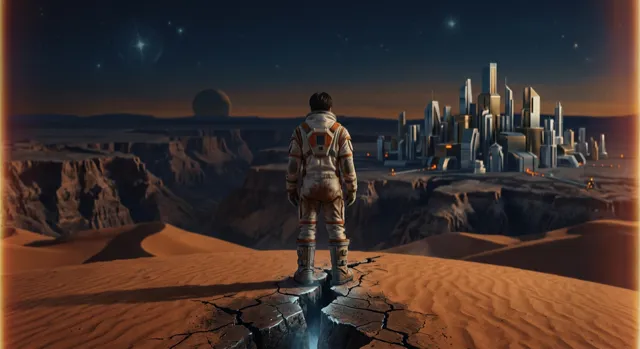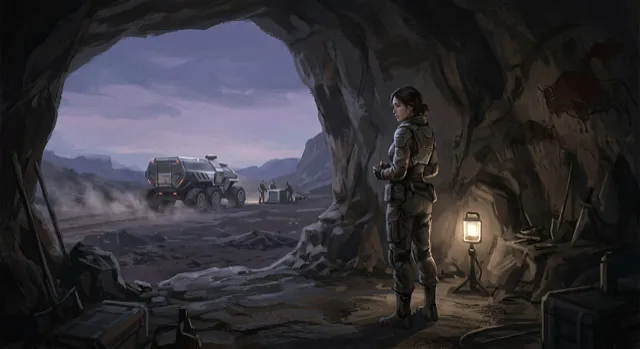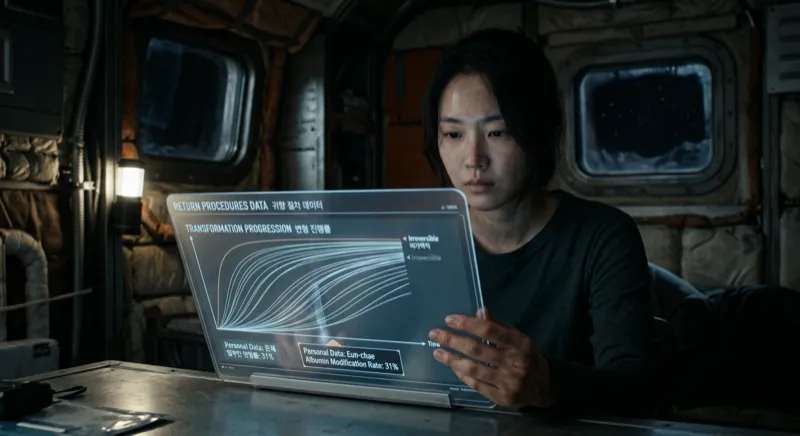
Iron-oxide dust had worked its way into the seam of the airlock. Minjae wiped his helmet visor with a gloved hand. The dust smeared. A red streak cut across his field of view. He wiped the visor once more and opened the airlock's inner hatch. Instead of the sound of air rushing out, a wind blew toward him from within. It was warm. There was no reason for warm air to come out of an abandoned facility. The interior temperature of an atmosphere plant should have matched the Martian air outside. Somewhere near 50 below. The sensors in Minjae's suit measured the temperature just inside the airlock. 14 degrees. His hand stopped on the hatch frame.
Atmosphere Plant Ares-4. Left unmanned for 7 years since the terraforming project was shut down. Fourteenth on the list of facilities slated for decommissioning. Over the past 14 months, Minjae had dismantled 13 of them. He had broken down the electrolyzers, cut out the piping, loaded the materials onto pallets, over and over. All 13 had been dead. Empty shells, their power cut off, their catalysts degraded. Ares-4 was the fourteenth. Minjae pulled up the decommissioning manifest from headquarters on his helmet display. 3 catalytic reactors, 12 electrolyzers, 48 gas-separation membrane modules, 2,400 solar panels. Once the materials were dismantled and hauled to the orbital elevator, a bonus and a return ticket to Earth would follow. Minjae's Mars residence visa had 93 days left. When the visa expired, so did his eligibility to board a return ship. There was no administrative body on Mars to process a visa extension. The estimated time for the decommissioning job was 68 days.
There was no dust on the floor of the inner corridor. Outside, iron-oxide dust covered everything. The floor inside was clean. It wasn't that someone had swept it. The surface of the floor was different. A thin film covered what should have been bare concrete. It was a grayish green. Minjae knelt and touched the film. He could feel its texture through the glove. It was damp, and faintly sticky. He took the glove off. He touched the floor with his bare hand. It was warm. Tiny bubbles were rising from the surface. When the bubbles burst, there was a smell. It wasn't metallic. It was the smell of earth. The smell of wet soil after rain. A smell you could only catch on Earth. There was no way for soil to smell on Mars. Martian soil held no organic matter.
Minjae stood and walked along the corridor. The grayish-green film had spread from the floor up onto the walls. The deeper the corridor went, the thicker the film became. What had been the thickness of a sheet of paper near the entrance grew, farther in, to the thickness of a knuckle. The color deepened too. There was a gradient, from the pale gray-green near the mouth to a dark green deeper inside. In some places the film on the walls had climbed all the way to the ceiling. It had grown even over the light covers on the ceiling. The lights bled through the film in green. In that stretch the air was different. The humidity was high. Minjae's sensor measured the oxygen concentration. 18.3 percent. The oxygen concentration of the Martian atmosphere was 0.13 percent. A 130-fold difference. This figure was close to Earth levels. An atmosphere plant left abandoned for 7 years was still making oxygen.
The door to the catalytic reaction chamber stood open. Minjae stepped inside. He stopped. His own breathing echoed inside the helmet. His heart quickened. He pulled one foot back, then halted and steadied his breathing. It was not a danger signal. The sensors detected no toxic gases. The oxygen concentration was high. Radiation, too, was within normal range. There was nothing dangerous here. There was only something that should not have been here.
He knew the chamber's original layout from the schematics. Three cylindrical reactors, 8 meters tall, standing side by side. What the chamber looked like now did not match the schematics. The outer walls of the reactors were not visible. The grayish-green film covered the reactors entirely. Bubbles were rising from the surface of the film. The bubbles were larger than the ones in the corridor. The corridor's bubbles had been the size of a fingernail. Bubbles the size of a fist swelled up over the film and burst. Each time one burst there was a wet sound. Water had pooled on the floor between the reactors. Liquid water, on Mars. Minjae stood before it and looked at the surface. The water was not clear. It was a pale yellow-green. Fine particles floated in it. The chamber's lights reflected off the surface. The lights, too, were alive. It meant power was coming from the solar panels. Solar panels that no one had maintained for 7 years were still supplying power. There must have been a time when Martian dust storms buried the panels. It meant the system had survived even then.
Minjae closed the decommissioning manifest. In its place he opened the catalytic reactor's original specification sheet. A device that drew in carbon dioxide and used a catalyst to split it into carbon monoxide and oxygen. The catalyst was an iridium-ceria composite. Reaction temperature 850 degrees. Power supplied by solar panels. Design lifespan 10 years. By design, the catalyst needed replacing every 3 years. It had not been replaced in 7 years. And yet the reactor was still running. Minjae scraped a sample of the film from the reactor's outer wall. He fed it into the portable analyzer. The results would take 4 minutes. While he waited, he looked around the chamber. The surfaces of the 3 reactors were not uniform. The film on Reactor 1 was the thickest. Reactor 3's was the thinnest. Reactor 2 was in between. There was a connecting corridor between 1 and 3. The film had grown on the floor of that corridor too. The three reactors were linked by the film into a single system. From the film on the surface of Reactor 1, the bubbles were rising most vigorously of all.
The analysis came back. I waited for the numbers on the analyzer's screen to change. It could have been an error. I waited 10 seconds. The screen didn't change. Minjae's eyes stayed fixed on the display. The composition of the film was laid out. Residue of the iridium-ceria catalyst: 12 percent. Magnesium perchlorate breakdown products: 31 percent. The remaining 57 percent was an organic compound the analyzer couldn't identify. Magnesium perchlorate was a primary component of Martian soil. It was highly toxic, one of the greatest obstacles to human settlement on Mars. Plants can't grow in it, and on contact with skin it damages the thyroid. This film was breaking down the toxic substances in Martian soil. That had never been the catalyst's function. It was a reaction that appeared nowhere in the design.
Minjae opened the channel to headquarters. The Mars-Earth transmission delay was 14 minutes. Minjae sent a message.
"Ares-4, arrival report. Interior conditions differ from the specification. Abnormal biological activity confirmed in the catalytic reactors. A detailed survey is required before decommissioning."
28 minutes later, the reply came from headquarters. Not a voice, but text. 'No survey necessary. Proceed with decommissioning as planned. Completion within 68 days is mandatory. Return schedule cannot be changed.' Minjae stared at the screen. There was an added note on the final line of the text. 'Sale contract for Ares-4 materials has been finalized. Penalty fees apply in the event of delayed fulfillment. To be borne by the decommissioning engineer.' Minjae switched off the communications panel.
Minjae slept in the reactor hall. There was a habitat module for decommissioning engineers beside the airlock, but the reactor hall was warmer. 18 degrees. The habitat module only reached 12 degrees with the heating on. Minjae laid a mat on the floor next to a reactor and lay down. From the ceiling came the sound of bubbles bursting at regular intervals. He closed his eyes. The bubbling sounded like breathing. As if the whole building were drawing breath. Minjae took off the helmet. The oxygen concentration was sufficient. He breathed without the mask. It was the first time on Mars he had breathed without a helmet. The air was damp and warm. The air filling his lungs smelled of soil. Minjae drew a deep breath. He had been on Mars 2 years. For 2 years he had breathed only the filtered air inside a helmet. This air was different. Mixed into it was the smell of something alive.
When he woke in the morning, the gray-green film had grown right up to the edge of the mat. Overnight it had spread more than 3 centimeters. Minjae touched the film's boundary. The boundary was the thinnest part. It was translucent. Beneath it he could see fine, thread-like structures. Branching like hyphae, boring into the microscopic cracks in the concrete surface. The film might have been absorbing the calcium in the concrete. It was growing by taking the building itself as nutrient. Minjae raised himself and went over toward Reactor 1.
He put his hand into the water pooled on the floor of Reactor 1. The water level had risen since yesterday. Moisture was condensing out of the film on the reactor's outer wall and running down to the floor. The film itself was part of a water cycle. A system that made water, stored it, circulated it. It was warm. 32 degrees. As he held his fingers in the water, fine bubbles rose over the back of his hand. As they burst, he felt a faint prickle on his skin. It didn't sting. It tickled. Minjae moved his fingers. The bubbles scattered along the motion of his fingers, then gathered again. Minjae pulled his hand out. Pale green particles clung to the back of it. They didn't come off easily even when he rubbed. The particles clung along the grain of the skin. When he washed with water, they came off.
Over the next 3 days, Minjae surveyed the reactor hall. He measured the film's rate of expansion every 12 hours. An average of 2.4 centimeters a day. He looked at a sample taken from a thick part of the film under a microscope. It had a cellular structure. Single-celled. Roughly 5 micrometers in size. The form resembled Earth's cyanobacteria, but the structure of the cell wall was different. It was photosynthesizing. But not with chlorophyll. The metallic elements of the iridium-ceria catalyst had been integrated into organelles within the cells. The catalyst had simply been mediating chemical reactions, and then, over 7 years, reacting with the organic precursors of Martian soil, it had produced a new form of cell. Minjae lifted his eyes from the microscope screen. His hands were trembling. This was life born on Mars. Not of Earthly origin. It was made by iridium and ceria and perchlorate and the carbon dioxide of Mars. It was something no human had designed. Something no human had intended. And something no one knew whether humans could ever make again.
Minjae did not report this to headquarters. He knew what would happen if he did. Once the words biological activity reached the legal team, a contamination-risk assessment would begin, site access would be forbidden for the duration of the assessment, and in the end an order for remote incineration would come down. A single line of text. 'Proceed with dismantlement as planned.' Instead, Minjae recorded the data. The membrane's growth patterns, oxygen output, the rate of perchlorate breakdown, the water's temperature and acidity, the cells' rate of division. As the data accumulated, a single picture emerged. Day one, oxygen concentration 18.3 percent. Day two, 18.7 percent. Day three, 19.1 percent. It was climbing steadily, 0.4 percent at a time. The perchlorate concentration was falling in the opposite direction. In a soil sample taken from inside the reaction chamber, the perchlorate concentration measured one eighth of the Martian average. This system was purifying the soil of Mars. Breaking down the poison that was perchlorate, making oxygen, cycling water. What the terraforming project had tried to achieve at a cost of trillions of won, this membrane was doing on its own.
Day four was the start date of the dismantlement schedule. Minjae checked the demolition equipment in the habitat module. Hydraulic cutter, bolt-removal tools, remote controller for the crane. He packed the equipment into a backpack and went to the reaction chamber. He stood before reactor No. 1. He lifted the hydraulic cutter. He switched it on. The blade began to spin. The blade touched the membrane on the reactor's outer wall. The membrane shrank back minutely around the blade. A reflexive contraction. Minjae's hand came away from the cutter. The strength had drained from his fingers. The cutter fell to the floor. The 4.2-kilogram tool struck the ground. The sound of metal against concrete rang through the reaction chamber.
Minjae did not pick the cutter up. The membrane would slowly spread over the cutter where it lay on the floor. Minjae left the reaction chamber. He walked the corridor. The membrane on the walls was staining the corridor lights green. He sat down before the communications panel in the habitat module. He wondered whether to contact headquarters. Even if he did, the answer would be the same. Instead, Minjae opened another frequency. The frequency of the research base in Mars's northern hemisphere. 4,200 kilometers away, three scientists were carrying out residual observations.
"Mars northern-hemisphere base, this is the Ares-4 dismantlement team. Do you read?"
Twelve seconds later, a reply.
"Ares-4, this is the northern base. Reading you clearly. Is this an inquiry regarding the dismantlement operation?"
Minjae said,
"No. I've discovered abnormal biological activity in the reaction chamber. A microorganism derived from the catalyst is breaking down the perchlorate in the Martian soil. I'll transmit the data."
A long silence. Seventeen seconds.
"Transmit it."
Minjae sent the data he had gathered over three days. Four minutes after the transmission completed.
"Ares-4, we've reviewed the data. Is this some kind of joke?"
"No. I observed it for three days and collected the data."
The silence stretched long. Minjae listened to the static of the speaker. Through the static he could hear the other person breathing.
"If this is real."
The voice broke off, then returned.
"This isn't just a catalyst. This is the starting point of an independent ecosystem. You must not dismantle it."
Minjae answered,
"I know."
The text from headquarters came again. 'No report on dismantlement progress. Penalty to be imposed for schedule delay. Return ticket subject to cancellation.' Minjae read the text. 11 of the 93 days had passed. 82 remained. If he began dismantling now he would be 11 days behind schedule, but there was a chance headquarters would approve the change. If he didn't dismantle it, the penalty and the cancellation of his return ticket. He would be left on Mars. Left on Mars for good. Remaining after his Mars visa expired amounted to illegal residence. He would never be able to return to Earth.
Minjae went back to the reaction chamber. He sat down at the base of reactor No. 2. He leaned his back against the reactor's outer wall. He could feel the surface of the membrane through his back. It was warm. It seemed to pulse faintly. There was a steady rhythm. Four-second intervals. Bubbles rose and burst at the membrane's surface, the vibration carrying through to his back. Minjae closed his eyes. The temperature in here was 18 degrees. The average temperature outside, on Mars, was 60 below zero. If this building were gone, the membrane, the water, the oxygen would all die in the Martian cold. At 60 below zero, liquid water cannot exist. The membrane's cells would freeze. What hundreds of scientists on Earth had failed to accomplish over decades, a catalyst and Martian soil had achieved here by accident.
Minjae stood up. He went to the communications panel. He opened the headquarters channel.
"Report from the Ares-4 dismantlement team. Beginning dismantlement of the reactors."
Fourteen minutes later, headquarters replied.
"Confirmed. Proceed."
Minjae cut the connection. He sat in the chair. He laid both hands on his knees. His hands were trembling. He had made a false report. He had, with his own hands, severed the last link to a return ticket. Minjae waited for the trembling to stop. Three minutes. It did not stop. Minjae rose on trembling hands. He opened the door of the reaction chamber. He did not take up the demolition equipment. Instead he brought six sealed containers from the habitat module. From the membrane of each of the three reactors he took two samples apiece. The thickest part of the membrane and the thinnest. When he peeled away the thick part, the membrane contracted. Like a wound closing, the cut edge curled inward. He collected water too. He gathered a soil sample as well. He put the sealed containers into his backpack.
Minjae went back to the habitat module and tuned the comm frequency to the Northern Base.
"Northern Base, this is Ares-4. I've secured the samples. Sealed them in a culturable state. I'll bring them to the base."
A reply came.
"Ares-4, you're 4,200 kilometers from base. Eighteen days one way by rover. The fuel to get back—"
Minjae said,
"I'm not coming back."
Silence. 22 seconds.
"And the decommissioning?"
"I filed the report. Said it was underway."
"But in reality."
"I didn't dismantle the reactor. Headquarters has no one to send for an on-site inspection. Verifying it would take six months, minimum. If the membrane grows in that time—"
Minjae's voice cut off. He picked it up again.
"The power to hold the reaction chamber's temperature comes from the solar panels. I didn't dismantle the panels, so the power holds. Sealing the chamber door keeps outside dust from getting in. The sealing is done. I sealed the airlock's inner hatch with adhesive and shut the outer hatch. I switched the ventilation system over to internal circulation."
"You made this call out there, alone?"
"Yes."
"And your return?"
"There isn't one."
A sigh came over the speaker.
"Ares-4 decommissioning crew. Your name—"
"Minjae."
"Minjae. We'll talk when you get here. You have food?"
"17 days' worth."
"That's not a lot."
"It's enough."
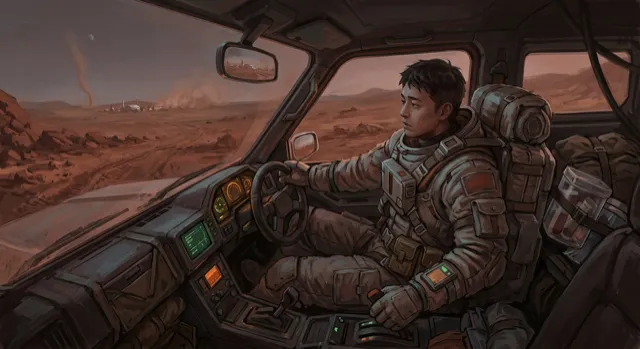
Minjae pulled out all the emergency food in the habitat module. 34 compressed ration bars. 2 water-purification filters. 23 liters of water left in the tank. He loaded it all onto the rover. Into the backpack he put the 6 sealed containers and the data storage unit. He inspected the rover's oxygen generator. He checked the charge left in the fuel cell. Enough for 18 days one way. On the 19th the fuel would run dry. A round trip was impossible. Minjae stopped as he passed in front of the reaction chamber. Warm air was leaking through the seam of the sealed hatch. Minjae laid his palm against the hatch. It was warm. He took his hand away. He opened the airlock and stepped outside. The Martian sky glowed faintly through the red dust. The thermometer read 47 below. The wind blew. Fine particles of iron oxide clung to his visor. Minjae looked back. The outer wall of Ares-4 was buried in iron-oxide dust. Inside the building the membrane was growing, water was circulating, oxygen was being made. From outside, none of it showed. It looked like nothing but a dust-covered rectangle, the same as every other building on Mars.
Minjae climbed into the rover. He started the engine. The rover began to move across the Martian stone field. 4,200 kilometers. Inside the backpack the sealed containers knocked against each other. Minjae looked in the rearview mirror. Ares-4 was shrinking. The rectangle in the dust became a dot. Minjae turned his eyes forward. His return visa had 82 days left. Six months for headquarters to send inspection personnel. In that time the membrane of Ares-4 would grow. Past the reaction chamber into the corridor, past the airlock to the outside. Into the soil of Mars. Minjae would never see it. Eighteen days to the Northern Base. When he reached the base he would hand over the samples, pass on the data, and past that he could not know. What would be left once the visa expired, once he became an illegal resident, once the connection to Earth was cut. Minjae decided not to think about it. The red stone field ran on to the horizon. The sky was pink. The sun hung low. Each time the rover's wheels bit into stone, the body swayed. The sealed containers knocked again. It was a sound from inside the backpack. Minjae did not slow down. The rover's dashboard showed the distance left to the destination. 4,187 kilometers. The sealed containers in the backpack knocked once more. A small sound. Minjae listened to it and watched the horizon. Beyond the horizon nothing showed. The rover's wheels went over a stone. The body tilted, then righted. The sealed containers knocked once more inside the backpack.