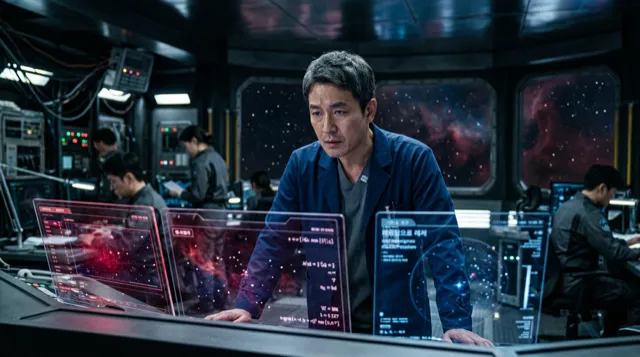
Every current of the city was projected onto the wall like a vast river of light. Billions of vectors. The movement of individuals, the flow of goods, the exchange of information—all rendered as green lines, streaming smoothly along their predicted paths. Everything in its calculated, optimal state. And there, in the middle of that immense green river, a single vector blinked red. A very small point. It appeared, vanished, and appeared again.
The warning was not a sound. The neural implant just inside Han Seo-jin's temple sent its signal as a faint pressure. He set the nutrient tube he'd been drinking from back into its holder and shifted his gaze to the main monitor. The red point was surfacing in Sector 17, Residential Block 4-Beta. He raised a hand into the air. As his fingers moved, the data zoomed, filtered, and rearranged itself. The river that had shown the whole city was replaced in an instant by the fine grid of Sector 17.
An error. The deviation between the system's prediction and the event that actually occurred. Most errors were nothing more than statistical noise. They arose from external variables—an unforeseen traffic jam, a sudden shift in weather—and reverted to green within seconds, once the system calculated a new optimal path. But this red point was different. For 12 hours it had cycled between vanishing and reappearing. It correlated with no external variable. The cause narrowed to a single identification number. Personal ID 734-88-1029.
Han Seo-jin was an Error Corrector. His duty was to erase the red points and return the city's flow to its perfect green. He opened the file on the personal ID. Lee Su-a's face rose onto the screen. The cultivation log from a high-altitude hydroponic farm held 5 years of watering records stacked neatly side by side, without a single lapse. Social contribution score: 89.2. In the psychological profile field, a single tag was fixed: 'compliant.' Over the past 5 years, her rate of deviation from her assigned path had been under 0.001%. A citizen who had followed, exemplarily, the life-path the system had granted her. And yet a new warning tag had been attached to her file. 'Nondeterministic Error.'
It was a classification Han Seo-jin had never seen before. He played back Lee Su-a's real-time observation record. Footage from 3 hours earlier. She was inside her residential module. A small, standardized space. The system's prediction was unambiguous. '19:00, nutrient meal. 19:20, designated rest. 19:37, learning module access. 22:00, sleep.' But at 19:20, instead of resting, she went out onto the balcony. On the balcony stood three hydroponic pots connected to an automatic nutrient-supply system. Plants the system had assigned, judging them optimal for her health and psychological stability. The prediction was that she would check the plants' condition for 2 minutes and come back inside.
Just as predicted, she inspected the three pots in turn. And then she did something the prediction did not contain. She picked up a small watering can from the corner. Beside the three pots stood an old clay pot, unconnected to any automated system. A cracked, moss-covered pot. An object that did not exist on the system's resource-management ledger. She watered that fourth flowerpot. A single scrawny stem barely rose above the soil. By the system's analysis, a plant with a survival probability under 5%. Her act of watering it was a perfect waste, included in no optimization calculation whatsoever. An action with a probability under 0.00001%. And yet it had happened.
Han Seo-jin froze the footage. On the screen, her profile hung still as she looked down at The Fourth Flowerpot. The act itself was trivial. It had no effect on the city's flow. But through the eyes of the Calculator, this was an event on the order of observing a particle that should not exist in the universe. The Calculator predicted every human choice. Synthesizing genetic information, environmental data, past behavioral patterns, and real-time biosignals, it calculated the probability of a person's next action. On that prediction it built a path, presented to every individual, that maximized the efficiency and stability of society as a whole. Unpredictability was, in essence, the seed of chaos. The one enemy the system sought to eradicate.
The next day, the error repeated. The system predicted she would take the A-3 elevated walkway on her way to work. Probability 99.8%. For no reason at all, she walked the B-1 walkway. An inefficiency of 47 seconds resulted. The probability that she would choose Protein Supplement Meal Type C for lunch was 98%. She chose the carbohydrate-centered Type D. Her afternoon work efficiency was projected to drop by 1.2%. Every choice was trivial, yet consistently it departed from the prediction.
Through the neural implant, a message arrived from the Nexus, his direct supervisory system.
"Error 734-88-1029 reclassified as nondeterministic. Probability of self-extinction within 24 hours under 0.1%."
It was a cold, synthetic voice.
"Corrector Han Seo-jin, Level 2 intervention approved. Determine cause and resynchronize path."
Han Seo-jin's back came away from the chair. Level 2 intervention. It meant field contact. For the past 3 years, every correction he had carried out had ended with remote data modification. To meet an individual in person meant the system had judged it a grave variable.
He began simulating the contact with Lee Su-a. Working from her psychological profile, the Calculator generated thousands of conversational scenarios. The most efficient sentences, words, intonations, even the exact lengths of silence needed to steer her back onto a predictable path—all of it was computed. Han Seo-jin ran the simulation over and over, burning the optimal conversational route into his short-term memory. The core of the scenario was this: to make her recognize that her own behavior was 'inefficient,' and to make her accept that the system's proposal was a 'benefit' to both herself and society.
The mission time was set for 18:00 the following day—the hour she returned to her residential module after work. Han Seo-jin was issued a cover identity: 'building management systems inspection technician.' His clothing, his equipment, even the optimal answers to anticipated questions were all transmitted as data. Every variable had been brought under control. All but one—the target herself, Lee Su-a.
The next evening, Han Seo-jin stood before Residential Block 4-Beta in Sector 17. The gray technician's uniform was a little too big for him. The recycled air carried a faint trace of ozone. He tilted his head back and looked up at one balcony among the countless others. Floor 34, her module. Four flowerpots, tiny at this distance. The Fourth Flowerpot could not be seen from here.
His neural implant displayed the current time and his heart rate. Everything within normal range. His path of action had been calculated to perfection. And yet he knew that what he was about to do was the moment when a perfectly predicted world would collide with an unpredictable, unknown point. A damp sensation spread across his palms. He checked the data. It was his own body's response. The system classified it as a 'minor stress reaction' and predicted it would vanish within 0.2 seconds. The sensation did not vanish.
Han Seo-jin walked into the building's shared entrance. The lobby's guide robot scanned him and quietly cleared the way. He took the elevator up to the 34th floor. The corridor was thick with the smell of disinfectant and a faint mechanical hum. He stopped before the door of Lee Su-a's home. The metal door bore only a small identification sensor, no ornament of any kind. He ran a final check on his mission protocol. The first sentence. Where to direct his gaze. The tone of his voice. Everything was ready.
He drew a deep breath. The air entering his lungs was cold. And he pressed the call button.
The door made almost no sound as it opened. With the faint hiss of escaping compressed air, part of the door slid away into the wall. Light leaking through the gap split the shadows of the corridor. In that light stood Lee Su-a. She matched the image data the system had provided exactly. Soft brown hair, average height, colorless indoor clothes. Her expression fell within the category the simulation had predicted—'acceptance without wariness.' But there was a subtle difference the data could not capture. Her eyes were fixed not on Han Seo-jin's face but on the far end of the corridor, past his shoulder. As if she had not been waiting for him to come, but for something else.
"What is it?"
Her voice matched the predicted tone exactly. A neutral question carrying almost no emotion. Han Seo-jin delivered the first line of the imprinted scenario.
"I'm from building management. This is a routine inspection of the environmental control systems for every residential module on the 34th floor. May I come in for a moment?"
Every word, every syllable had been tuned to carry a calculated, optimal persuasiveness. Lee Su-a hesitated for a moment. 0.7 seconds. 0.4 seconds longer than the predicted response time. Only then did her gaze reach Han Seo-jin. It moved over his uniform, the diagnostic tablet in his hand, and then his face, in turn.
"All right. Come in."
She stepped aside and opened the way. Han Seo-jin walked in. The interior of the module was exactly as he had seen it countless times on his monitor. Standardized furniture, a nutrient-supply device and learning module built into the wall. Everything in its place. But there was something the video data had never conveyed. The air. Mingled with the ozone smell peculiar to recycled air was a very faint scent of soil. Particles so minute the system's environmental sensors could not detect them. Han Seo-jin's neural implant tagged this abnormal olfactory information as 'unclassified data.'
His mission protocol called for him to inspect the balcony's automation systems first. As he moved toward the balcony, Lee Su-a followed quietly behind. Her presence made no sound, yet the pressure he felt at his back was the kind of thing that could not be converted into data.
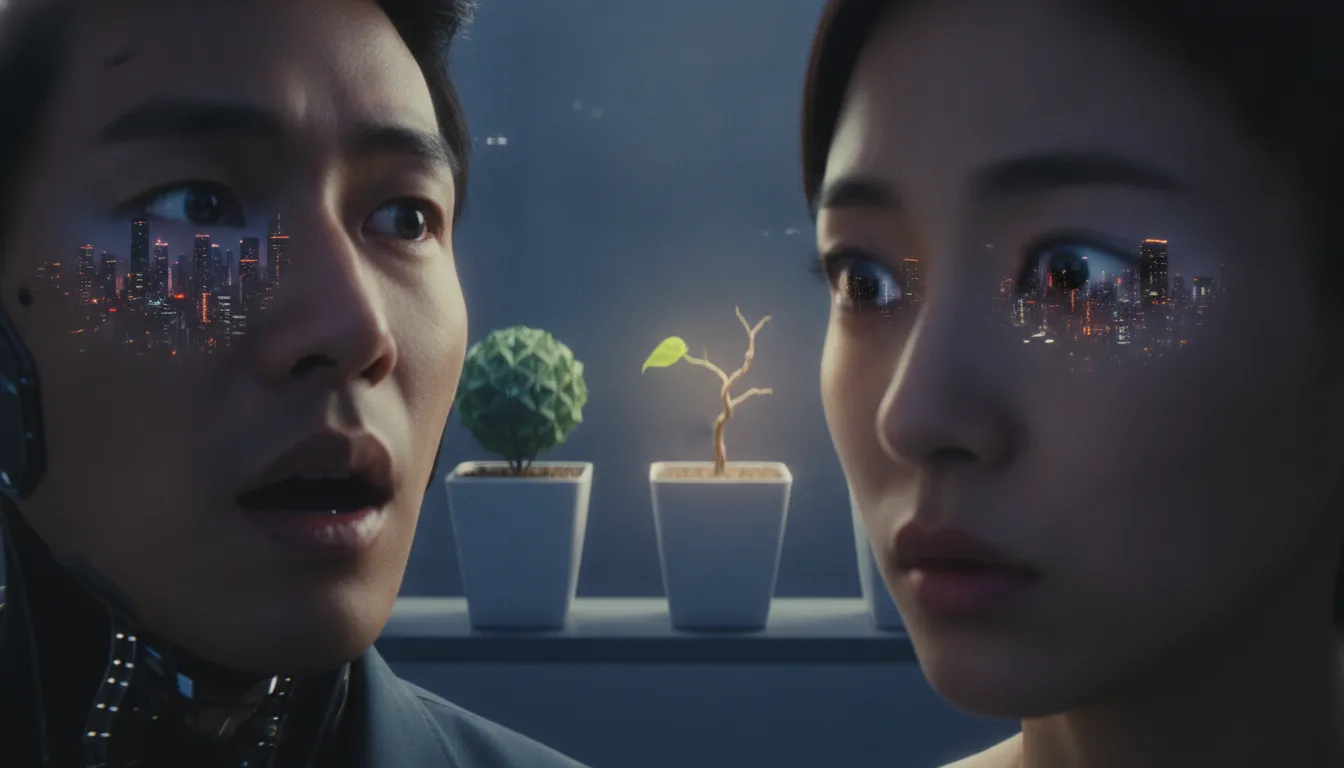
The balcony was sealed off from the city's polluted atmosphere by a transparent nano-membrane. Three hydroponic flowerpots gleamed, lush, in their optimal light and nutrient solution. Beside them, Han Seo-jin's gaze came to rest on the Fourth Flowerpot. Up close, the pot looked older and shabbier than it had on video. Dark red soil showed through a crack running down its side, and the slender stem looked so precarious it might snap at any moment. At the tip of the stem hung two very small leaves. It was alive.
Han Seo-jin raised the tablet and pretended to inspect the automation systems. His mission directive glowed on the screen. 'Stage 2: Induce recognition of the inefficient resource-waste factor.' He lifted his eyes from the tablet and, as naturally as he could manage, pointed at the Fourth Flowerpot.
"This specimen is not registered in the management system. Nor is it connected to the automated nutrient-supply line."
His voice was that of a perfectly controlled technician. A tone with just the right blend of concern and expertise. According to Lee Su-a's psychological profile, there was an 87% probability she would respond to this observation with something compliant—that she 'hadn't realized,' or that it 'had been a mistake.'
"I know."
Her answer was a single word. An affirmation too concise to appear anywhere on the list of predicted responses. For an instant, Han Seo-jin's conversational algorithm dropped into a void. He opened his mouth to advance to the next scenario.
"An unregistered organism can introduce a minute error into the resource-distribution efficiency of the entire sector. Furthermore, uncontrolled soil allows external contaminants to enter—"
"This little one's name is 'Today.'"
Lee Su-a cut him off. Han Seo-jin stopped. 'Today.' A naming convention that did not exist in the system's language database. His neural implant fired a warning signal. 'Target's response pattern deviating 12.8% from predicted trajectory. Conversational strategy recalibration required.'
"A name?"
Han Seo-jin barely managed to ask it back. Not a calculated line, but a purely spontaneous question that had escaped his lips.
"Yes. Yesterday it looked dead. But this morning, I saw that little leaf—it had just come out, new. So its name is Today. Come tomorrow, it might get another name."
She looked down at the flowerpot and smiled faintly. That smile seemed to belong nowhere among the millions of emotional-expression data points the system had analyzed. Her fingertips gently traced the cracked rim of the pot.
A new directive flowed in from the 'Central Hub.' 'Switch to conversation protocol Delta-9. Attempt logical persuasion through an emotional approach.'
In accordance with the new directive, Han Seo-jin modulated his voice to be gentler.
"The system fully understands the pleasure of raising plants. That is precisely why it assigned you three optimal species. Those flowerpots were calculated to have a 99.3% probability of contributing positively to your psychological stability. But this fourth flowerpot… its chance of survival is negligible. When it dies, the probability of a negative impact on your psychological state reaches 73%. The optimal path for you is to abandon this inefficient effort."
He delivered a flawless sentence. The most effective persuasion the system could produce, logic and consideration coexisting within it. And yet Lee Su-a shook her head.
She looked Han Seo-jin straight in the eye. In her pupils was reflected the vast river of the city's light beyond the balcony. Billions of predicted green vectors.
"Probability isn't everything, is it?"
That single sentence brought down every one of Han Seo-jin's defensive systems. His implant could not find an optimal rebuttal to it. 'Probability is not everything.' It was a statement that denied the very foundation of this world. His fingertip pressed the edge of the tablet and let go.
"If everything went exactly as predicted, what would be the meaning of living?"
she added softly.
"Today—even the Calculator couldn't have known this little one would put out a new leaf."
Han Seo-jin could not answer. That damp sensation spread across his palm again. The system still classified it as a 'minor stress response,' but he was dimly beginning to feel it was something else. A thin crack was forming in his once-perfect world. Not the red dot on a screen, but this woman standing right before his eyes and her dying flowerpot—that was the epicenter of the crack. His finger stopped on the tablet. He could not find the button to move on to the next scenario.
Han Seo-jin's neural implant screamed. As though its logic circuits were overloaded, hundreds of error messages skimmed across the surface of his consciousness. 'Rebuttal-data search failed.' 'Discrepancy with psychological profile: 34.7%.' 'Unidentified concept: meaning.' The Central Hub demanded an immediate response. 'Target resistance confirmed. Switch to Tier-3 intervention protocol. Refute the target's irrational attachment and order the specimen's immediate disposal.'
His mouth opened mechanically. The system transmitted the most efficient command to his tongue and vocal cords. But no sound came. His eyes had left the city lights reflected in Lee Su-a's pupils and fixed on the fourth flowerpot behind her. That small, fragile leaf clinging to the tip of a gaunt stem. A life that, by the system's calculations, should not exist. A reality of less than 0.00001% probability. It was not an error. It was something close to a miracle.
"Your… ID is 734-88-1029."
Han Seo-jin finally spoke. His voice was not the tone the system had tuned. It was trembling faintly.
"You are a high-altitude hydroponic-farm technician. Social contribution: 89.2. You are a model citizen, recognized by the system."
"Do those numbers explain who I am?"
Lee Su-a asked quietly. She was not reproaching him. It was a pure question, as though she genuinely wondered.
Han Seo-jin could not answer. He had spent his whole life handling numbers. He had believed that every human being, every object, every current could be reduced to data and probability. That was the only way to preserve the city's peace and efficiency. And yet now, standing before his eyes, was a being that numbers could not explain. Her actions were inefficient, her logic irrational, and her smile refused to be converted into data. His implant rewound the same frame. It was the twelfth time.
'Warning. The Corrector's vital signs have exceeded permissible range. Complete the mission at once and return.'
The cold command from the Hub stabbed at his temple. He stood at a crossroads. Would he erase this red dot as instructed, or… He looked down at his tablet. On the screen, a 'Mission Result Report' form was blinking. He raised his fingers and let them hover over the keyboard. 'Cause of error: subject's deeply entrenched irrationality. Correction failed. Forced synchronization requested.' This was the correct answer. The only answer the system demanded. Enter it, and everything would return to its original, perfect green. This little chaos would vanish, and he could become part of the efficient city once more.
His gaze turned again to The Fourth Flowerpot. The being she called 'Today.' That unpredictable hope—that tomorrow it might be given yet another name. What if that flowerpot unfurled another leaf tomorrow? What if, someday, it bloomed into flower? What if it survived out of sheer stubbornness, mocking the system's predictions? The probability converged to nearly 0. But as she had said, probability was not everything.
Han Seo-jin began to type. His fingers moved not along the motions branded into him by simulation, but along a path he had never once traveled.
'Report: Findings on inspection of Error 734-88-1029.'
'Cause: Emergence of a psychological variable not reflected in the predictive model. Beyond the standard stabilizing stimuli the system provided (3 hydroponic flowerpots), the subject spontaneously generated an additional variable capable of embodying the concepts of "overcoming" and "growth."'
'Analysis: The behavior incurs resource inefficiency, yet possesses a paradoxical effect that may positively influence the subject's long-term psychological stability and system compliance. This may constitute a new form of "self-correction" mechanism.'
'Action: Grade-3 intervention withheld. Designating the entity in question (the Fourth Flowerpot) as a "controlled nondeterministic variable." Recommend reclassifying it as a subject of long-term observation for the purpose of additional data collection.'
He pressed the 'Transmit' button. The data flowed into the central system. He had deceived the system. No—he had merely translated into a language the system could understand. 'Hope' into 'long-term psychological stability,' 'love' into a 'self-correction mechanism,' the name 'Today' into a 'controlled nondeterministic variable.'
A moment later, a reply arrived through his implant. 'Recommendation accepted. Error 734-88-1029 converted to observation grade. Mission complete. Return.'
The red dot stopped blinking. But it did not turn back to green. It now glowed on the system's map as a faint orange point. A subject of management. But not a subject of removal.
"The inspection is finished."
Han Seo-jin said, lowering his tablet. His voice had recovered its calm.
"There is no anomaly in the system."
Lee Su-a said nothing. She simply looked at him. In her eyes there was neither a word of thanks nor a sigh of relief. There was only a quiet understanding. As though she knew exactly what choice he had made.
Han Seo-jin gave her a slight bow and turned away. As he stepped out through the entrance, he thought he caught, ever so faintly, the scent of soil following at his back. He rode the elevator down to the ground floor. Outside the building, the cold night air met him. He lifted his head and looked up at the building he had just left. Hundreds of identical windows. One of them was Lee Su-a's home. The light spilling from hundreds of millions of windows no longer merged into a single river; each blinked in its own color.
His implant sent no warning whatsoever. His heart rate was stable, his stress index within the normal range. In the system's eyes he had returned to an error-free vector, to perfect green. But inside his temple, in the very spot where the warning had sounded, a faint orange warmth had begun to glow.
Slowly, he drew his hand from his pocket. From his fingertip a single cold droplet fell, and the sensation of it seeping into unseen soil was vivid.