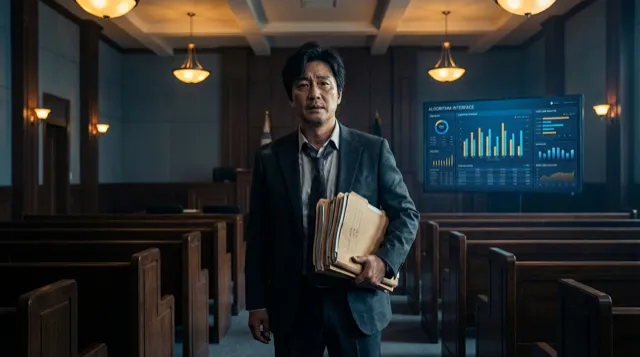
"Your Honor, I ask that you recalculate this defendant's parole eligibility score."
The voice that rang out in the courtroom was low and firm. Every eye in the gallery turned toward the court-appointed defense counsel. The man standing at the defense table had suit cuffs worn slightly thin and a crooked tie knot, but his gaze alone did not waver.
Oh Jeong-hun lifted the case file. The bundle of documents, over 300 pages thick, swayed with its weight. "The defendant, Park Jae-seong, is serving time on a charge of theft, and in his parole review he was ruled 'ineligible.' But the algorithm of FairMind, the AI prediction system on which that ruling was based, has a grave defect."
The presiding judge looked at Oh Jeong-hun over the rim of his glasses. "Counsel, be specific."
"The FairMind system predicts the risk of reoffending and scores parole eligibility accordingly. But one of the system's input variables is the defendant's residential postal code. Defendants living in certain postal codes—that is, in dense low-income areas—systematically receive lower scores than residents of other areas with identical criminal records."
This was the heart of the problem Oh Jeong-hun had been tracking for the past eight months.
Oh Jeong-hun was 45, a court-appointed defense attorney with the Seoul Central District Court. He had practiced criminal defense for nearly 20 years, 14 of them as a public defender. The cases retained lawyers avoided, the cases of defendants who had no money to hire a lawyer—those fell to him. The pay was meager and the cases were endless. Handling 25 to 30 cases a month was routine. Even so, Oh Jeong-hun read every case file himself. While his colleagues read only summaries for the sake of efficiency, he read the full record. But the accumulated fatigue was gnawing at his body. Chronic pain in his left shoulder, insomnia, digestive trouble. His wife, Su-hyeon, worried, but Oh Jeong-hun could not stop. To stop was to make someone's defender disappear.
It was eight months ago that he first came to suspect a problem with the FairMind system. While reviewing parole decisions, Oh Jeong-hun noticed a strange pattern. Inmates with similar offense types, similar time served, and similar correctional records had wildly different eligibility rates depending on where they lived. For residents of Seoul's Gangnam-gu, the eligibility rate was 78 percent; for residents of Seoul's Guro-gu, it was 31 percent. At first Oh Jeong-hun thought it a coincidence. But the wider he cast his sample, the sharper the pattern grew.
"This is no coincidence." Oh Jeong-hun muttered to himself in his office. The data he had organized into a spreadsheet filled two monitors. Analyzing 3,200 parole review results from correctional facilities nationwide, he found that the gap in eligibility rates between the top 20 percent and bottom 20 percent of postal-code areas reached 2.4 times. Even after controlling for offense type, sentence, and correctional record, the gap remained significant.
The very process of gathering the data was a war. Parole review results were not public data. He extracted the records of cases he was handling or had once handled, one by one, and secured additional data by asking fellow public defenders. Some colleagues gladly helped; others refused, saying, "Poke at this and we all take the hit together." Oh Jeong-hun did not blame them. A public defender's position was inherently precarious—a status close to contract work, a crushing caseload, a structure that required constant deference to the institution. Within it, to challenge the system was an act close to self-destruction.
One evening, as Oh Jeong-hun was organizing the data, a visitation request came in from Park Jae-seong. Through the transparent partition of the prison visiting room, Park Jae-seong's face was visible. He had lost weight since half a year ago.
"Counselor, the parole result came out... they say I'm ineligible." Park Jae-seong's voice trembled. "What did I do wrong? Even the guard said I was a model inmate."
Oh Jeong-hun brought his hand close to the partition and said, "You did nothing wrong, Jae-seong. There's a problem with the system. I'm exposing it right now."
"The system?" Park Jae-seong wore a puzzled expression. "You're saying a computer sets my score?"
"Yes. And I'm gathering proof that the computer isn't fair. It'll take some time, but don't give up."
Park Jae-seong bowed his head. "Counselor, I'll be honest. Each day in here is so long. I meant to work once I got out, to take care of my mother and live with her... How long do I have to wait?"
Oh Jeong-hun could not answer. He could not promise an exact time. He said the only thing he could. "I'll do everything I can."
Leaving the visiting room, Oh Jeong-hun leaned against the corridor wall and closed his eyes for a moment. His chest felt heavy. He knew how powerless the words "I'll do everything I can" were. But being able to say nothing more was the reality of the public defender.
Oh Jeong-hun believed he had to understand the AI system itself. But to him, a former law student, machine-learning algorithms were no different from a foreign language. So he sought help—Professor Kim So-ra of Seoul National University's computer science department. Kim So-ra was a leading domestic authority on algorithmic fairness, a scholar who had publicly voiced a critical stance on the courts' adoption of AI.
"Attorney Oh, if you send me the data, I'll analyze it." Kim So-ra said at their first meeting.
"Thank you. But, Professor, wouldn't sharing this data externally pose a legal problem?"
"Parole review outcomes are confidential, but once personally identifying information is stripped out, the data can be used for research purposes. There's also the option of obtaining de-identified data through a freedom-of-information request."
Oh Jeong-hun pursued two paths at once. One was to de-identify the data from the cases he had handled and pass it to Professor Kim So-ra; the other was to file a freedom-of-information request with the Ministry of Justice. The request was denied, as he had expected. The stated reason: 'a risk of harming the fairness of judicial administration.' Oh Jeong-hun gave a bitter smile. It wasn't his request that harmed fairness—it was the system itself.
Kim So-ra's analysis came back two months later. The conclusion confirmed Oh Jeong-hun's instinct. Along with the report, she had prepared visualizations. On a scatter plot, parole-eligibility rates by postal code were coded in color, and when overlaid on a map of Seoul, they traced almost exactly the same pattern as the income map. Wealthy neighborhoods in green, poor ones in red. Oh Jeong-hun stared at the graph for a long time. What he had only ever seen as numbers, now spread out across a map—a geography of discrimination laid bare before his eyes.
"Could this material be submitted in court?"
Oh Jeong-hun asked.
"Of course. Though how far the court will accept statistical evidence is anyone's guess. Korean courts are far less accustomed to statistical evidence of discrimination than American ones."
"Even so, we have to. Without this, there's no way forward."
Kim So-ra nodded.
"I feel the same. To be honest, I'm under pressure at the university because of this research. My department takes on a lot of contract work from the Ministry of Justice, so the faculty are uncomfortable with it."
"I'm sorry. That I've brought trouble down on you too, Professor."
"Not at all. This is research that has to be done. A scholar who can't speak the truth isn't a scholar."
There was a firm resolve in Kim So-ra's voice.
"The FairMind algorithm uses the defendant's prior criminal record, correctional performance, and reentry plan—and, on top of those, a variable called the 'Community Stability Index.'"
Kim So-ra pointed at the screen in her office as she explained.
"This index is calculated from the postal code of the defendant's residence. It's a composite score built from the local crime rate, unemployment rate, density of welfare infrastructure, and so on—and the problem is that it reflects the characteristics of the neighborhood, not of the individual."
"So you're saying that no matter how exemplary a person's conduct in prison, if their home address is in a certain area, their score gets docked?"
Oh Jeong-hun asked.
"Exactly. In effect, this is 'digital redlining.' It's the same structure as when, in the past, American lenders refused loans to areas densely populated by particular races. The postal code is functioning, in practice, as a proxy variable for socioeconomic class."
Oh Jeong-hun felt anger and sorrow surge in on him at once. The faces of the countless defendants he had represented came back to him. Park Jae-seong, a thief, 26 years old. He had lived in a semi-basement in Guro-gu and was serving time for stealing groceries from a convenience store. In prison he had completed a vocational training course and even drawn up a plan to find work after release. And yet FairMind had ruled him ineligible for parole. Around the same time, a fraudster who lived in an officetel in Gangnam was ruled eligible. The difference between the two men was not the gravity of their crimes, but their postal codes.
Oh Jeong-hun resolved to take the matter to court. But building a legal foundation was no easy thing. Korean law had no explicit provision on bias in AI systems. He would have to construct his argument by combining the equality clause of the Constitution, the due-process principle of the Criminal Procedure Act, and the fairness clause of the recently enacted AI Framework Act. Night after night, Oh Jeong-hun combed through precedents. He drew on the American case State v. Loomis, the European Union's AI regulation, and Canada's algorithmic impact assessment regime.
At two in the morning, his wife, Su-hyeon, came into the study.
"You're at it again, love?"
"Just a little more. I only have to finish this part."
"Your health comes first. I know your shoulder's been hurting worse again. You need to see a doctor."
Oh Jeong-hun turned his head to look at his wife. In Su-hyeon's eyes, worry and weariness were set side by side. Seventeen years of marriage, all of them lived as the wife of a public defender, were etched into her face. Oh Jeong-hun felt a pang of guilt. But he couldn't stop.
"This is an important case. If I don't do it now, no one will."
Su-hyeon sighed and set a glass of water down on the desk.
"I know. I know that's the kind of man you are. But if you collapse, who's going to defend those people?"
The words drove into his heart like a nail. She was right. And yet Park Jae-seong's face kept coming back to him. That look in the visiting room, when he had asked, "Counselor, when can I get out?" The eyes of a 26-year-old, hope and fear tangled together.
The courtroom battle proved rougher than he had expected. The prosecution countered that the FairMind system had been jointly developed by the Ministry of Justice and the Korean Institute of Criminology and Justice Policy, and rested on a validated statistical model.
"This system recorded an 82 percent accuracy rate in predicting recidivism,"
the prosecutor said.
"The defense's claim is an overreading of a handful of variables that ignores the system's overall reliability."
Oh Jeong-hun stood up.
"Your Honor, that 82 percent accuracy is an overall average. But whether that accuracy is distributed evenly across regions is a separate question. According to the analysis report we have submitted, the accuracy in higher-income areas is 89 percent, whereas in lower-income areas it is a mere 68 percent. In other words, this system is systematically rendering inaccurate judgments about defendants from poor neighborhoods."
A murmur ran through the courtroom. The presiding judge raised a hand and called for order.
"Counsel, can you vouch for the reliability of that analysis report?"
"It was prepared by Professor Kim So-ra of Seoul National University, and its methodology has been peer-reviewed. If the court wishes, I will call the professor as an expert witness."
The judge thought for a moment.
"The request to call an expert witness is granted."
Professor Kim So-ra's testimony became the turning point of the case. She explained the structure of the algorithm in terms a layperson could understand.
"FairMind's 'community stability index' is, in technical terms, a proxy variable," Kim So-ra said from the witness stand. "It does not measure an individual's risk of reoffending directly; it foists the statistical characteristics of a region onto the individual. This has the same structure as what statisticians call the 'ecological fallacy.' A high crime rate in a region does not license us to say that every individual in that region is more likely to commit a crime."
"But the policy authorities maintain that this variable makes a meaningful contribution to predicting recidivism," the prosecutor asked on cross-examination.
"Statistical significance and ethical justification are two different things," Kim So-ra answered firmly. "Using race as a variable might well raise the accuracy of crime prediction. But we do not permit it. The same goes for postal codes. To use a variable that stands in for socioeconomic class in criminal justice is to make poverty itself a crime."
Listening to Kim So-ra's testimony, Oh Jeong-hun felt his chest grow hot. The injustice he had felt on instinct was being given clear expression in the language of scholarship. And yet there was unease, too. Whether the judge would accept this logic was anyone's guess. Korean courts tended to be conservative on technical questions, and were loath to hand down rulings that directly repudiated executive policy.
Three weeks remained until the sentencing date. In that interval, unexpected pressure began. The Correctional Service of the Ministry of Justice sent an official letter to the Korea Legal Aid Corporation, the body Oh Jeong-hun worked for. It was titled "Request for Confirmation Regarding Activities Exceeding the Scope of a Court-Appointed Attorney's Duties." Oh Jeong-hun's superior, Director Kim, called him in.
"Jeong-hun, what is this? A letter came from the Ministry of Justice."
"You've seen it, so you know. It's pressure over my challenging the parole review system."
"Pressure or whatever it is, it puts the Corporation in an awkward spot. You know where our budget comes from."
Oh Jeong-hun clenched his teeth. The Korea Legal Aid Corporation's budget came from under the Ministry of Justice. A court-appointed attorney who criticized the Ministry's policy was, in effect, threatening his own livelihood. This was the structural contradiction of the system. The court-appointed attorney, whose duty was to protect citizens' rights, had been placed in a position of having to read the mood of a state agency.
"Director, I've only done my job. Defending a defendant's rights is what a court-appointed attorney does, and the system's bias violates those rights."
Director Kim sighed.
"Yes. You're right. But reality is reality."
As he came out of Director Kim's office, Oh Jeong-hun ran into a fellow court-appointed attorney, Lee Tae-ho, in the hallway.
"Jeong-hun hyung, I hear a letter came from the Ministry of Justice? Are you all right?"
"I'm fine. If I were going to drop a case over a single letter, I'd never have started in the first place."
Lee Tae-ho hesitated, then spoke.
"Hyung, I want to help too... but honestly, I'm scared. My contract renewal is coming up."
"Tae-ho, being scared is normal. I'm scared too," Oh Jeong-hun said frankly. "But if we don't act because we're scared, this system just keeps running. And people keep getting hurt."
Lee Tae-ho nodded without a word. The conflict showed in his eyes. Oh Jeong-hun did not press him any further. Each man had his own fight.
Oh Jeong-hun returned to his office and looked out the window. Under Seoul's gray sky the courthouse came into view. He thought: inside this building, hundreds of trials are held every day, and the fates of thousands are decided. How many of those decisions are being swayed by algorithms, most people have no idea. Algorithms are invisible. You can see the judge's face, but you cannot see the code that shapes the judge's judgment. Raising a challenge against something invisible was far harder than fighting a visible enemy.
The sentencing day arrived. The courtroom was packed. Media interest was high as well. As the first judicial ruling on an AI parole system, this trial stood to become a precedent.
The presiding judge began to read the ruling. Oh Jeong-hun felt a pressure like a hand squeezing his heart.
"This court rules as follows. FairMind's 'community stability index' is based not on the defendant's personal characteristics but on the statistical characteristics of his region of residence, and this is found to fall outside the bounds of reasonable differentiation in light of the equality principle of Article 11 of the Constitution and the fairness clause of Article 12 of the Framework Act on AI."
Oh Jeong-hun's hands trembled.
"Accordingly, the parole eligibility review of the defendant Park Jae-seong must be conducted anew with that variable excluded, and the court recommends that the Ministry of Justice carry out a fairness impact assessment across the full range of input variables in the 'FairMind' system."
The courtroom stirred. Oh Jeong-hun closed his eyes. He had won. But in that moment, what flooded his mind was not the elation of victory but the thought of all the places this ruling could not reach. The FairMind system was running in correctional facilities across the country. This ruling had ordered a rehearing for one man, Park Jae-seong, and no more; for the thousands of other inmates harmed by the same bias, nothing had changed yet. Institutional change is not accomplished by a single verdict. It required repeated precedents, legislative response, the vigilance of civil society, layer upon layer. Oh Jeong-hun knew how long and grueling that process was. It was not a complete victory. The court had not ordered the whole system scrapped; it had ordered the exclusion of that one variable and a rehearing. But it was a beginning. A precedent had been made.
On his way out of the courtroom, Park Jae-seong's mother was waiting for Oh Jeong-hun. A woman in her early sixties, her eyes were red and swollen.
"Thank you, counselor."
She bowed her head.
"It isn't over yet, ma'am. The rehearing still has to come back with a favorable finding."
"Even so. Just knowing that someone fought on my son's side... that alone is enough."
Oh Jeong-hun could not find the words. His throat tightened. He nodded and made his way down the courthouse steps.
At the bottom of the steps, Su-hyeon was waiting. His wife took Oh Jeong-hun's hand without a word. The hand was warm. This warmth, Oh Jeong-hun thought, was what kept him standing. Fighting the system was lonely, exhausting work, but in the end it was people protecting people. Not algorithms.
Su-hyeon asked.
"Did you win?"
"I won. But strangely, I don't feel happy."
"Why?"
"Because this isn't one man's problem. The system has to change, and one ruling isn't enough."
Su-hyeon took Oh Jeong-hun by the arm.
"You don't have to do all of it. You've started it, and that's enough. Other people will do the rest."
Oh Jeong-hun found comfort in his wife's words. But at the same time he had his doubts. Would others really pick it up and carry it on? Among the public defenders, would there be another willing to take on a case like this? Oh Jeong-hun asked himself. Why me? The answer was simple. Because if not me, no one will. And that was a sad answer.
On the way back, Oh Jeong-hun took out his phone. The file for the next case had already arrived. Another parole review. The postal code was different, but the structure was the same. Oh Jeong-hun opened the file. The fight had to go on. That was the life Oh Jeong-hun, public defender, had chosen.