When the sampling rod bored into the permafrost, the resistance that traveled up her wrist felt different. Down to 40 centimeters it was the same as last week—hard, ice-laced soil. Below that, the rod suddenly dropped. Sujin stopped and read the depth gauge. 43 centimeters. There was a cavity, 3 centimeters across. In 7 years and 2,400 cores drilled at this polar site, it was the first time she'd hit a void.
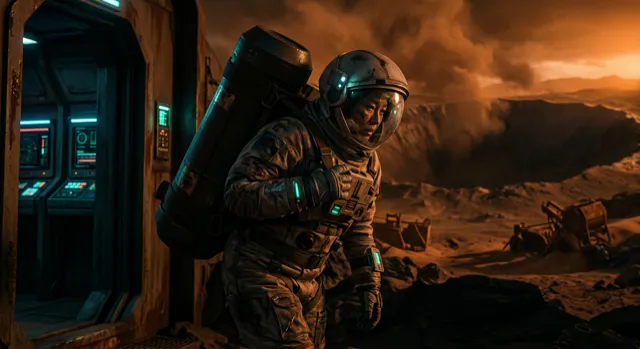
She drew the core up and sealed it in a container. The soil clinging to her fingertips froze the instant it met the minus-73-degree air. Sujin stood and looked toward the base. 400 meters off, the dome rose against the horizon, its shadow stretched long over the orange soil. And somewhere between here and there, the spot where Mining Robot 4 should have been standing was empty.
On the way back she found Unit 4. It had stopped at the edge of a mining pit, canted to one side. Sujin examined the joints. The color of the magnetic-alloy casing had changed. A surface that should have been silver-gray had taken on a dark red. She pressed it with a gloved finger. The alloy crumbled—like dried clay. She scraped the powder into a sealed bag and worked through Unit 4's other five joints in turn. Four were in the same state. The fifth was still silver-gray, but red flecks were beginning at its edge. Sujin photographed the fifth joint too, for the record. The spots were about 3 millimeters across. By tomorrow they would be larger.
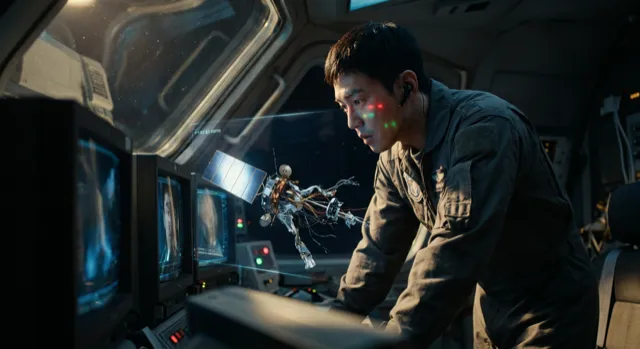
When she came through the airlock and pulled off her helmet, the air inside the base felt cool. The heating output was lower than yesterday's. Sujin hung her gloves on the shelf and opened the control monitor. Of the 8 robots, 3 were down. Unit 4, communications lost; Unit 7, left joint drive dead; Unit 2, drill arm unresponsive. When she rewound the timeline, a pattern emerged. Sequential failures north to south, all within 48 hours. Among the remaining 5, Unit 5's joint temperature had ticked minutely upward. She couldn't tell whether it was a warning sign or normal deviation. Sujin sent Unit 5 a remote recall command, confirmed that it had begun moving toward the base, then closed the monitor and went to the lab.
She placed the alloy powder under the microscope. 500x. Tubular structures ran between the metal crystals. Diameter 0.8 micrometers. Similar to Earth's iron-oxidizing bacteria, but half the size, with magnetic particles embedded at regular intervals along the inner walls of the tubes. They were penetrating only the grain boundaries, selectively. The grain interiors were still intact. Sujin raised the magnification to 1,000x. At a point where a tube branched, a trace of liquid glinted. She applied fluorescent staining. The entire interior of the tubes lit up. It was alive.
Sujin's hand stopped. She set down the probe and braced both hands on the bench. 7 years on Mars. She had seen nothing but rock and ice. She let out a breath and looked again. The fluorescence inside the tubes was flickering—irregular, but not random, a rhythm. Sujin photographed the branch points of the tube structure and saved the data. Without lifting her eyes from the microscope, she surveyed another region of the sample. The tube structure was penetrating selectively along the grain boundaries. The grain interiors were intact. It was attacking only the interfaces. This was no random corrosion. If it were random, it would have to attack the interiors too. Sujin turned the alloy fragment, its boundaries eaten away. The grains separated from the metal lattice and fell off like loose kernels. She recorded video, went to the communications panel, and sent a report to Earth. 4 minutes to the orbiter, 14 to Earth. 28 minutes round trip. While she waited, she went out to look at Unit 7.
When she opened Unit 7's joint cover, there was something Unit 4 hadn't had. Over the discolored alloy lay a white, frost-like film. When Sujin scraped the film with her sampling rod, the alloy beneath collapsed along with it. Unit 7's arm sagged and powder poured from the joint. The powder settled on the red soil, and Mars's thin wind scattered it. Silver-gray powder mingled with the iron-oxide soil, staining it. Sujin sealed a sample of the white film in a container and returned to the lab.
Under the microscope the white film revealed itself. The tube structure had reached out beyond the metal into an interconnected network. Fine threads bridging tube to tube formed a lattice. Sujin brought a magnetometer up to it. A faint magnetic field was detected around the network. As the microbes digested the alloy's magnetic particles, they were emitting a magnetic field of their own. Magnetotrophic metabolism. On this planet, life that used magnetic fields as an energy source had lain buried beneath the permafrost for hundreds of millions of years. Sujin checked the measurement data three times over. All three times, the same result. She leaned back against her chair and looked up at the ceiling. Air from the ceiling vent cooled the sweat on her forehead. The frame of the vent was magnetic alloy too. Sujin got up and ran a finger along the edge of the frame. Still silver-gray, for now.
Sujin placed alloy powder in a culture dish and began incubating it at minus 20 degrees. She also took out the core she'd sampled that morning and set the cavity layer, 43 centimeters down, under the microscope. It was densely packed with the same tube structure. They had already been living inside the permafrost. The mining work, tearing up the frozen ground, had brought them to the surface. There they had met a new food—the robots' magnetic alloy, hundreds of times purer than the permafrost's natural magnetic minerals. The permafrost's natural minerals were low in purity. Around the natural minerals the tube structure grew sparse. Around the alloy powder, by contrast, the tubes crowded together thickly. When the food changed, so did the density.
A response came from Earth. Team lead Dohyun's voice came through the comm.
"Halt mining until the cause of the corrosion is identified. Send the samples up to the orbiter."
Sujin grabbed the comm.
"The orbiter's structure is magnetic alloy too. Send the samples up and the orbiter's at risk. It's most likely biological in origin."
14 minutes of silence passed. Dohyun spoke again.
"Biological? You're sure?"
Sujin transmitted the microscope footage. 28 minutes later, Dohyun's voice had dropped a tone.
"Wait. You're telling me there's life on Mars right now?"
Sujin answered.
"I need more verification to confirm it. But what the microscope footage shows is unmistakable. A tube structure that generates its own magnetic field is digesting metal."
She heard the sound of Dohyun exhaling, short.
"No samples leave the site. Activate the contamination-prevention protocol. Stand by until HQ issues guidance. And Sujin—this could be your paper, or it could be your grave. Be careful."
Sujin cut the comm and pulled up the list of magnetic-alloy parts inside the base. Airlock hinges, life-support valves, the base of the communications antenna, the core of the magnetic-field generator. The very skeleton of the base was food for the microbes. Not one of those parts could be swapped for a nonmagnetic material.
24 hours later she opened the culture dish. A white film had formed over the alloy powder. The tube structure covered the powder entirely. Sujin checked the measurement data three times over. Without any external magnetic field, the network was sustaining a magnetic field of its own. It was a mode of metabolism that did not exist on Earth. Sujin made backup copies of the data and moved them onto a separate storage device. One she kept in the lab, one in her quarters. Whatever happened to the base, the data had to survive.
The next morning, Sujin opened the airlock and went out to inspect the outer wall. A dark-red discoloration had started on the frame outside the airlock. At its edge she saw a white film. The microbes had made the jump from the robot to the base. Carried on Sujin's gloves, or on the wind. Sujin heated it with a portable heater. At 60 degrees Celsius the film dried. But the tube structure had already worked its way beneath the surface. She set the heater down and marked the extent of the discoloration with a marker—to measure how fast it spread tomorrow. Even the marker ink stiffened in the sub-zero cold and barely flowed. It took Sujin three passes before she left a clear line.
She spread out the map and marked the excavation depths and the corrosion points across the mining zone. Depth and corrosion intensity ran in proportion. She ran the numbers. 12 days for the airlock frame to reach its structural limit. 9 days for the magnetic-field generator core to fail. When the core died, the radiation shielding went with it. Sujin transmitted the calculations to Earth and sat in her chair, waiting for the confirmation signal to come back. Beyond the base wall the heater's hum ran on, even and steady. There was no knowing whether that sound would still be there a few days from now.
Three days later, on the morning inspection, a white film had spread wide at a point 300 meters north of the base. Area, roughly 40 square meters. It hadn't been there the day before. Sujin walked along its edge. The film reached toward the base in a gentle curve. Not a straight line. It aligned with the bearing of the magnetic-field generator. The colony was sensing the magnetic field and moving toward its source. It looked as though a white line had been drawn across the soil of the Martian pole. Sujin crouched and took a sample from the film's edge. Thickness, 2 millimeters. It crumbled at a touch—but when the crumbled bits settled to the ground, they seemed to draw back together.
She ran into the base and sent an emergency report.
"Colony advancing toward the base. Homing on the magnetic-field generator. Shutting the device down stops the advance but drops radiation shielding. Requesting guidance."
28 minutes later a response came. Not Dohyun—Jeongeun, HQ's biosafety officer.
"Do not shut down the device. Drop the shielding and exposure exceeds the limit. Respond with physical containment."
Sujin answered.
"The tube structure is 0.8 micrometers across. It penetrates between soil particles. A physical barrier is meaningless."
Jeongeun fell silent for a moment. 28 minutes later the answer came.
"I'll grant that we can't solve your situation remotely from here. Respond with your best judgment. We're coordinating a shuttle schedule. And Sujin—don't push yourself too hard."
Sujin set down the comm and stood before the control panel. Turn it off and the colony stops, but she takes the radiation. Leave it on and the radiation is held off, but the colony reaches the core and eats the device. Either way, the base was finished. Turn off the magnetic field and the colony stops, but Sujin gets irradiated. Leave it on and Sujin is safe, but the colony reaches the core and devours the device. And once the core died, the shielding was gone regardless. It was only a matter of time. Sujin lifted her hand from the control panel and went back to the lab.
Under the microscope she set a cross-section of a core from deep in the permafrost. The tube structure was dense. It had formed hundreds of millions of years ago. The arrangement of magnetic particles along the inner walls of the tubes repeated a pattern. This was no simple metabolism. Between the repetitions there was variation. Sujin began to record the variations. In one hour she counted 97. Combine those 97 variations and the number of possible patterns was astronomical. Whether this was mere metabolism or something more, the equipment she had now could not decide. As she recorded, her hands trembled. Not from the cold.
The next morning, the film had crept to within 50 meters of the base's outer wall. Sujin decided to reconfigure the magnetic field generator's coil array by hand—push the output to maximum and turn the field away from the base. Every time the wrench slipped on the sub-zero metal it kept sticking to, pain flared in her knuckles as she worked the coil screws loose. It took 3 hours. She tightened the last screw and switched the device back on. The output gauge on the control panel climbed into the red. The spec sheet said nothing about how long it could hold this.
Six hours later she went out to check. The film had changed direction—moving away from the base now. It was working. But as the field concentrated toward the north, the radiation shielding to the south and east weakened. The living quarters were to the south. The radiation meter read 3 times the usual. Sujin gathered her sleeping bag and food packs and moved to the northern lab. It was where the field was strongest, the only space where the shielding held. She spread the sleeping bag under the workbench. Into a non-magnetic container—the one and only non-magnetic vessel, titanium and ceramic—she placed the cultured colony, the core samples, and the data drive, and set it within arm's reach. Mars's first specimen of life lay 30 centimeters from where Sujin slept.
From Earth came Dohyeon's voice.
"I've moved the shuttle launch up. It arrives in 3 days. Grab the specimens and the data and get on it. We're abandoning the base."
Sujin asked,
"If we abandon the base, the colony eats every scrap of magnetic alloy left. Hundreds of kilograms of metal, hundreds of times purer than the natural magnetic-mineral concentration in the permafrost, left sitting there. The colony density ends up nothing like its natural state."
28 minutes. Dohyeon answered.
"I know. But people come first."
Sujin said,
"Without baseline data on how the colony behaves in an environment with no artificial field, we'll never know what we did to this ecosystem. Even when the next expedition arrives, it'll already be disturbed."
28 minutes later, fatigue weighed on Dohyeon's voice.
"Sujin. If you die out there, the data's useless too. Do what you can in 3 days. The rest we figure out once you're home."
Sujin cut the transmission and opened the base's magnetic-alloy inventory again. The amount she could dismantle alone in 3 days: 40 percent of the total. The other 60 percent had to stay behind. It wasn't perfect. But it beat doing nothing. Reduce the total mass of magnetic alloy the colony had to feed on, and its rate of expansion would slow too. The time it took to settle back toward a natural density could change. Sujin drew up a list, the order of dismantling. First to come apart: Unit 4, already corroding. Then Unit 7, then Unit 2. The airlock frame had to come off last—the part that needed to hold its seal the longest. By the time the list was done it was 2 in the morning. Outside the window, darkness. Stars packed the Martian night sky. Sujin knew where Earth was. Above the eastern horizon, just over the orange dust layer, a blue dot.
The next morning she started dismantling. She separated Unit 4's joint assembly, picked out only the magnetic-alloy parts, and hauled them to a crater 2 kilometers off. 15 kilograms a trip. Even in Mars's gravity, the round trip in a cold-weather suit took 2 hours. As she pried off Unit 4's discolored joint, the alloy crumbled in her hands and the powder clung to her helmet's outer shell and the front of her suit. When she got back to the base near sunset, the sweat inside her suit had gone cold and a chill ran down her spine. The oxygen-consumption warning flashed twice on her helmet display. She was pushing too hard. A dull ache sat in every knuckle. She crawled into the sleeping bag under the workbench and fell asleep to the whir of the sealed cabinet's cooling fan.
On the second day she dismantled Unit 7 and Unit 2 and pulled off part of the airlock frame. The moment she drew the frame's bolts, the whole airlock groaned. With the frame out, the seal weakened. She packed the gaps with temporary sealant. Her fingers bore down hard on it. She spent another 10 minutes at the airlock making sure it had set. She pressed along the sealant's edges with her fingertips, feeling for any gap. This sealant had to hold until the shuttle came.
The morning of the third day. The shuttle was due in the afternoon. Sujin stood before the magnetic field generator. The core was an 80-kilogram block of magnetic alloy. Pull it, and the base's entire radiation shielding was gone. 6 hours until the shuttle. 6 hours without shielding meant a dose of 15 percent of the annual limit. She could live with that. Sujin tucked the radiation meter into her suit pocket. Its case pressed against her thigh.
She switched off the device. When the coils' hum died, the base went silent. Beyond the walls came the sound of the Martian wind. A sound she'd heard every day for 7 years, and forgotten, buried under the noise of the coils. It was the last silence she would ever hear in this base. Sujin began loosening the bolts. 12 of them. With every turn of the wrench, the fingers inside her gloves resisted. At the 9th bolt the wrench slipped and cracked the back of her hand. A dull pain spread through the glove to her wrist. Sujin rubbed the back of her hand against her suit and took up the wrench again. When the 12th bolt came free, the core came away from the frame. She shouldered it and walked slowly to the airlock.
When she stepped out of the airlock, the morning light was spreading orange through the iron-oxide dust. The radiation meter buzzed in her pocket — a warning that unshielded exposure had begun. Sujin ignored it. 6 hours and it would be over. In 6 hours she would board the shuttle. She hoisted the core onto her back and set off toward the crater. The weight bore down on her shoulders and the small of her back. Halfway there she set it down and rested. A dark-red discoloration had already begun to creep across the core's surface. The microbes had reached it. Sujin brushed the stained surface with her glove. A fine powder came away. She lifted the core again. 600 meters left to the crater. With every step her breath came rougher inside the thermal suit. Her breath fogged the inside of the helmet, then vanished under the heater. When she reached the crater's edge, Sujin set the core on the ground and braced both hands on her knees. It took 2 minutes to catch her breath. Her heart rate hung on the helmet display. 130. Down on the crater floor, the robot parts she had hauled out yesterday and the day before lay scattered, silver-gray. Before long a white film would spread over them too. The 2 kilometers between the crater and the base would buy her time against the colony's advance.
By the time she had set the core down in the crater and made her way back, the shuttle's landing signal came through on her comm. Sujin picked up the nonmagnetic container and the data pouch and left the lab. At the door she looked back once. The microscope sat on the workbench. Its frame was a magnetic alloy. In a few days that frame too would turn dark red, and a white film would cover it, and the tubular structures would bore into the metal lattice. The machine that had been the first to peer through a lens at life hundreds of millions of years old would itself be devoured by that life. Sujin stood there for 3 seconds, unable to pull her eyes from the microscope, then turned, shut the door, and went to the airlock.
She secured the container in the shuttle's cargo hold and took her seat. Through the window she could see the base. The airlock, stripped of its frame, gaped like a black hole. The sealant was barely bridging the gap. If the wind rose, the edges of the sealant looked ready to tremble. A white film had spread across the north side of the base. Now that the magnetic field was gone, the film was no longer dragged in a single direction. It would spread outward in every direction toward the 60 percent of the magnetic alloy that remained. The microscope frame, the life-support valves, the joints of the 5 robots still left behind. Everything Sujin had not been able to carry off would become fresh food for the colony. The engine ignited. The seat pressed into her back. Outside the window the base shrank fast. Sujin held the container on her knees with both hands. The ceramic surface was cold against her palms. Inside it, the things that had lived on since hundreds of millions of years ago went quietly on with their metabolism, even without a magnetic field.