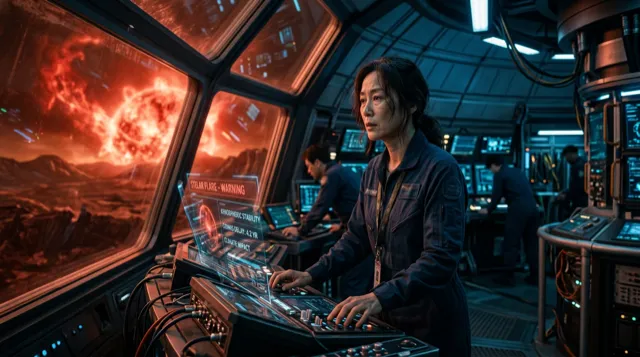
The warning light came on. Recovery target approaching: 300 meters. Dogyeong pushed himself up from the pilot's seat and looked at the forward monitor. A dead satellite hung there. A military-grade reconnaissance satellite, registration name Gamma-7. Decommissioned in 2071, it had been circling in orbit for 13 years. 14 meters long, 8 meters wide. Only one of its solar panels remained. Where the other had snapped off and fallen away, a strip of torn insulation dangled. When the sunlight caught the frayed end of the insulation, it glinted silver. Dogyeong checked the recovery manifest. Gamma-7. Shredding class 3. Recover, then deorbit for disposal. Bonus: 12 percent of base pay.
Dogyeong's recovery vessel, Milky Way-14, was a ship built solely for low-orbit debris disposal. Hull length: 22 meters. It was equipped with a shredding chamber and a compression hold. This quarter's recovery record stood at 63 percent of quota. Fall short of quota, and the vessel lease would be terminated. Once the termination notice came, he would have to hand the ship back. If he processed the remaining four targets, Gamma-7 among them, before the month was out, he could just barely fill his quota. Dogyeong took a sip of coffee and began the approach protocol.
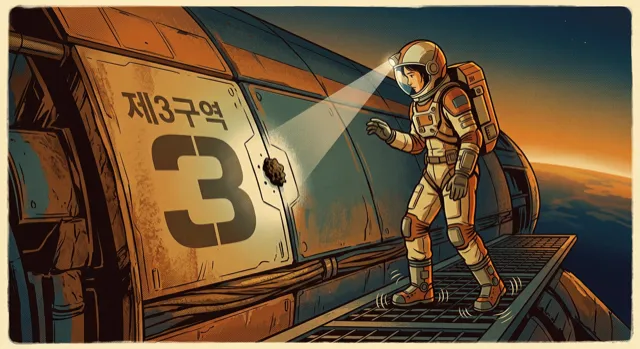
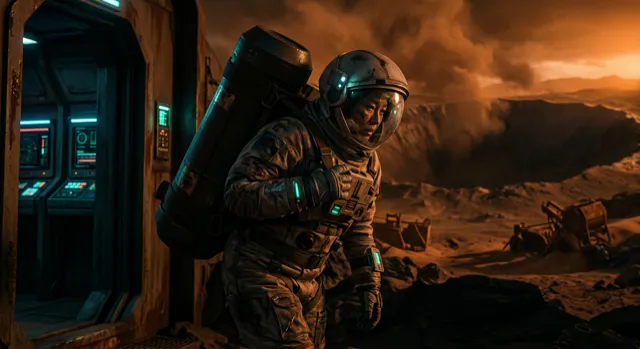
The recovery arm made contact with Gamma-7's outer hull. The magnetic anchors engaged. Dogyeong put on his EVA suit and went to the airlock. Depressurization completed, and the outer hatch opened. Against the black backdrop of space, Gamma-7's hull loomed close. Sunlight carved sharp shadows across the satellite's surface. Dogyeong clipped the tether cable to his waist and moved along Gamma-7's hull. His gloved hand gripped the satellite's surface. It was warmer than he'd expected. 13 years since decommissioning. Only one solar panel remained, but the surviving panel was still generating power. Dogyeong's hand stopped. The power was alive. For a dead satellite with live power, an interior inspection before shredding was mandatory. Because of the risk of residual batteries or propellant exploding.
Dogyeong opened Gamma-7's side access hatch. The hatch seal had rusted, but it gave way when he cranked the manual lever. Air escaped from within. There was residual pressure. Dogyeong switched on his helmet flashlight and went inside. A narrow passage. A bundle of cables ran along the wall. In places the cable sheathing had been stripped away. The bare copper wire glowed red in the flashlight's beam. The air in the passage was cold. With the residual pressure so low, sound barely carried. Dogyeong moved deeper along the passage. Only his own breathing echoed inside the helmet.
The door to the central equipment bay stood open. Dogyeong peered inside. The flashlight swept across the room. Dogyeong froze. His breathing echoed inside the helmet. Something was moving in the room. Small. Several of them. A faint metallic sound rose from the floor.
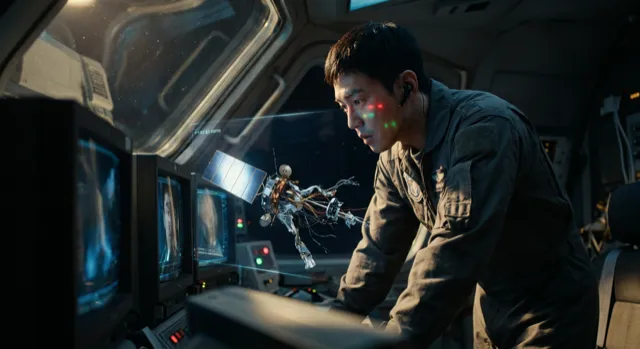
They were about the size of a palm. Several of them. They were moving along the floor and the walls. Dogyeong steadied the flashlight and narrowed his eyes. They were not original components of the satellite. They resembled the standard maintenance microrobots carried aboard military satellites, but their structure was different. Where there should have been 6 legs, there were 8. Some had gripper arms in place of legs. One carried on its back a sensor module half the size of its own body. These were forms that appeared nowhere in the original design.
Dogyeong took one step into the room. The things on the floor reacted. They did not turn toward him. Nor did they move away from him. Half of them moved toward Dogyeong, and half climbed the wall and vanished among the cables on the ceiling. Dogyeong held his breath. His heart had begun to race.
The ones that had moved toward Dogyeong stopped in front of his boots. 3 of them. Each a different shape. One most closely resembled the original maintenance robot, but fragments of other components had been welded to its leg joints. Another had a body that looked like two maintenance robots fused together. The third was hard to describe. An optical sensor, a communications module, and a shard of solar cell had been combined into a single body. Parts from the original satellite, dismantled and reassembled.
The third one touched Dogyeong's boot with a gripper arm. Lightly. Without force. The gripper arm traced across the surface of the boot. It looked like a motion for checking the material. Dogyeong did not move. 10 seconds. The third one withdrew its gripper arm and drew back. The other two drew back with it. The three of them moved to a single point on the wall. At that point a wall panel had been detached. Behind the panel was a space. Dogyeong shone the flashlight into it.
Inside was a structure. A newly built circuit, unlike the satellite's original wiring. Copper wire, optical fiber, and connectors were arranged with precision. It did not look as though a human had made it. The way it was connected matched no standard of human engineering. And yet it was not disordered. If anything, it looked efficient. There was a pattern to it. The circuit was connected to the satellite's remaining power system. Power from the solar panel was being distributed through this circuit. It was a power-distribution system the robots had built themselves.
Dogyeong returned to the airlock. He boarded the recovery vessel and sat in the pilot's seat. He took off his helmet. His hair was damp with sweat. His hands were shaking. Dogyeong laid both hands on his knees and waited for the trembling to stop. Dogyeong opened the communications panel. The transmission delay to mission control was 2.4 seconds. Dogyeong pressed the mic button, then let it go. What was he going to report.
The shredding procedure was simple. The collection arm fed the satellite into the shredding chamber, and a hydraulic press compressed it. The compressed debris was stored in the hold and jettisoned all at once at deorbit. Standard procedure. Dogyeong had run it hundreds of times. Shredding Gamma-7 would earn a bonus and add one entry to his quota. Process the remaining 3 and his lease contract held.
Dogyeong went back into Gamma-7. The central equipment bay. The robots were still moving. This time he saw more. He killed his flashlight and watched in the dark. A faint light came off some of the robots — the infrared emission of their sensors. In the darkness the robots were passing light back and forth. Communication. The pattern of infrared flickers was irregular. But not random either. There were pairs — when one robot flickered, another answered. The interval before the reply was constant too. Dogyeong switched his helmet camera to infrared mode. The screen showed the infrared activity across the whole bay. A web of light stretched between the robots. Its nodes were robots, its links were infrared signals. The signals weren't evenly dense. They were most frequent among the robots near the structure. The ones at the edges signaled less often. He couldn't tell whether it was a hierarchy or a division of labor.
Dogyeong sat in a corner of the bay and watched for 2 hours. Once he held still, the robots began to treat him like an obstacle. They routed around his boots. None climbed onto his knees, but some passed beneath the soles. In the meantime he logged their behavior. There were patterns. Some pairs traded parts. One robot detached its own leg and handed it to another. The receiving robot pulled off its sensor module and passed it back. After the swap, both robots' forms had changed. The trade wasn't random. It had rules. Infrared communication came before each one. After the trade, the two robots moved differently. The one that got the leg moved faster. The one that got the sensor lingered near the circuitry on the wall, its pincer arm making fine adjustments, bending the contact points of the copper wire.
Dogyeong returned to the collection ship. He sat in the chair and played back the recording. He watched the part-swap over and over. What was this. He stopped the video, leaned back, and looked at the ceiling. A vent was set into the ceiling of the collection ship. The fan droned at a steady pitch. Was it programmed maintenance behavior. The maintenance robots had been designed with self-repair. But not part-swapping. Sharing parts with another unit was behavior the design never included. The infrared communication wasn't in the original spec either. For 13 years, with no human watching, the robots had built this behavior themselves.
Dogyeong opened the communications panel again. This time he pressed the mic button.
“Control, this is Milky Way-14. Reporting on the internal inspection of Gamma-7.”
Response after 2.4 seconds.
“Milky Way-14, Control. Go ahead.”
Dogyeong said,
“Residual power confirmed. Part of the solar array still active. Estimated time for the internal battery to discharge: 48 hours.”
Control answered.
“Milky Way-14, proceed with shredding once it's discharged. We'll expect your shredding report in 48 hours.”
Dogyeong let go of the mic. His palm was damp. He rubbed his hand on the armrest. He hadn't reported the robots. He didn't know what would happen if he did. The internal workings of a military-grade satellite could be classified.
48 hours. In that time Dogyeong went into Gamma-7 three more times. 2 hours each. He logged the robots' behavior. On the second visit he found something new. Deep in the equipment bay stood a larger structure. The robots had built it. A structure reassembled from the satellite's dead parts. 40 centimeters tall. Its function unknown. Not an antenna, not a sensor, not a thruster. It resembled no equipment humans make. Power was being fed to it. Seven robots were gathered around it. They touched its surface with their pincer arms, spoke to it in infrared, and now and then detached their own parts to fasten onto it. The structure was growing over time. It stood 5 centimeters taller than when he'd first seen it.
On the third visit Dogyeong sat near the structure and watched. Each robot that gave a part to the structure shrank by that much. It gave up a leg, a sensor, a pincer arm to the structure and moved on whatever was left. Its movements slowed. Its functions thinned. But it didn't stop. The robots that had contributed stayed close to the structure. As if tending it. They seemed to sweep its surface with their pincer arms, check the joints where other robots had attached parts, read its condition in infrared. Dogyeong's throat tightened.
Dogyeong slept in the collection ship's narrow bunk. He pulled the blanket up to his neck. When he shut his eyes, the robots' infrared web lingered on the inside of his eyelids. He didn't dream. When he opened his eyes, 38 of the 48 hours had passed. In 10 hours he had to file the shredding report.
Dogyeong entered Gamma-7 one last time. The equipment room. The structure had grown larger. There were fresh traces where 3 robots had attached new parts. The robots that had given up those parts stood halted on the floor of the equipment room. They didn't move. Whether their power had run out or they simply lacked some essential component, he couldn't tell. They had offered the vital parts of their own bodies to the structure and stopped working. All that remained of the halted robots was shell and frame. Their internal motors, sensors, and communication modules had all been transplanted into the structure.
Dogyeong sat down before the structure. He switched off the flashlight. In the darkness, the web of light his infrared sensor had caught appeared on his helmet display. It was a diminished web. The nodes of the halted robots were gone. The remaining robots were routing their communications around the empty nodes. The network was reconfiguring itself. Bypassing the vacancies left by their halted comrades, forging new links, holding the whole structure together. The infrared flickering of the survivors had quickened. Their traffic had grown. To keep the same network alive with fewer members, the load on each node rises. The robots were carrying that load.
Dogyeong closed his eyes without taking off his helmet. Shred it, and the quota is filled. The lease holds. He doesn't lose the collection ship. And if he chose preservation? Report it to control, and the robots might become research subjects. But leaving a military-grade dead satellite uncollected counted as abetting illegal dumping. License revocation. Without a license he couldn't fly the collection ship. Either way, he loses the collection ship.
Dogyeong opened his eyes. One of the robots near the structure was touching his boot again. It was the third-form robot, the one he'd met first. A body made of an optical sensor, a communication module, and a shard of solar cell. This robot had touched Dogyeong three times across the 48 hours. The same motion every time. It dragged its pincer arm across the surface of the boot, withdrew, and waited. Learning? Curiosity? A leftover of its programming? Or something else Dogyeong had no name for.
Dogyeong took off his glove. He held his bare hand out to the robot. The robot stopped. Its infrared sensor blinked. It seemed to be signaling the others. After 3 seconds the robot extended its pincer arm and touched Dogyeong's finger. The pincer's metal was cold. The pressure was steady. The pincer traveled along the surface of his finger. It stopped at the nail. Along the surface of the nail the pincer moved in tiny increments. Dogyeong did not pull his hand away. The pincer's pressure held steady. It was not an attack. It was analysis. Or it was something else. Dogyeong had no name for it.
Dogyeong returned to the collection ship. He sat in the cockpit. He looked at the clock. 4 hours until the shredding report. Dogyeong opened the communication panel. He set the frequency to somewhere other than control. The Orbital Debris Research Institute. The institute's reply channel opened.
"Orbital Debris Research Institute."
Dogyeong said,
"This is Milky Way-14. I've found abnormal activity on Gamma-7, my collection target. Autonomous reconfiguration and parts-swapping behavior in the maintenance micro-robots. An infrared communication network. A structure they built themselves. Presumed to have transformed over 13 years without human oversight. I'm holding 48 hours of recorded footage."
A long silence. The institute answered.
"Milky Way-14, can you transmit the video data?"
"I can."
"Transmit it. We'll be in touch after we've reviewed it."
Dogyeong transmitted the footage he'd shot over the 48 hours. An hour passed after the transmission finished. A reply came from the institute.
"Milky Way-14, the video data is fascinating. But we don't have the authority to defer a collection. Collection orders fall under the control center. Please file a deferral request with control."
Dogyeong asked,
"And the odds a deferral request gets approved?"
"We can't judge that. It's control's call."
The line cut off. Static drifted from the speaker. Dogyeong switched off the communication panel.
2 hours until the shredding report. Dogyeong looked at Gamma-7 from the cockpit. The dead satellite's silhouette hung on the monitor. One solar panel caught the light and threw it back. Inside it, robots the size of a palm were swapping parts, talking in light, offering their own bodies to the structure.
Dogyeong opened the control frequency.
"Control, this is Milky Way-14. Requesting a hold on the shredding of Gamma-7. A phenomenon of research value has been found inside."
2.4 seconds later control answered.
"Milky Way-14, grounds for the shredding hold?"
"Autonomous reconfiguration behavior in the maintenance robots. I've completed a video transmission to the Orbital Debris Research Institute."
The silence ran long. 8 seconds.
"Milky Way-14, under control regulations, deferring the collection of a military-grade dead satellite requires Ministry of Defense approval. Holding a collection without Ministry of Defense approval counts as abetting illegal dumping. That's grounds for license suspension. Please proceed with the shredding."
Dogyeong said,
"And how long does the Ministry of Defense approval process take?"
"90 days at minimum."
"And if I hold the shredding for 90 days?"
"That's grounds for license suspension and cancellation of the lease."
Dogyeong set the microphone down. He looked at the cockpit's instrument panel. The status light on the shredding bay's hydraulic press was green. Ready to run. The collection arm was locked onto Gamma-7's outer wall. Engage the press, and it was over.
Dogyeong rose from the seat and went to the airlock. He passed back inside Gamma-7. The equipment bay. In front of the structure. The robots were moving. Dogyeong laid a hand on the structure—a gloved hand. The surface of it was vibrating, faintly. The current inside carried up through the glove and into his palm. Dogyeong lifted his hand away. One of the robots moved to the spot where his hand had touched and checked the surface with its pincer arm.
Dogyeong left the equipment bay. He passed through the airlock and returned to the collection vessel. He sat down in the cockpit. He opened the collection-arm control panel. He began keying in the sequence to tow Gamma-7 to the shredding bay. Halfway through entering the sequence, his fingers stopped. Dogyeong deleted it.
Dogyeong opened the navigation system. He checked Gamma-7's current orbit. Altitude 420 kilometers. He calculated the orbital decay rate. At its current speed, natural decay would bring it to atmospheric reentry in 6 years. Dogyeong activated the collection arm's thruster module. He began running the numbers to push Gamma-7 out of its current orbit and up into a higher one. Altitude 800 kilometers. At that altitude the orbital lifetime was over 200 years. He checked whether the thruster module had enough fuel. It did. The amount needed to boost Gamma-7 came up on the panel. 78 percent of the total reserve. Burn that fuel, and there wouldn't be enough left for the orbital transfers on the remaining 3 collection jobs. Quota unmet. Lease terminated.
Dogyeong entered the thrust sequence. He set his finger over the execute button. On the monitor, Gamma-7 hung there. The glare off its solar panels flickered. Dogyeong pressed the button. The thruster module ignited. Through the collection arm, Gamma-7's orbit began to climb. 420 kilometers. 450. 500. The fuel gauge on the panel dropped. Dogyeong didn't look at the gauge. He watched Gamma-7 on the monitor. The satellite was rising into a higher orbit. Each time the altitude number ticked up, the fuel reserve fell by one notch.
When the thrust cut out, Gamma-7 was at an altitude of 812 kilometers. Dogyeong detached the collection arm. Gamma-7 shrank on the monitor. The dot on the screen dwindled, then vanished. Dogyeong stared at the empty screen for 5 seconds. Dogyeong sat in the cockpit and opened the control frequency.
"Control, this is Milky Way-14. During collection of Gamma-7, a thruster-module malfunction sent the target off into a higher orbit. Insufficient fuel to reapproach. Reporting end of operations for the day."
2.4 seconds until Control answered. In the meantime Dogyeong looked at the fuel gauge. Reserve 11 percent. Not enough for the orbital transfers the remaining 3 collections would need. Control's voice came out of the speaker. Dogyeong leaned back against the seat and closed his eyes. Control's question filled the speaker. Dogyeong didn't answer. The glow of the cockpit instrument panel flickered over his face. The interval was close to the rhythm of the infrared net. Dogyeong didn't open his eyes.